Co-operative wholesaler Suma recently published its Sustainability Impact Report for 2024, the first year on record where the global average temperature passed the 1.5°C warming limit set out in the Paris Agreement.
As global supply chains face mounting pressure, Suma is making progress towards its 2030 sustainability goals through a range of measures, taken both globally and locally.
The organisation’s second annual Sustainability Impact Report tracks its progress in six key areas: Net Zero, Nature, Zero Waste, Decent Work, Healthy & Sustainable Diets, and Education & Engagement.
According to the document, Suma is set to achieve Net Zero by 2048 – two years before the UK government’s legally binding target for Net Zero by 2050.
In 2023/24, the co-op saw a 3.7% (62 tCO2e) reduction in its Scope 1 and 2 emissions compared to the previous year, and a 3.6% reduction in its electricity use.
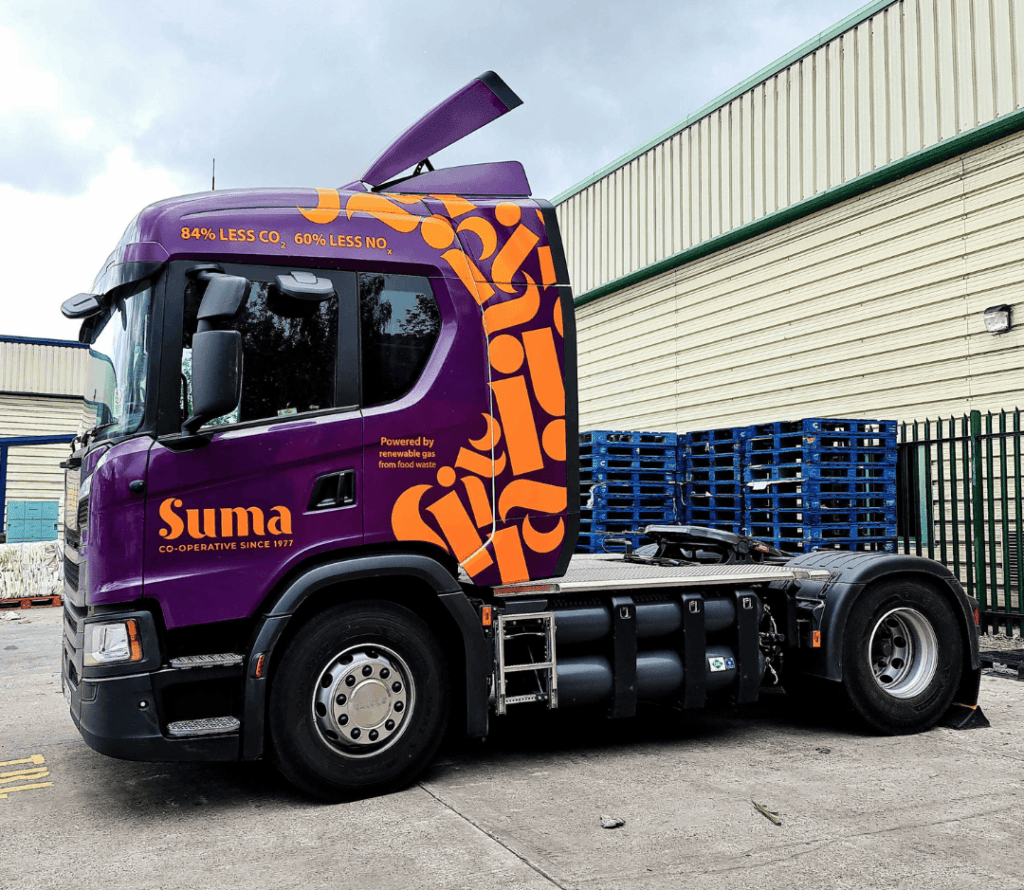
It also decreased its fuel use by almost 50,000 litres, through measures such as better route planning and vehicle optimisation, driver training to reduce driver idling times, and the use of Suma’s two biogas trucks.
“It wasn’t anything major that we had to do,” says Ben Pearson, Suma’s sustainability
co-ordinator.
“You don’t need to be radical straight away to see those improvements. […] We saw some really good changes just from making those incremental steps as we go on the journey, so it was nice to see those rewards come through.”
Related: Suma wins Sky ad campaign in sustainability competition
Suma now plans to investigate key products and suppliers that have the highest associated emissions, in order to reduce its Scope 3 footprint, and is looking into the possibility of installing solar panels on its roofs.
When it comes to Suma’s concern for nature, the co-operative is looking both close to and far from home. It is in the process of developing a monitoring plan for local bird species in and around its site.
“Situated on the banks of the River Calder and adjacent to the ancient Elland Park Wood, we have a unique opportunity to establish projects that enhance the variety of wildlife near our workplace,” says the report.
The project was initiated by Kasia Breska, Suma worker and board sustainability champion. “I was really interested in how we can, as a business, as a site, as a group of people, positively impact the natural environment around us specifically.”
For Breska, the project is about taking co-operative values and principles seriously, especially the principle of concern for the community.
Suma is also examining its impact on nature further afield, via its Ethical Supply Chain Working Group, which is looking at enhancing data collection and transparency in its supply chain for its primary ingredients, to ensure higher ethical standards among suppliers.
And its updated buying policy outlines preferences for bringing in new products which follow the principles of reduce, re-use, recycle, as part of its goal towards zero waste.
Other moves towards this goal include the co-op this year moving all of its retail sized ALTER/NATIVE by Suma hair and body care bottles to Prevented Ocean Plastic™ (POP™), which is made using plastic litter collected within 30 miles of the coastline.
“I think anything to do with plastic reduction should be top priority for any company these days, considering the amount of microplastic in the environment in current times,” says Breska – although she acknowledges that food companies are restricted with what packaging they can use.
Breska is herself involved in a number of charities that are connected to ocean conservation, and is a surfer. “So this really resonates with me on a personal level. If you’re by the sea often, you see how big the problem is.”
Related: Suma and Forus Tree co-ops collaborate on reforestation project
As well as embedding sustainability actions into team plans and responsibilities, Suma is continuing to consider its workers and those working throughout its supply chain in its sustainability strategy, from assessing supply chain risks when it comes to living wages and modern slavery, to the democracy of the co-operative itself.
Other goals set out in Suma’s impact report include promoting healthy and sustainable diets, and education and engagement with the public on sustainability issues.
The co-op launched a Vegan Toolkit in January 2024, a guide to embracing a plant-based lifestyle during Veganuary and beyond, and works with local schools to promote healthy food, Fairtrade and co-operative ways of working.
And it has been working with its local council around climate action planning, and features as a case study in Calderdale’s Climate Action Plan.
This progress has taken place against a challenging backdrop for both the business and its wider community.
“We saw more beloved customers being forced to close as the cost of living crisis hit them hard,” says Breska in the report.
The report also highlights the decline in global circularity (the extent to which materials are reused and recycled), from 9.1% in 2018 to 7.2% in 2023.
Pearson highlighted this as a trend Suma is trying to help buck through use of reusable ‘closed loop’ bulk drums and by championing refill options to consumers.
“I think it’s still an understudied and underappreciated way of shopping amongst consumers, so we do anything we can on this aspect,” he says.
Suma hopes that its varied work around sustainability, and the efforts it is making to report on its journey, will inspire other businesses to think about the different ways they can make an impact.
“There’s no one size fits all approach to sustainability,” says Pearson.
“One thing might work for one company and one thing might not work for another. Because there’s so many different options out there, whether it comes to packaging, or on-site measures, solar panels, rainwater harvesting, or if you’ve got a fleet of trucks. You need to find what works for you.”
Another crucial point of consideration is people. Pearson recommends businesses ensure they have at least one person with time to focus on sustainability, whether that be a dedicated role like his, or an extra responsibility like Suma’s sustainability champions, who work in different departments throughout the co-op.
“It’s really important to get some kind of foothold in other teams. I think the best way we do that is through the champions.”
Breska, who works in quality control as well as sitting on the board as sustainability champion, sees Suma’s co-operative structure as a key way of ensuring sustainability is embedded throughout the business and its workers.
“The fact that we are an equal pay co-op, and our workers own the co-op, engages members far more compared with those working in standard business models. By definition, you are the co-owner of the company, so you take co-ownership of responsibilities.
“I think that plays out really well in terms of sustainability, because we do listen to each other, we have voting systems, and we do involve everyone. And the more people you involve on the point of sustainability, the more sustainable the company is going to be through and through.”