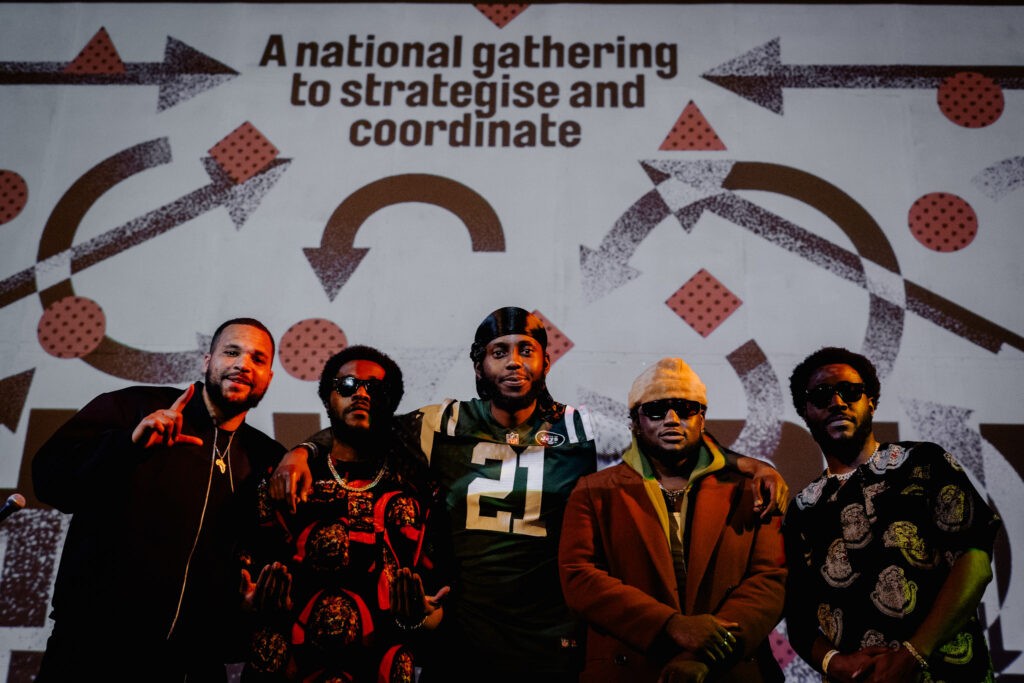
Local co-op and solidarity economy initiatives were in evidence at last month’s World Transformed festival, which gathered more 3,000 people from left-wing movements to strategise and organise around principles of socialist utopianism, creativity and collaboration.
The annual event and political education project started in 2016 as an attempt to revitalise the left’s presence at the Labour conference. This year, for the first time, it took place independently of Labour. Instead, it welcomed speakers from the Greens and the fledgling Your Party, with a programme of over 120 discussions, workshops and social events.
Hosted across multiple venues – including spaces run by co-ops Work for Change, Niamos and Hulme Community Garden Centre – the presence of the co-op movement and wider social and solidarity economy was seen in the list of partners and in session topics throughout the festival. This included a panel comprising the authors of Radical Abundance: How to Win a Green Democratic Future.
The book draws on experiences from around the world, from Tottenham to the Basque Country, to explore how the transition to an economy based on communal, social control can – and is – taking place.
In Tottenham, for example, Wards Corner Community Benefit Society was formed in 2007 with a grassroots campaign to save the Seven Sisters (Latin Village) indoor market. The society is currently managing the market space and has developed a community plan to restore and run it for the benefit of the community long term.
Catalina Ortiz, associate professor of the Bartlett Development Planning Unit at University College London and chair of Wards Corner, tied the struggle of her community to one of identity.
Related: Community power at Cooperation Town
“This takes place in a backdrop of a country where, despite the increase of Latin Americans coming into these lands after different kinds of shifts and movements, [they] aren’t recognised.”
Until this summer, Haringey Council did not recognise Latin Americans as an official ethnic category, meaning members of this community would be counted as “other” when filling in forms – as is still the case in the UK Census.
“It ties back to the Seven Sisters market,” said Ortiz, “because in that little corner, you could find a Latin village, a place where you could find the food that you were missing. That’s why the market is not only a market, but a home, a support network and a social infrastructure.”
This struggle for recognition and visibility reflects two competing visions for the city of London, she added.
“At the market, you could see microcosms that try to emulate the space, the texture, the colours, and the music of the type of places [the market traders have come from]. But if you see it through the lens of local authorities, this is a place of nuisance, that is full of risks and has many issues that don’t comply; something to be cleaned up.
“On the one hand, there is the Latin Village, and the plan that the community made in terms of understanding and reasserting different cultures, and the cultural practices that happened there, and on the other, the development that [property developer Grainger plc] proposed, where you would have Pizza Express instead.”
Iker Eizagirre Zufiaurre, from the Basque Country’s Hiritik At urban planning co-op and transformative economy network Olatukoop, also emphasised the role of local identity in global transformation.
“Basqueness is still a resistant identity, and it is worth asserting,” he said. “As one nation of around three million people divided between two states, still fighting for the right to exist, we
have learned that national and social liberation goes together. From our corner of Europe, we have learned that in practice, national liberation and social justice fit each other when the strategy is right.”
For Eizagirre, this strategy is simple: build people’s sovereignty through the foundational economy. “Today, we work on food, energy, care, housing, biodiversity and money through public, community and co-operative collaboration.
“By doing these things, we open cracks in the capitalist system and start to build new democratic structures that put life and not capital at the centre. Each crack becomes a space to organise and politicise the people.”
Similar ideas were explored in a workshop hosted by Co-operation North, focusing on building independent community power through neighbourhood assemblies and solidarity economies.
Inspired by other groups such as Cooperation Jackson in the USA, the Kurdish Freedom Movement in Syria, and Barcelona En Comú in Spain, Co-operation North consists of groups in Hull, Sheffield and Manchester who are all working to build solidarity economies.
Related: Cooperation Jackson calls for support as Trump policies hit finances
Alongside musical performances and a pay-as-you-feel community meal, Co-operation North ran an assembly design workshop, where participants grouped together based on locality, discussed the assets in their communities and explored what an assembly on a key topic of concern might look like.
Assemblies have become a key organising instrument for Co-operation North members, as Lauren from Co-operation Hull explained.
“What we’re doing in our assemblies is beginning to deliberately pool our resources using tools like savings clubs, food co-ops and community owned energy, to make life better for everyone and build local power, so we’re not at the mercy of the market or politicians.”
Another assembly, held by Co-operation Manchester this summer, has led to a community-led clean up of an unused outdoor space in Hulme. Members of Co-operation Manchester noted that one of the driving factors behind this project is the lack of spaces for communities to gather in Manchester, fuelled the city’s rapid gentrification and sky rocketing property prices.
This issue is a key difference that sets projects in the UK apart from influences such as Cooperation Jackson, who over the past decade have been able to acquire more than 40 properties in West Jackson, including a shopping mall and three commercial facilities.
“In Jackson, they started in an area where there wasn’t much existing community infrastructure and investors weren’t really interested in the area, so buying land and property for them was really achievable,” said Shaun from Co-operation Manchester.
“Here, it’s a very different story. So while community ownership of land and property is very much at the core of what we want to do going forward, right now it’s less feasible than some of the work we are currently doing.”
A big part of this work is about creating more “glue” between local solidarity economy actors, “which there is an absolute plethora of”, added Shaun.
Meanwhile, Co-operation Sheffield has established an autonomous education project as well as a food buyers co-op, alongside assemblies and strategic thinking about what solidarity looks like.
“Like many things in the left space, solidarity can be really easily co-opted and diluted, but solidarity is inconvenient and it is uncomfortable – it requires risk, and it requires sacrifice,” said Co-operation Sheffield member Elise.
“Solidarity economy projects and assemblies are ways to build up that muscle of getting comfortable being uncomfortable or inconvenienced in a culture where we’re conditioned to not want to do that, and to build up that muscle, build up skills, and build up relationships that better equip us for the turbulent, to say the least, future on horizon.”