As the co-op movement looks to scale up in response to the challenges of the 21st century, awareness and understanding of the model takes on new importance – an issue which takes in the thorny question of how a co-op should actually be defined.
These fundamental questions of the movement were a key theme to the recent conference of the UK Society for Co-operative Studies (UKSCS), held in Birmingham, with contributions from sector leaders and academics who dug into the history and ethos of the co-operation.
Co-ops and the EU
The context for this academic debate was set out in an opening keynote from Giuseppe Guerini, president of Cooperatives Europe, who summed the up the case for co-ops as a mechanism for delivering fairer systems in food, housing, social care, energy and the digital economy, arguing: “We cannot imagine solving market failure using the same market procedures.”
It’s an argument often made at co-operative events – but is less familiar outside the movement.
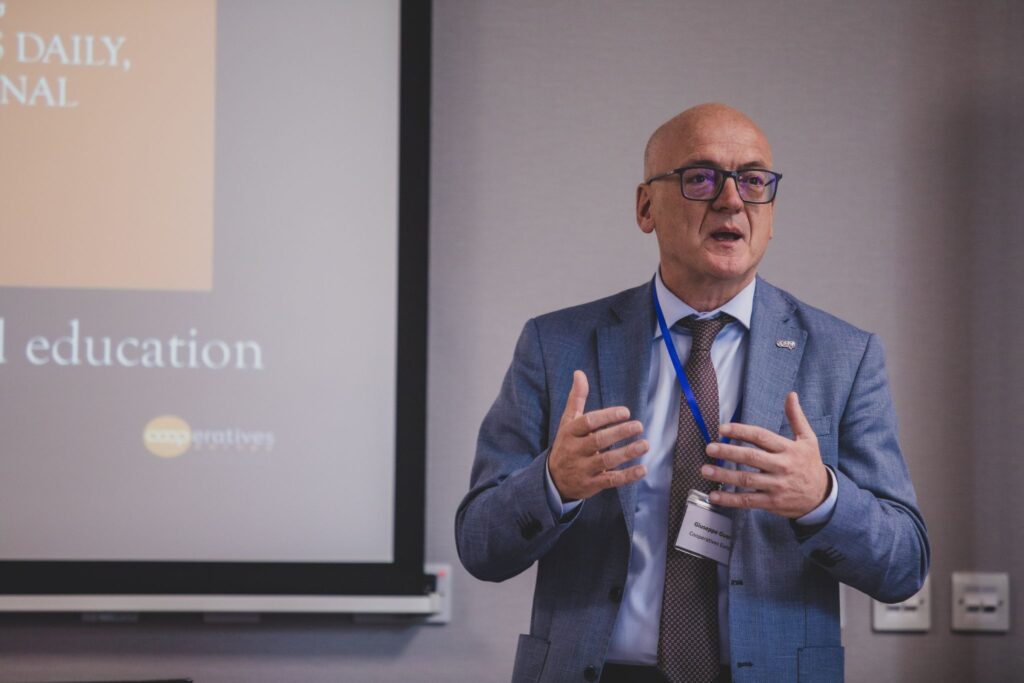
“We need education and training to grow the social economy,” said Guerini, arguing that co-operatives themselves have a responsibility to deliver this. Asked by an audience member why co-ops are not at the top table of policy making, he said: “Co-ops do not invest enough in creating knowledge to share with business schools.”
With the Covid-19 pandemic bringing a paradigm shift in favour of state action, there are opportunities to gain government support – with the various national co-op sectors needing a more favourable environment for startups, better access to finance and modernised legal frameworks.
To that end, Cooperatives Europe is lobbying for better regulation of public procurement, competition, finance and investment, he said. For instance, in the procurement market, EU public tendering ignores social value and goes for the lowest bidder – something Cooperatives Europe is looking to change.
How to work with business schools?
Guerini’s speech was followed by a panel session which looked at the importance of co-operative education and research in growing the movement. While business schools may be reluctant to teach about co-ops, students are still receptive to the message: Dr Anita Mangan, from the Department of Management at the University of Bristol, said that her students were interested to learn about co-ops and workplace democracy.

“A lot of students wanted to be doing English or whatever,” she said, “but their parents told them they wouldn’t get job with that, so they’re doing business studies and they’re bored – so teaching them about something alternative like co-ops gets their interest.”
Her colleague Martin Parker – author of education critique Shut Down the Business School – added that business schools are “an important pressure point” in shaping the economy, with one in seven UK students taking business studies.
“We see the markets as something like the weather, we think you can’t do much about them,” he said, “but the market is something you can shape.”
That reshaping is harder when most business schools just teach growth, markets and corporates, Parker added. Another problem is that business schools themselves are market-driven, and looking to pull in students and generate income, while academics pursue big grants and high profile publications. In that context, co-op education is seen as too niche.
Related: Symposium looks for ways to energise the co-op brand
But there are problems on the co-op side, he warned. “Most co-ops are not interested enough in education globally, and are suspicious of business schools … there are some pretty big walls that need to be jumped over.”
Francesca Gagliardi, a reader in institutional economics at the University of Hertfordshire, noted a recent shift from studying co-ops as a legal and historic form to looking at them as engines for social transformation, and called for closer relationships between co-ops and academia. She highlighted the UK retail co-op movement’s efforts to secure new laws on assaults against store workers, and the Co-op Group’s Hate Divides Communities, Co-operation Builds Them campaign, as examples of how co-ops can push for change.
For Parker, the starting point in education should be discussing the need for change, before moving on to co-ops as an answer. “Talk about the climate challenge,” he said. “Students see the problem, so we need to talk to them about alternatives to the inexorable environmental impact of a type of capitalism.”
Double trouble
As Guerini noted in his speech, education is not the only route to co-op growth; there is also state action. In the UK, Keir Starmer’s government has pledged to double the size of the co-op movement; two years in, James Wright, policy and development lead at Co-operatives UK, shared his impression on how this is progressing.
Noting that the government “didn’t define what doubling was, set a time scale or say why they were doing it,” Wright said a lot of work has been done within the co-op sector and within government to interpret the policy.
Related: Doubling the size – hit, miss or maybe?
It should definitely mean significantly increasing the number of co-ops and mutuals, added Wright, but should also involve a growth in economic and social impact.
He warned that co-op growth has been “pretty static” in recent years, but there progress in housing co-ops, community business, and worker co-ops in the creative and digital industries. A policy to double the movement should build on this and put in the right conditions for co-op growth.
One way to do this, Wright argued, is to integrate the double agenda into other government policies – for instance in energy and retrofit, in tackling market failures in housing, and in food policy.
Enabling action is needed from the government on access to finance, modernising the legal framework and tax reform, he added. Meanwhile, there are not enough development agencies or secondary co-ops, and new pathways are needed for businesses looking to transition to co-op ownership.
In terms of what has actually been done, the picture is mixed, said Wright, welcoming the Pride in Place programme, right to buy provisions, investment in community energy under the Local Power Plan, a £30m investment in credit unions from dormant assets, and planned reforms of co-op law, including commitments to improve the Mutuals Register and moves to allow the development of credit union service organisations.
Related: How do you give away power? The tricky question for Pride in Place
But the Law Commission review has been delayed, and there is room for improvement in other areas, said Wright. There are “good words” in local growth plans, he told the conference, but “the timescale for turning those words into concrete action is maybe a bit of a concern.”
In agriculture, Defra has a £30m farmer collaboration fund in place but is “currently fixated on small, finite collaboration projects, not on long-term co-operative structures”.
And worryingly, there is “an immediate crisis” in co-op development work, with a 60% drop in funding in 2026 compared to 2024 for co-op development agencies.
“If they can’t earn a living at it, they’ll stop doing it,” said Wright, noting that expert advice will be needed for communities taking part in Pride of Place.
He also criticised the lack of support for co-ops from the British Business Bank.
“We’re at that point where there’s a risk of inertia in the system,” he said. “Just coming in and saying they’ll do something and writing a lot of policy papers isn’t enough. A lot more political will and direction will be required. We’ve done the constructive behind the scenes stuff, we need to push now.”
Related: Funding crisis stops Barefoot co-op training in its tracks
Identity crisis?
The second keynote of the conference was delivered by Dominic Kendal-Ward, general counsel of the Co-op Group, who – stressing that he was speaking in a personal capacity, and making a “provocation” to spark discussion – warned against “insularity” and purist thinking in the co-op movement if it wants to go mainstream.
With the world looking for answers to its mounting problems, and a window of government support in the UK that may close at the next general election, Kendal-Ward warned that “we need to show now we have the ability to create real outcomes”.

It is not enough for movement to just ask for resources, he said. “We need to come knowing what problems we want to solve, what our solution is, and the role co-ops play in that.”
This goes back to the question of defining the movement, with Kendal-Ward stressing the importance of membership. “We do a lot of work on this but the truth is there is a low public understanding … People have a warm fluffy feeling or a memory of Co-op stamps but it’s not based on the fact we are member-owned.
“If we can first get people to understand how we can solve their daily problems and work backwards from that … that, for me, shows us a better way of communicating this.”
Meanwhile, there is a “risk of insularity”, said Kendal-Ward. Principle 6 – co-operation among co-ops – remains important, he argued, but should not be exclusive. “Are we inside the tent or outside it? We need to recognise there are good things about Plcs, the public sector, charities.”
There have long been partnerships between public and private sector, he noted, but “you don’t often see co-ops as part of that. When you see water companies not doing a good job, and problems with the national infrastructure, there are solutions to that. Co-ops have a part to play but with the financial and regulatory barriers we face, we need to partner outside the movement to deliver.”
For Kendal-Ward, the “flexibility” of the co-op form is a strength. “It’s a broad model – from tiny worker co-ops to big agricultural and retail co-operatives.”
He warned against pushing for a restrictive legal definition of the co-op model. “As somebody who grew up on company law – it comes in a massive book. Co-op legislation, you can read in an hour. Be careful what you wish for because our legal system is permissive. That big book on company law is a list of restrictions; for co-ops, our list of restrictions is tiny.”
Related: Why the world needs co-op law … ICA webinar launches research project
Striking a controversial note among the conference audience, Kendal-Ward added: “I don’t think there’s loads of people out there pretending to be co-ops. To come up with strict definition that excludes some organisations and stifles innovation fees like a backward step to me. The value is that actually, we’ve got a really flexible model.
“At the moment we struggle to how we define ourself – but public perception comes from how we act, what we say, what we do, not from a legal definition.”
Meanwhile, co-ops should be reaching out beyond the movement for support. “We’re a good investment – a long-term, ethical investment … We aren’t trying to replicate what companies do, we are a different form.”
Responding from the audience, Vivian Woodell said: “You’re right thst we shouldn’t become legal nerds who just want to deal in fine differences … but there’s a danger of being wooly and vague, everything and nothing.
“You need a good idea of who you are to get things done. It doesn’t mean you can’t collaborate. But if you aren’t careful you could end up with people taking advantage of you and extracting capital.”
Kendal-Ward said: “For me, it’s enough to say we return value at point of origin, and cleave in some way to co-op principles.
“Our job is to make money for members, that’s my job. It is important as a business model to recognise something that isn’t the public sector but isn’t an extractive business model, it sits in between.”
Tiziana O’Hara, from Co-operative Alternatives, responded: “We only became effective in our efforts when our message became clear and based on co-op heritage” – and asked: “What is your end game is you get embedded in a system that doesn’t work?”
Repeating that his speech was intended as a “provocation” rather than a strict point of view, Kendal-Ward said: “There is absolutely a role for the ICA definition and the values and principles. I came to the co-op movement because it lines up with my own principles. But if you are too strict, you miss out on a range of opportunities.”
Lessons from the big 300
For a global perspective on co-op growth, Garry Cronan, from the University of Sydney, looked at the word’s 300 biggest co-ops and mutuals.
Doubling the UK movement in 10 years would need an annual average growth of 7.2%, he said; co-op growth in the UK has been considerably lower than that in recent years – but a better understanding of the dynamics of growth will help, and a look at larger co-ops can sow how scaling has occurred.
“Around 45% of the total revenue base for the global movement is in the top 300,” he said. “This tells us a lot about the shape and influence of those co-ops on the political economy of the movement. They contain the DNA of numerous early generation co-ops, and almost all of them are the result of earlier mergers.”
The top 300 are on average 113 years old, said Cronan; most started small and grew slowly from an internally funded model, even if they go to the market with various hybrid equities.
“Size does bring some complexity but also greater resources,” he added. “The top 300 includes many champions who underwrite the movement. Small is not necessarily better, and survival in a hostile policy environment is often a sign of strength.“
These giants emerged from an ecosystem where a lot of small co-ops formed, in conducive sectors like agriculture, retail, insurance and banking, before consolidating, he said.
But the picture is not promising for a repeat of the process. “The current environment is not creating the same mass waves of formations that occurred in the past,” warned Cronan. “As mergers and concentration occur … larger co-ops are getting larger, and smaller ones more numerous, but the middle ones are falling out. There is less scope for renewal.
“In terms of the options for doubling, the UK and Australian sectors are both in this mature phase of their life cycle. Growth is built on the base of longstanding co-ops in traditional sectors. While this base has generated today’s movement is unlikely of itself to grow significantly. We need to learn from the history of the 300 which features and structures are likely to support the growth of the movement.”
The question, he says, is do sectors like tech, digital, AI, social care, housing offer the same conditions that drove the formation of the top 300 in the 19th century?
“It is a mistake to think about just forming individual co-ops,” he argued. “History shows the most sustainable way of building is by selecting a suitable industry, and by seeding and nurturing.”
Growth in Northern Ireland
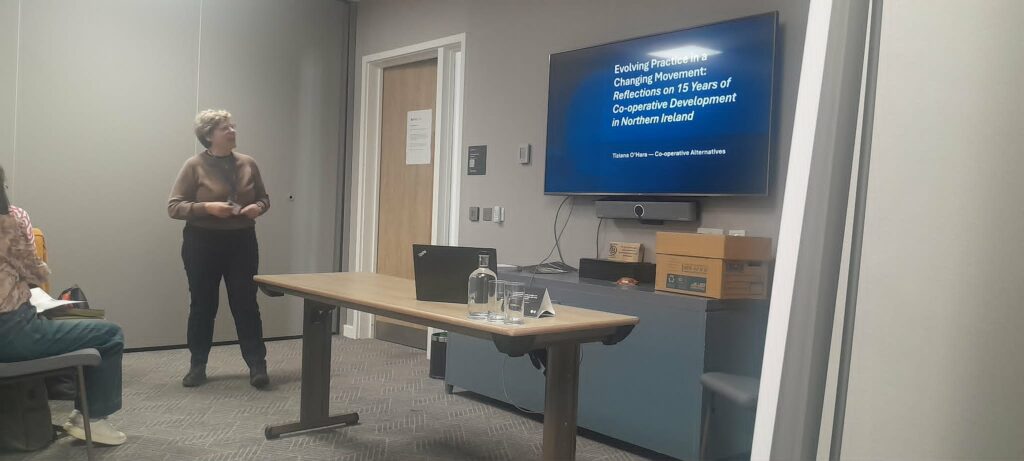
Tiziana O’Hara from Co-operative Alternatives, a development agency jn Northern Ireland, talked about the challenges of growing the co-op sector in the region. In 2010, the community economy was dominated by charities but the co-op model still had traction, particularly in agriculture and the credit union sector.
Meanwhile, argued O’Hara, problems facing the region – including the political uncertainty of the frequent suspensions of the devolved government, the tailing off of grant funding and peace money, brought one positive – “a spur for people to do things for themselves”.
Related: Regional support programme launched for Northern Ireland’s co-ops
Shoots of co-op growth began with the social economy becoming “enterprise-curious“ social economy – charities looking to transition to biz,” she added, with charities looking to transition to a business model.
Co-operative Alternatives tried to build on this with business planning, market analysis, financial modelling, fundraising plans and governance support.
Phase two of its efforts to grow the co-op sector saw the organisation look to grow businesses from scratch, and brought some new worker co-ops, multistakeholder co-ops, and energy co-ops.
O’Hara said that it is important to note that long-term structural change is not just about co-ops, but about how they fit into a system.