Award-winning Catalan housing co-op Sostre Cívic has called for more EU support to scale up community-led, permanently affordable housing across Europe.
The co-op took part on Monday in a meeting of the European Parliament’s Special Committee on the Housing Crisis in the European Union (Hous), held in Brussels.
José Téllez, head of communications at Sostre Cívic, was invited to address the committee, speaking alongside European experts and representatives working in social, affordable and non-profit housing.
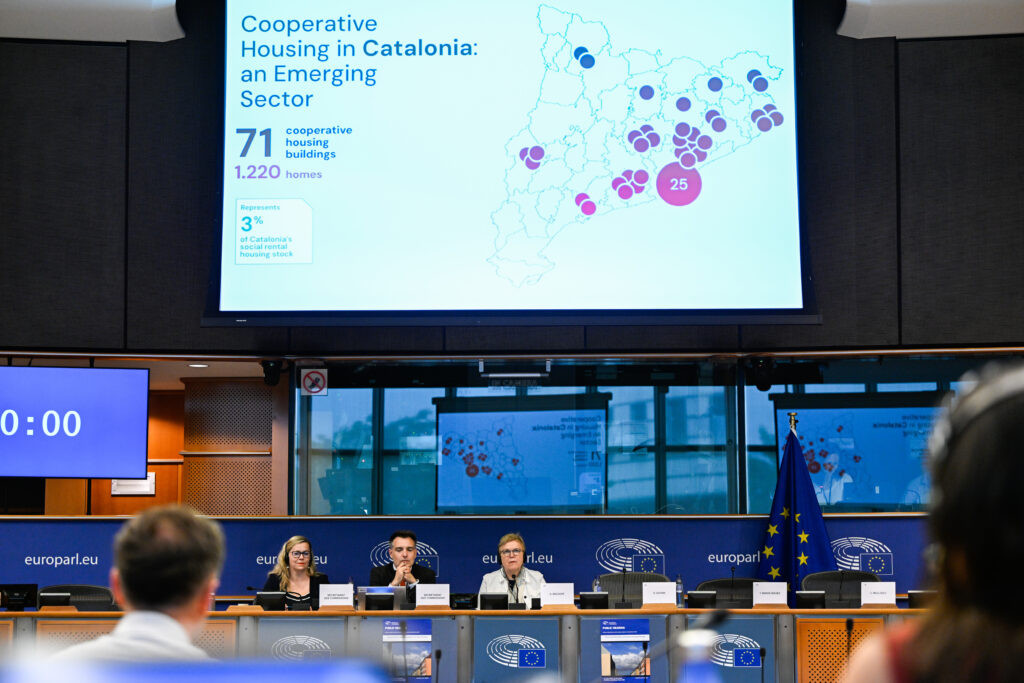
During his presentation to MEPs and representatives of the European Commission, Téllez described co-operative housing based on an indefinite right of use as an emerging part of the social housing sector. Under this model, the co-operative retains collective ownership of the buildings, while members have a stable, long-term right to live in their homes.
Housing costs are calculated based on the project’s actual development and management costs rather than market prices. Homes are therefore removed from speculative resale and remain affordable over time.
The sector is growing across Spain, with Catalonia accounting for 56% of all projects. The region currently has 75 co-operative housing projects comprising more than 1,200 homes. Although these figures remain modest, the sector has grown at an average annual rate of 53% since 2016.
Related: Lessons for Australia from Europe’s housing co-ops
In just over a decade, it has reached a volume equivalent to approximately 3% of Catalonia’s public and social housing stock.
Sostre Cívic manages 45% of Catalonia’s co-operative housing projects. It has more than 2,500 members, 15 completed projects providing 225 occupied homes, and a further 13 projects under development that will deliver another 315 homes.
Téllez highlighted Sostre Cívic’s multi-project structure as one of the main drivers of this growth. Instead of creating a separate co-op for each building, different housing communities are integrated into a single organisation.
This structure allows the co-op to retain institutional knowledge, maintain a specialised professional team, share resources between projects and generate economies of scale.
Main image: José Téllez
All images: Laurie Dieffembacq © European Union 2026
A second essential factor has been co-operation with public authorities. This includes the long-term allocation of publicly owned land by municipalities, access to public and ethical finance, and grant programmes supporting the development of protected and affordable housing.
These public/co-operative partnerships attracted particular interest from committee members as a possible means of expanding non-profit housing provision while ensuring that public investment produces a permanent social return.
Related: Bill to support housing co-ops in Netherlands passes lower house
Sostre Cívic called on the EU to place co-operative, community-led and non-profit housing at the heart of its affordable housing strategy. The co-operative argued that the sector needs stronger political recognition, dedicated European financing instruments and regulatory frameworks that enable community-led housing models to grow in different member states.
“Over the past ten years, Catalonia has shown that co-operative housing based on an indefinite right of use is a stable and replicable model,” said Téllez. “European policies must now move beyond recognition and towards direct investment.”
Responding to the presentations, Matthew Baldwin, director-general and housing coordinator at the European Commission, explicitly identified co-operatives and non-profit housing providers as key actors in delivering affordable housing.
Baldwin announced further work on a pilot initiative to develop a social bond framework that could facilitate investment in these projects. He also argued for a combination of enabling regulatory frameworks, public support policies and financial incentives. At the same time, he acknowledged that community-led housing initiatives continue to face significant barriers, including the lack of legal recognition for some housing models in several member states.
The committee meeting also included the presentation of Housing Speculation in the EU, a study commissioned by the European Parliament and authored by Manuel Aalbers and Felix Böhmer of KU Leuven in Belgium.
Related: How can co-ops beat financial barriers and tackle Australia’s housing crisis?
According to the study, the value of investment funds operating in the EU rental housing sector has increased fortyfold since 2004, while rental income has increased twentyfold. The authors interpret this growing disconnection between asset values and underlying rental income as a potential indication of a housing bubble.
The report documents a range of abusive practices linked to housing financialisation and recommends strengthening public, social and cooperative housing as an affordable alternative outside speculative markets.
It also describes the European Affordable Housing Plan as insufficiently ambitious in addressing the structural causes of housing financialisation.