The results were announced in the early hours of 27 February: the UK’s Green Party had won a landmark victory in a by-election in south Manchester, ousting Labour from a seat it had held for more than a century.
The new MP is a working-class 34-year-old woman who put her plumbing career on hold for politics. But the story of Hannah Spencer’s victory in the Gorton and Denton by-election – where Reform came second and Labour a distant third – was about more than the Greens’ first victory in the north; it was a demonstration of how the disillusionment of a frustrated population plays out on the political stage.
That same evening, co-operators gathered in Birmingham for the two-day Future Co-ops Conference, where the issues of populism and an erosion of trust led an agenda looking at how the co-op movement can challenge the far-right and reclaim power for communities.
World of division
“We’re sitting in a world of increasing division, so what are we going to do about it as a co-op movement?” asked Jo White, CEO of co-op development agency Co-op Futures, which organises the annual event. “We thought we’d set ourselves the small challenge of exploring how the co-op ideals and principles can reclaim power for communities.”
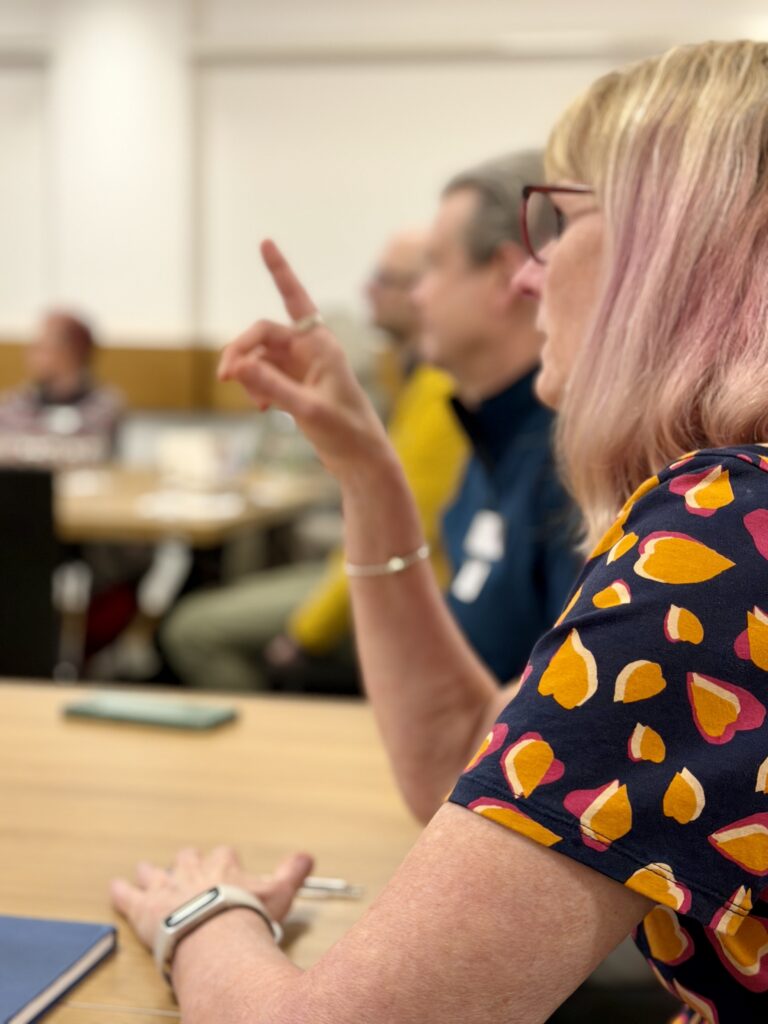
Populism is about division, she said, and thrives in moments of crisis. “And right now, people feel distrust because they don’t believe what they’re being told, and instead feel disempowered. The way to fight this is to give people agency and the power to feel what they do makes a difference – and that is what we think sits at the heart of the co-op movement.”
Related: With populism on the rise, can co-operatives save democracy?
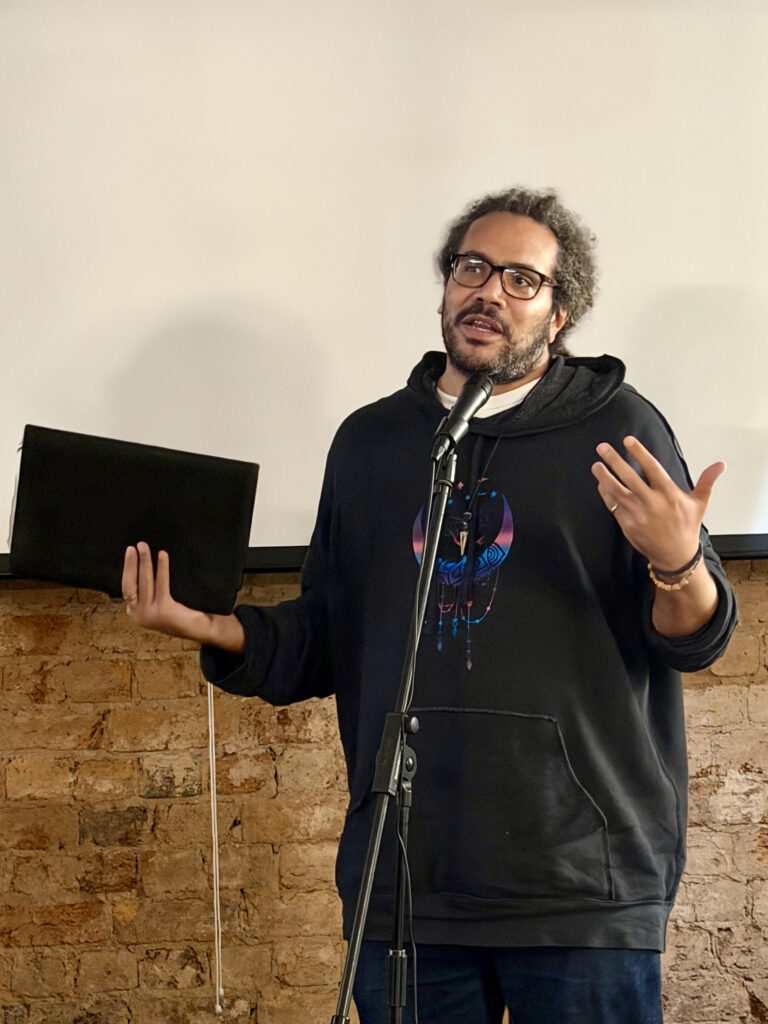
The tone for the event was set with a preliminary gathering at The Good Intent, a city-centre not-for-profit pub in Birmingham’s historic Great Western Arcade, with short films that spoke directly to the conference theme, mixed with poetry from Rawz, a multi-disciplinary artist whose work is rooted in words, social justice, and an exploration of our interconnected worlds.
On the Saturday, the event moved to the Priory Rooms at the Friends Quaker Meeting House, with an opening plenary from Andrew Fowler from non-profit research and consultancy organisation More in Common.
“We were set up about five years ago in the wake of the murder of MP Jo Cox, which is where we got our name from, because her maiden speech in the houses of parliament included the idea that ‘we have more in common than that which divides us’,” said Fowler.
Related: Report on Future Co-ops 2025
Last year, More in Common published its Shattered Britain report, which explores the driving forces behind polarisation in Britain today. It was based on interviews with over 10,000 people and explored the “driving factors of division in the UK at the moment and how we can actually find some solutions”.
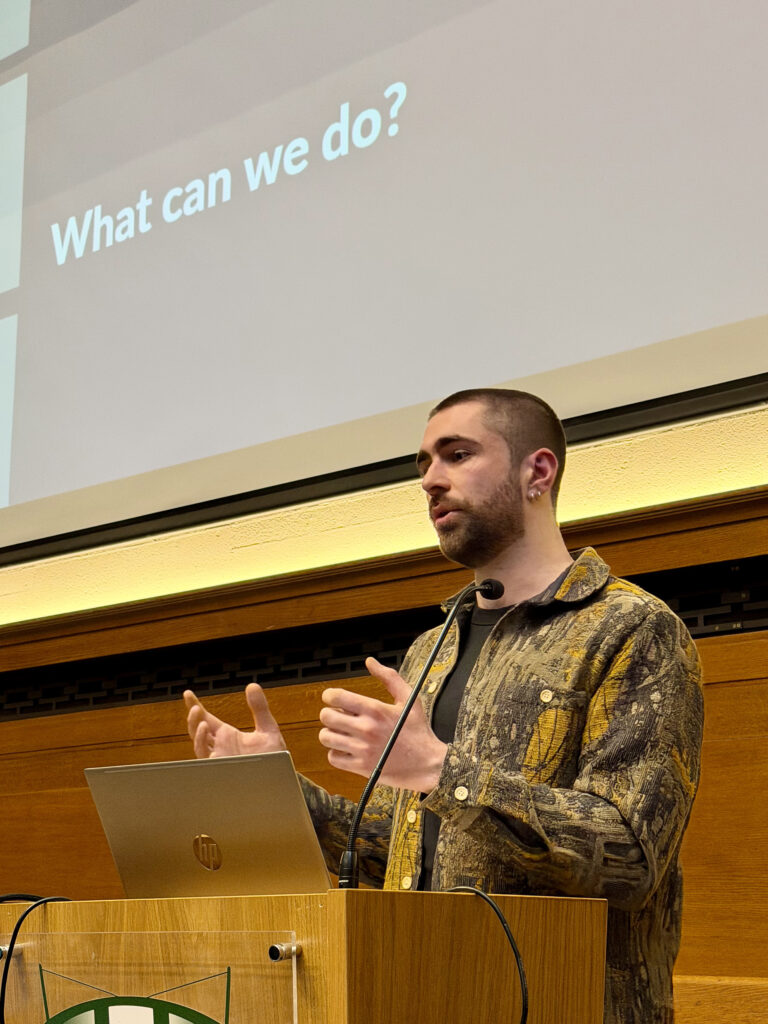
The report identifies seven ‘segments of Britain’ based on research into core beliefs, values and behaviours (progressive activists, incrementalist leftists, established liberals, sceptical scrollers, rooted patriots, traditional conservatives and dissenting disruptors) and describes how trust, exhaustion, agency and threat are the four primary factors driving divisions. These lead to “people feeling like the political class – as well as business leaders, journalists and even judges and the police – are not there to serve society whatsoever,” said Fowler.
Around 60% of the public feel exhausted by the division of politics, the report found, while a third believe that what they do doesn’t really make an impact on society. Meanwhile people still care about environmental issues such as climate change, but this is overshadowed by other challenges.
“We’re in a poly-crisis,” said Fowler. “People are saying, ‘How we can deal we deal with this one thing that might affect us in two or three years time, when there are so many issues that I’m facing in my day-to-day life right now?’”
Issues of identity, migration and social cohesion are on the rise, with half (51%) of Britons reporting feeling disconnected from society around them. “And I can’t tell you enough how much the cost of living crisis grinds people down – finance is the number one worry for most people.”
Related: Community power in the UK … Reviving the social club
All of this is leading to a real political stasis in this country, he added. “We are seeing the complete collapse of the centre two parties that have held down political life in the UK for over 100 years; the really interesting thing that came out of the Gorton and Denton by-election was that Labour and Conservatives combined had just 26% of the vote.”
Integration is key to understanding social cohesion, he said, and is an area that co-operatives have a role to play. “We’ve got to centre people and understand the different world views when we’re entering this conversation.”
More in Common’s research suggest that some of this integration can be achieved by restoring pride in local communities and the environment. “When we spoke to people about what made them most happy in the place they lived, it was nature, it was their local environment and it was access to good quality parks,” Fowler said. “Community-owned assets are extremely popular, and community respect is central to rebuilding trust.
“We need to understand that there is a whole host of ideological diversity across the UK. And we can work with this because we have shared values; we need to find the common ground.”
Participation
One process that facilitates this finding of common ground is citizen’s juries and assemblies. In a session on participatory democracy, Mara Livermore from Shared Future shared how people-powered participation can shape real decision-making by “giving communities meaningful influence over contested issues of public policy”.
There are lessons here for the co-op movement, she said. “I’ve always been the kind of person who kind of believes that people do like to get on, and that if they find something interesting then they will work hard, collaborate, and solve the problem that’s in front of them – and they’ll do it with the person next to them. We know trust is low and that things are fractured, but actually public trust in citizen’s assemblies is high.”
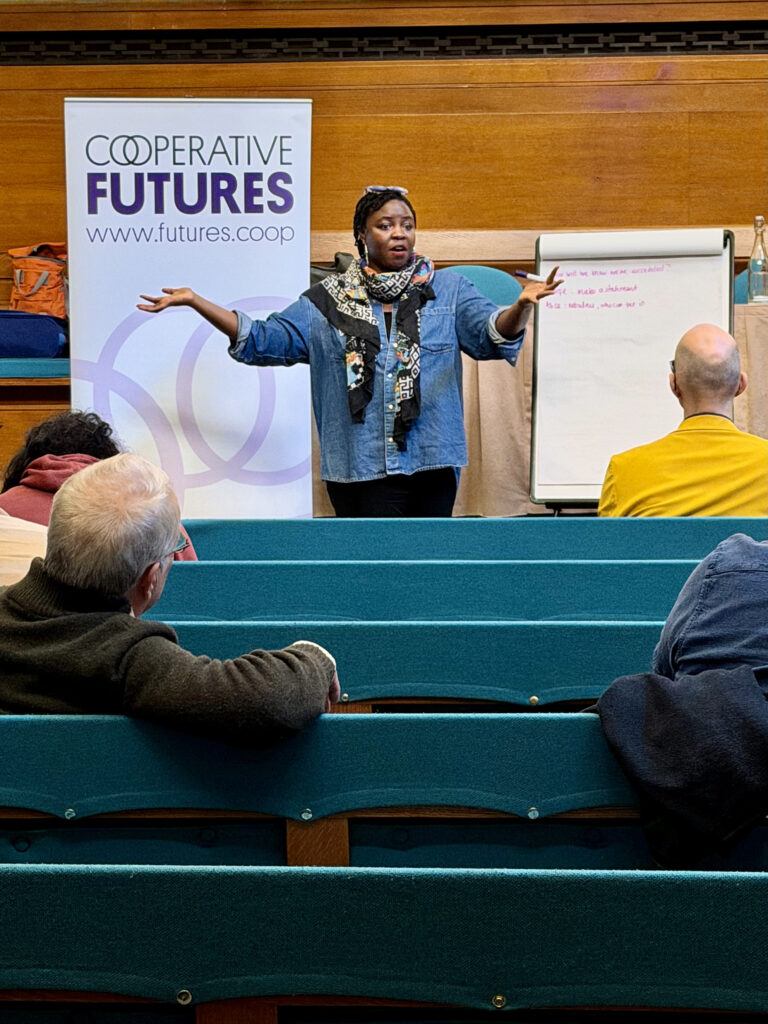
Participatory democracy is a way of bringing together a group of people, who are a “mini public”, reflective of the demographic of an organisation, she said, who are then supported to work together to make recommendations back to that organisation.
Assemblies and juries have a number of parts, from an oversight panel that ensures the project design is fair and rigorous (and then push for implementation of recommendations) to facilitators, commentators and the randomly selected members of the juries (20-40 people) and assemblies (45-200 people). Deliberations, discussions and reflections then take place over a number of months, with recommendations written and voted on.
Related: Where does the working class fit into the modern UK co-op movement?
“There’s a little bit of magic in it, to be honest,” said Livermore, giving the example of the Birmingham Museums citizens’ jury, convened to answer the question: ‘What does Birmingham need and want from its museums, now and in the future; and what should Birmingham Museums Trust do to make these things happen?’
“What I’ve learned,” said one jury member, “is how you get the cross-section of people and you give them a problem to solve, you get so many really interesting, different perspectives and common sense as well.”
The dual ideas of politics and participation thread through all sessions, including a conversation facilitated by Jabu Nala-Hartley on where the co-operative movement should build power next. Born in South Africa, where her mother was the first Black female trade union leader, she learned from a young age “to not let systems built on prejudice and inequality go on unchallenged”.
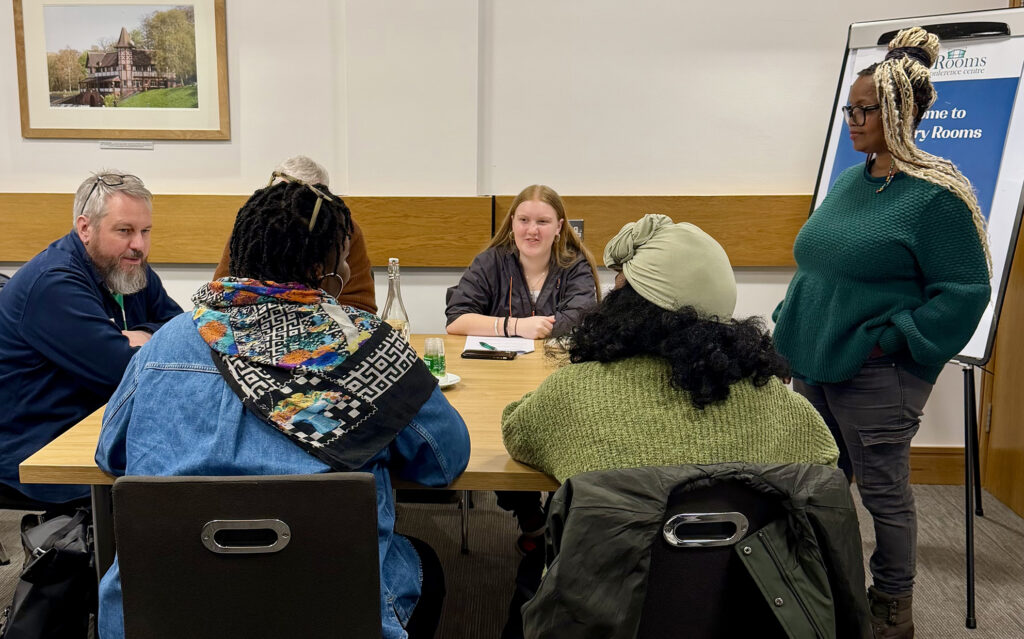
From being a disillusioned resident of one of the poorest areas of Oxford, she joined the Labour Party during the height of Corbynmania and became a city councillor (and the first Black woman chair of the council) – one of 10 who later resigned over Palestine.
The UK’s Co-op Party has a long-standing electoral agreement with Labour, “but where do we want to be in terms of building broader alliances?” she asked.
“Across the EU we are seeing a rise in the far right which is spilling into real fear and harm. Communities that once felt connected now feel divided because of the racist rhetoric.
“The values of the co-operative movement are about building communities and making sure that when this sort of political weather is taking place, people are anchored in communities, can draw strength from each other and can challenge the system from the perspective of ownership.”
Political allegiances
Recent frustration with Labour’s stances on a number or domestic and international issues and several high profile defections to the Green Party (including former North Tyne Labour and Co-operative mayor Jamie Driscoll, barred by Labour from standing for re-election in 2023, and former MP for Brighton (and current Woodcraft Folk CEO) Lloyd Russell Moyle) has prompted a discussion on where current alliances lie.
Delegates discussed how although the movement does have its own party in the UK, apex bodies including Co-operatives UK and the International Cooperative Alliance remain politically neutral, and historically, co-operative projects have garnered support from across the political spectrum. The first chair of the cross-party group on co-operatives in the Welsh Senedd for example, was a Conservative.
There was general agreement that while Labour’s ambition to double the co-op and mutual economy was welcomed in terms of building a more enabling environment for co-ops, it was more useful to push the co-op agenda wherever you are. “Co-operatives are a tool to bring like-minded people together to build a better world in their part of the community,” said one participant, while another argued that co-ops are less about party politics, and more about building businesses.
Delegates also heard from Alain Demontoux, Operations and FCA Compliance Manager at Co-operative & Community Finance, which is currently seeking investment in Icof Community Capital Limited, a fund that enables communities to take control of local assets such as pubs, shops, and other vital facilities.
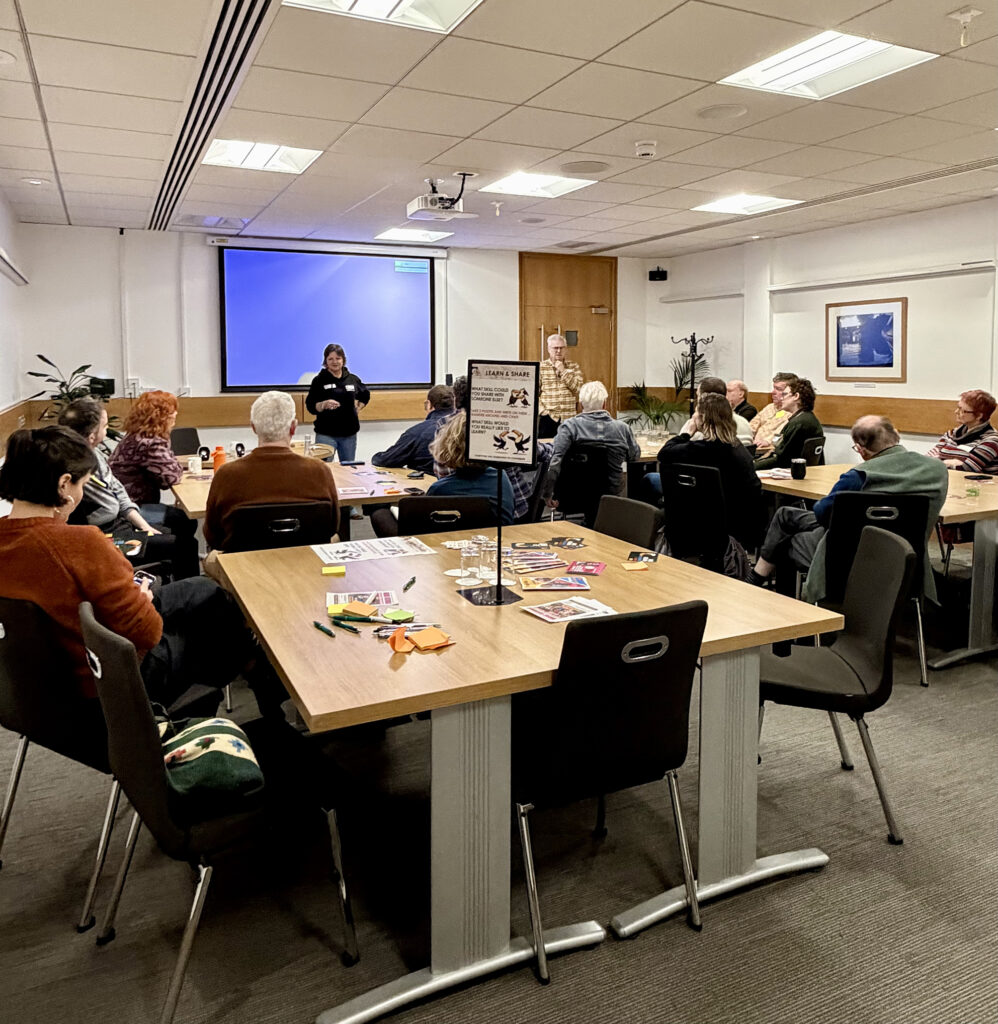
A session on the push for net zero, and attacks on this agenda from the far right, saw a discussion about climate change. Initially delegates spoke about how net zero seems like an abstract concept that does not apply to most people’s lives, especially when the cost of living is the biggest priority for a growing number of people. But climate change is getting worse, whether it be recent extreme rainfall or temperatures of 40 degrees celcius in summer.
Participants also spoke about how the far right is weaponising an anti-net zero agenda funded by the fossil fuel lobby. Misinformation is rife and hard to counter.
The workshop finished with a look at ways how co-ops can counter this narrative. The best way to do this, it was decided, is by demonstrating that climate action can create a better society for people. This can be achieved through solar panels that are owned co-operatively or by providing energy-efficient housing through housing co-ops.
The conference also offered practical sessions on how communities are creating fairer economies, workshops on how to counter attacks on the climate emergency and Coalville Can’s approach to regeneration through co-operation – and a lesson in how to hold difficult conversations in challenging times.
“The sense of belonging is the thing that will help us overcome some of these challenges,” said Jo White, closing the event.
“We’ve got the solution. Now we just need to be getting it out there.”