The Co-operative Retail Society Network (CRSN) is going from strength to strength in its bid to help rural businesses survive challenging times.
Launched in 2023, it is a partnership between a growing number of retail co-ops and Plunkett UK, which provides free business advice to rural communities looking to save or set up community-owned businesses. Members share resources and expertise with community businesses in need of help.
Currently comprising Midcounties, Central, Southern, Radstock, the Co-op Group and Co-operatives UK, the network was inspired by co-operative principles 5 (education, training and information) and 6 (co-operation among co-operatives).
There are several key ways in which it is aiming to grow the size and impact of the rural community ownership movement, including an annual financial contribution towards Plunkett UK’s free community business service, which helps support start-up and existing community-owned businesses.
Sharing expert co-operative and retail knowledge is proving to be a major boost to small community businesses looking for solutions, and by convening regularly as a collective, the network can explore practical and innovative ways of support, including visits to successful businesses that can share knowledge and experience with others starting out.
Related: Plunkett wins Linbury Trust funding for community business service
At the time of the network’s launch, issues such as the cost of living crisis and rising energy bills were major challenges to the long-term future of community businesses in rural areas. As Plunkett’s partnerships manager, Hannah Barrett, acknowledges, most of those challenges still remain for its network of 800+ community-owned businesses, with around 40 more opening every year and looking for advice.
“Those struggles are still there, if not worse,” she warns. “However, communities are coming together to provide solutions to issues like social isolation and lack of local employment, be it somewhere for young people to get further information via a job network or supporting all types of co-op, including community pubs.”
Main photo: Future of Rural Retail Taskforce event at Ditchley Park
“The funding which the network provides goes into Plunkett’s general business support pot and delivers to specific businesses, so we are very pleased about that. It is a significant part of the community business service we provide, and we can now utilise retail co-ops’ knowledge, expertise and networks for their benefit. The network support is also ensuring our business support offering is there and available for the communities. It really and truly is a demonstration of co-ops supporting other co-operatives.”
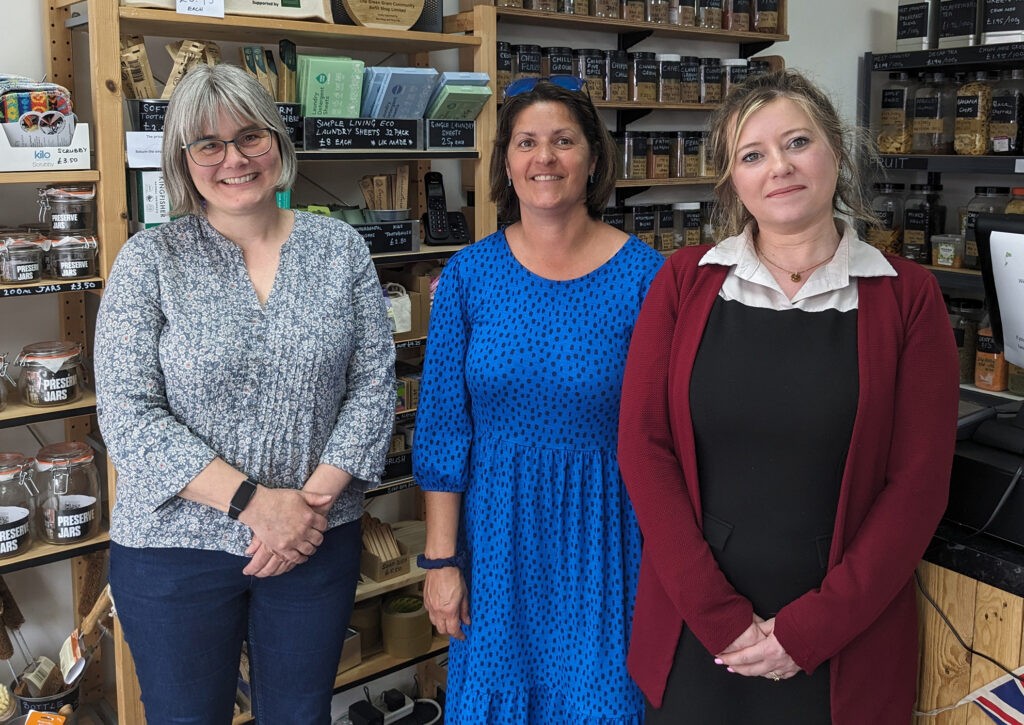
Recent initiatives include a study visit by Southern to the Green Gram, a community refill shop in Hampshire and a network meeting at Alfrick and Lulsley, a community shop in Worcestershire.
“It was very inspiring to see local engagement and support,” says Barrett. “We discussed knowledge sharing and how we can improve on that, and the co-operative societies were also able to learn from the ideas they got from communities successfully doing it for themselves.”
The network is helping Plunkett to ensure a sustainable sector of community businesses, she adds, and the organisation is now proactively inviting other societies to join.
“We are also working more comprehensively with societies to provide data case studies for them to use to speak to their boards and members. We also work on press pieces, taking staff on study visits so they can see community business in action and share knowledge. We provide the data about specific trading areas that a co-op covers, so they can see the work they could do with their patch.”
Another initiative saw community businesses benefiting from a webinar by Midcounties on energy efficiency measures and how they could be replicated.
“We are looking at environmental measures community businesses can put in place and talking about the strength of the local community’s involvement,” she adds, “and how the network can continually engage the wider community in what they do.”
Network members are also involved in forging links with other organisations nationally to build a better future for rural businesses, with Midcounties taking part in the Rural Retail Taskforce meeting convened by Plunkett at Ditchley Park in Oxfordshire last autumn. Co-chaired by retail guru Mary Portas and social economy advocate Charles Courtenay, Earl of Devon, it brought together organisations and experts from a wide spectrum of rural and retail sectors.
The taskforce meeting was followed by a series of UK-wide in-person and online roadshow events attended by over 80 community-owned shops, sharing insights and looking at emerging trends in retail and the needs of communities. In June, Plunkett’s Future of Rural Retail report outlined a raft of practical solutions and recommendations.
Related: Community businesses boost local economies and services, says report
“It’s one of the most important documents we have come up with and we are very proud of it,” says Barrett. “By trying to get communities to think about the future and widen their offering, we can help ensure each community is engaging and delivering.
“Midcounties are already talking to their members about energy, and we can share that with other members we work with. We can also offer input on everything from staff training to HR, health and safety and general retailing support marketing.”
Plunkett UK, which represents 10% of all independent co-operatives trading in the UK,
is one of the fastest-growing segments of the co-op movement. Hannah Barrett is optimistic that the CRSN can help community-owned businesses grow exponentially in the years to come.
“We have big plans for the future, and are having a network meeting in October focusing on what knowledge and training we can use and duplicate for our members.
“I would like to see the size of the network grow with greater collaboration so that community businesses really benefit from that shared knowledge and experience,” she says.
“The threat to local rural services is huge. We see a lot of pubs come to us because the hospitality sector is really struggling; at the current rate of closures, there will be no pubs left by 2050 [taken from a report in the Times]. With threats like these, it is understandable that we will see a rise in enquiries – but the good news is there is a steady number of people willing to take them on with a 99% success rate.”
As well as business support, planning and governance, the network also advocates, lobbying the government to improve policy to support the work Plunkett does.
“The Network offers a stable base for the community businesses we wish to serve, so we are asking for a long-term commitment,” says Barrett. “When you see co-ops working co-operatively, it gives people hope, which means ultimately the sector will thrive.”