Raising capital has long been a challenge for worker co-ops, who often lack the backing of external investors or the grant funding available to community-run ventures. One organisation is working to change that by pooling co-operators’ resources and distributing them democratically: Solidfund.
As a co-op itself, Solidfund operates on solidarity principles, including open membership and collective decision-making, with members deciding together how resources are used.
“Solidfund doesn’t give ‘grants’, lend money secured on peoples’ houses or take a charge on their assets. We just distribute it where members think it will have the most impact,” it says.
Solidfund primarily supports worker co-ops directly with start-up and development funding, as well as co-operative development activities, such as learning events and the training of
co-operative advisors.
Since its inception in 2014, Solidfund has distributed over £395,000, contributed by hundreds of individual members, across the UK and international worker co-op movement.
Solidfund currently has around 400 contributing members, mostly made up of individuals, as well as some co-ops who have joined as groups.
Related: Can worker control guide the world past a neoliberal crisis?
While Solidfund includes many long-time co-operators, member Siôn Whellens explains, it is also looking to reach those in related movements who can see the value of worker co-operation in their contexts, such as climate justice and the labour movement.
“There’s probably a historical opportunity to reconnect with the trade union movement, so we’re working through networks like Union Co-ops UK, as well as through our connections with a lot of our active worker co-operators, who are also connected into some of these quite lively base unions, like the Independent Workers’ union of Great Britain (IWGB). Unions that are organising migrant workers, cleaners’ co-ops, couriers, people like that.”
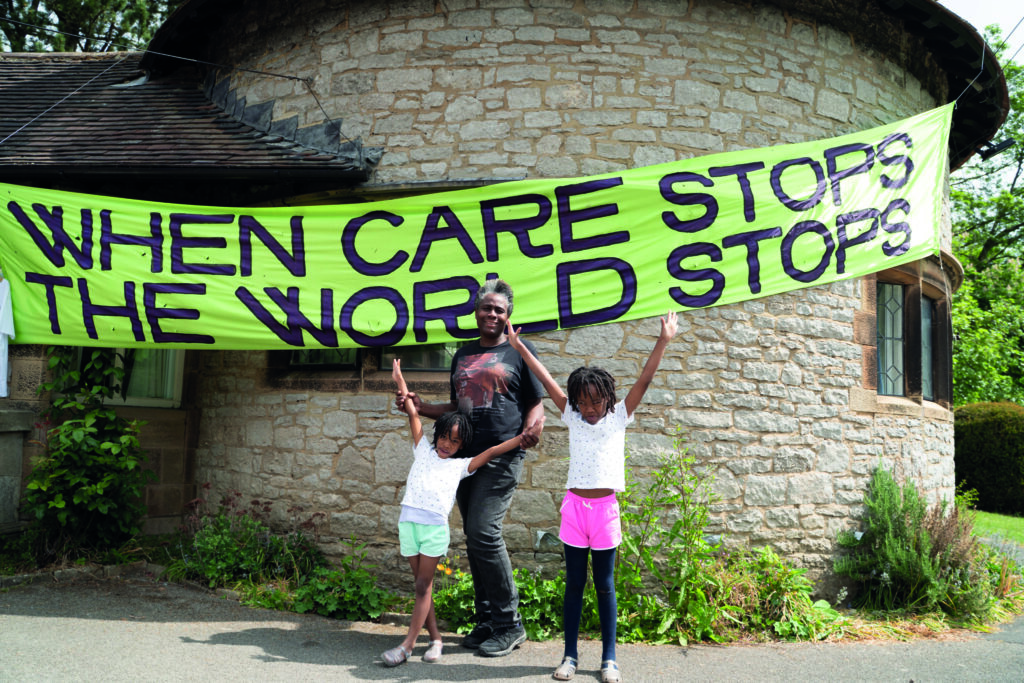
Solidfund member Mira Hall is one such person – an organiser with the IWGB and Nanny Solidarity Network (NSN) who joined Solidfund last spring.
“Worker co-ops often don’t have much money or are operating on a bit of a shoestring, but Solidfund allows us to be a bit more strategic around the ways in which we want the worker co-op movement to grow,” says Hall.
“It allows us to think in terms of what the role of worker ownership and worker control is in strengthening other movements, like racial justice or migrant justice, or the feminist movement, or rethinking how we organise care work, for example.”
Last year, Solidfund members voted to distribute £2,200 to NSN, which is in the process of establishing a childcare union co-op, to provide free childcare at the Worker Co-op Weekend.
“It was about making the movement more accessible to people with kids and caring responsibilities, which feels really important, and that’s the kind of thing that wouldn’t be possible without Solidfund,” says Hall.
The fund also has potential for helping to diversify the co-op movement, she adds.
Related: Heavyweight survey of the world’s worker co-op movement
“Often there’s a critique of the co-op movement in the UK, that it’s really white and middle class, … there’s a kind of gap for a lot of groups who really know how to co-operate and really have a vision but need a little bit of support.
“Seed funding is exciting in terms of the role it can play in making movements more diverse and making it more connected with different kinds of struggles, like [those of] migrant and minority communities … that is something Solidfund can do, build those bridges.”
Bridges are also being built across borders, with international solidarity a key commitment. Over the years, Solidfund members have supported various forms of co-operation, from the workers of the former GKN who were organising to take control of their factory in Italy, to, more recently, transnational tech co-op Yalla.
With members and associates in Palestine, the UK and across Europe, Yalla made a crisis appeal in 2024 for its members in Gaza. Solidfund member co-op Web Architects immediately proposed a contribution, and within 14 days of being put to a vote, £4,000 was unanimously agreed and sent to Yalla’s account.
“What stood out for us was the co-operative solidarity – and that it came though so quickly, which was really appreciated,” said Yalla co-founder Joe Friel.
“In fact, the solidarity of other worker co-operators and supporters was decisive in Yalla’s beginning. It was there through our early development, and it’s at the heart of our strategy today. I think it shows we were right early on to embrace the worker co-operative model for what we were trying to build.”
Beyond the material impact Solidfund is creating, there has also been an unexpected side benefit to this work, explains member Graham Mitchell.
“Like an increasing number of people now, I work from home. … In many ways that suits me fine, but it is quite isolating, and so opportunities to engage with like-minded people is really, really important.”
Mitchell describes taking part in online discussions around how to distribute Solidfund’s money as a valuable exercise in itself, creating connections that cross over into the physical world.
“I’ve just been to Co-op Congress – you meet people there that you’ve been chatting with through Loomio over the course of the year, then you see them for real, that’s great.”
Mitchell has a long history within the movement, having set up a desktop publishing worker co-op in the 1980s and going on to support a variety of co-ops since then. With his background in tech, Mitchell has been involved in the development of Solidfund’s website and Loomio, the digital platform it uses to organise with members and vote on fund allocation.
Related: A worker co-op success story from Kerala
“I think [the fund] has got enormous potential. … It has shown over its lifetime so far it is capable of raising significant amounts of money. The ambition I have for Solidfund is that it can grow that pot of money, so that there’s a few million pounds there.”
Mitchell gives the example of the £6.6m co-operative housing and retail development in Stirchley, Birmingham, which is now under threat after costs overran, as the kind of thing Solidfund could potentially support in the future, if it had more contributing members.
“Wouldn’t it be great if Solidfund could step in there? It’d solve a problem overnight. So, the ability to make that sort of impact, I think would be really good. It’s just a numbers game, really, getting enough people to make it happen.”
For Hall, the importance of Solidfund’s work is increasing in a moment where, under austerity, “the state has abandoned a lot of communities and the rise in fascism is becoming more real”.
“We need to think about how we’re coming together and building power, as communities and as workers, to meet our own collective needs … rather than being turned into each other’s enemies.
“At a fundamental level, co-ops and worker co-ops are just a structure for achieving that. It’s a way of doing solidarity.”
You can find out more about Solidfund and membership at solidfund.coop