The Uralungal Labor Contract Co-operative Society (ULCCS) is one of the most celebrated worker co-operatives in India. It’s also the oldest. Founded in Kerala in 1925 under the guidance of the social reformer Vagbhatananda, it began with 14 members and 36 paise (roughly US$0.13 in 1925 currency).
Today, the co-op has 19,272 workers, 13,174 worker-members and a turnover of ₹2,400 crore (US$300m, £220m).
For Kishor Kumar, chief project officer at ULCCS, the secret to the organisation’s success is trust. “You trust your people,” he says. “This is the first thing. You trust them, then they trust you. ULCCS is a big, extended family.”
Its core business is infrastructure construction. From its first contracts for fences, walls and wells, it now builds roads, bridges, highways, and public buildings for government departments, including the National Highway Authority, the Public Works Department, and the Kerala state government.
Its subsidiary UL CyberPark (main picture, above) is the only Special Economic Zone in India established by a labour contract co-operative society. It also runs an IT services company (UL Technology Solutions) and has developed craft villages for artisans, a telemedicine platform, a senior citizens’ day care centre, and a disaster management and rescue unit.
Kumar sees 1995 as a real turning point for the organisation, when current chair Remeshan Paleri began introducing mechanisation. “[Some members] believed that if you bring in machines, they will lose work and job opportunities,” he says. “But as a visionary person, Paleri decided to purchase more machines, which actually ended up creating more jobs.”
More recently, the organisation has diversified into IT – a vital move, says Kumar, given that half of India’s population is under the age of 30 (24% are under 15) and have an eye on a digital future.
As Kerala’s social fabric shifted from joint, multi-generational households to nuclear families, educational attainment rose, and the children of construction workers had different aspirations. Kumar believes the diversification into digital was a co-operative obligation: “We, as a socially committed organisation, decided to develop more jobs in newer areas” – and so used the co-operative’s surplus to diversify into sectors that attract educated young members, rather than losing them to the private sector.
This includes the Sargaalaya Crafts Village, created on the site of an abandoned granite quarry. “Every year we have a month-long exhibition which attracts over half a million visitors to the craft village,” Kumar explains, adding that the Indian government selected it as India’s best rural tourism project in 2016.

ULCCS turned 100 last year, during the 2025 International Year of Cooperatives, and Bruno Roelants’ recent book on worker co-operatives, Cooperativism at Work, was published in celebration of ULCCS’ anniversary.
In his introduction, Kerala’s former minister of finance, Thomas Isaac, wrote: “[ULCCS’s] success has been driven by rapid modernisation and the adoption of advanced technologies. This evolution has brought with it the challenge of staying true to co-operative principles amidst market pressures. That ULCCS has remained committed to its founding co-operative values is a testament to its integrity and vision.”
One of these core values is democratic member control. The book’s chapter on ULCCS, authored by Saji Gopinath, explains how of its 13,174 worker-members, only 534 are “A class” members with full voting rights, workers who “contribute their manual labour consistently.” Around 5,300 are “C class” members (technical and managerial staff) who share in profits but have no vote, and 7,330 are “D class” members, newer workers who can progress to A class “depending on consistent performance and contributions to the growth of the society.” The general activities of the society are managed by a board of directors elected from the members of the society.
It has a governing council that meets daily, and work councils that meet monthly to make decisions. Every six months, all worker-members come together to discuss strategic decisions for the society’s growth.

For Kumar, keeping member control intact across such a large organisation comes down to a daily practice dating back to the founding: “Every project team who is involved in a project sit together offline or online and debates together… What are the positive things we carry forward, and what are the bad things we have to eliminate? This started 101 years back. Every day we sit together, think together, decide together, and implement together.”
ULCCS’s welfare offer is a core part of its proposition, and as of March 2024, the salary of a ULCCS worker-member is around 40% more than the national average for similar work.
The Cooperativism at Work chapter includes an interview with Mr. Anandan, a worker director who joined ULCCS in 1974, at age 15, as an unskilled quarry worker, orphaned and supporting his family. He became a member at 18, team leader by 1984, and was elected to the Governing Council in 1993, serving as vice chair from 2013 to 2023, all with only a primary school education. He has since put three daughters through professional education in engineering, nursing, and architecture.
He believes the organisation’s growth – and its resilience – has been driven by its “collective sense of ownership and commitment”. This was perhaps most visible during the 1980s, when Kerala workers emigrated en masse to the Gulf states for better wages. ULCCS lost huge numbers of its workforce, and its remaining members “made sacrifices to ensure its survival”, said Anandan. “They took wage cuts, reduced paid holidays, forgave bonuses, and even contributed part of their earnings to help overcome the crisis.”
One of its more recent initiatives is U Sphere, launched in 2025 as part of ULCCS’s centenary celebrations as a dedicated venture into futuristic, high-tech, and eco-friendly building construction solutions, focused on advanced, pre-engineered, and precision-built structures, says U Sphere CEO Biju Mahima. “It’s an idea to take the story of ULCCS geographically as well as into the private sector.”
Mahima, who came from a corporate and military background, noticed a marked difference when he joined the co-operative: “In the corporate sector, decisions come from the top… in our system, the decision is from the labourers. They take the decisions, they know what to do.”
In a co-operative, the “welfare of the members is the first priority,” he adds, above profit and brand value. “It’s a beautiful and pleasant environment.”
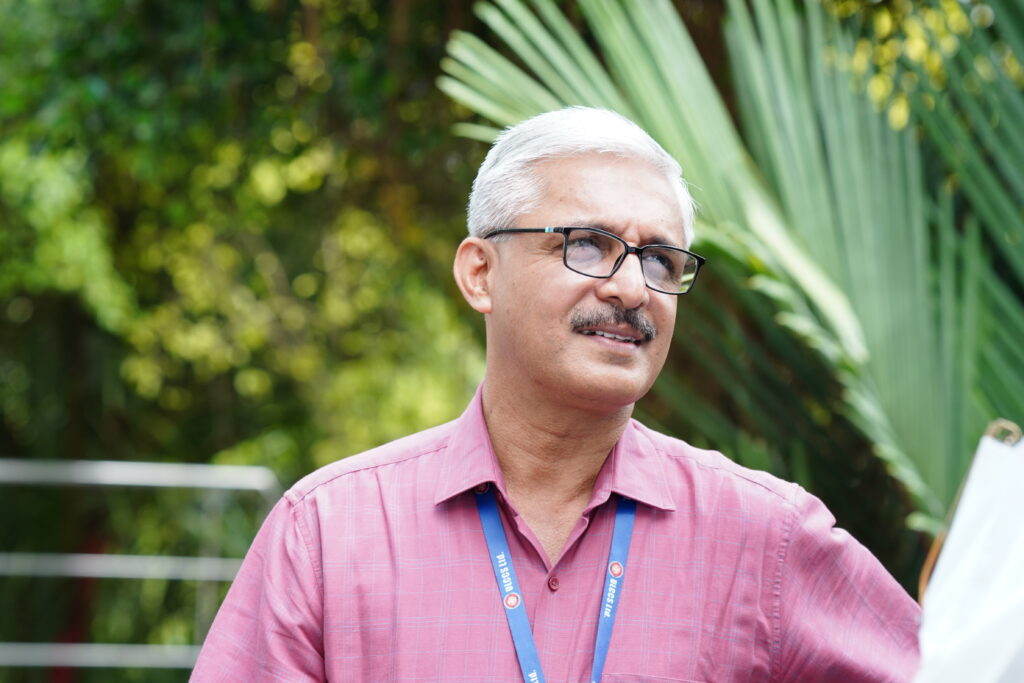
Kumar has represented ULCCS and high-level events around the world, most recently at the International Symposium on Cooperative Financial Institutions organised in May by the United Nations Department of Economic and Social Affairs (UN DESA), International Cooperative Banking Association (ICBA) and International Cooperative Alliance (ICA), sharing the co-operative’s story.
Looking to the next century, he cited plans to further its international work, bringing the ULCCS model to other communities worldwide.
“One hundred years is not a small time,” he says. “There are so many experiments that have happened – so many failures, so many successes … This is the result of the hard work of the people who worked hard for the development of mankind, and which will continue for the next one hundred years.”