In the northern hills of Kaski district in western Nepal, 51-year-old Tikadevi Nepali once lived a subsistence life. A resident of Lahachok in Machhapuchchhre Rural Municipality, she raised three children by selling milk after her husband died in 2002, leaving her burdened with debt after family properties were placed as collateral.
With no stable income and full responsibility for her children’s education, Nepali saved what she could from daily wage labour. In 2015, she bought a buffalo with a plan to sell milk for additional income source as she’d to secure her family’s future. Instead, she encountered a barrier deeply embedded in Nepal’s social fabric: caste-based discrimination.
When she tried to sell milk at a local dairy, they were reluctant to buy from her. However, no one openly told her about social discriminations. The inside story was villagers warning to dairies to stop buying milk if she became a supplier.
“I had no other option,” Nepali recalls. “My entire saving was spent into buying that buffalo.”
Eventually, a fellow farmer agreed to buy five litres of milk daily. Later, the chair of the Lahachok Small Farmers Agriculture Cooperative took a lead to organise a feast for villagers, where milk supplied by Nepali was used for cooking rice pudding (a popular Nepali dish) – a symbolic act that aimed to break stigma.
Now, Nepali has been able to supply more milk from two buffaloes in local dairy. Yet social barriers remain. Many villagers still refuse to eat food she prepares or visit her home during festivals and social functions.
“The co-operative helped to break down barriers,” she says. “However, untouchability still exists dominantly in our society.”
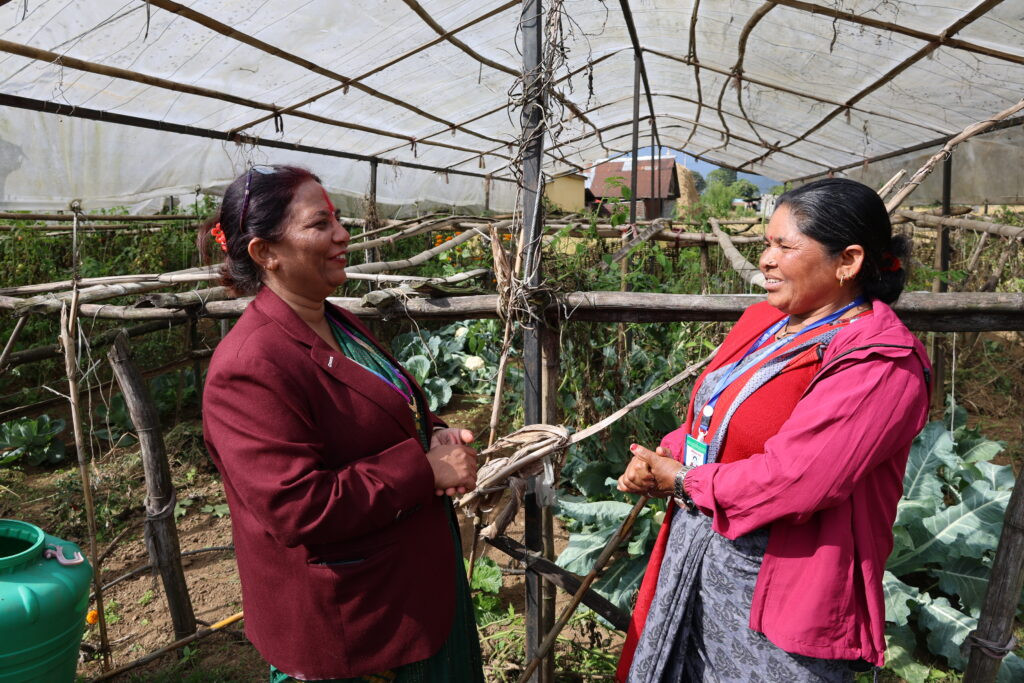
Nepali’s experience highlights a striking contrast in contemporary Nepal: while caste-based discrimination has been legally abolished for decades, it continues in subtle but persistent forms, especially in rural areas. At the same time, Nepal’s co-operative movement is emerging as an instrumental force for inclusion.
The Lahachok Small Farmers Agriculture Cooperative, run entirely by women, has around 1,200 members, roughly 10% of whom are Dalit women. The co-operative provides concessional loans aimed at improving livelihoods through livestock farming and agriculture.
According to its chair, Kamala Kumari Subedi, access to affordable credit has helped Dalit women become economically self-reliant. However, she acknowledges that social transformation remains incomplete.
“No one publicly expresses ‘untouchability’ as an issue any more because they know it is considered as violation of law,” she says. “But non-Dalits still avoid places where Dalits live and refuse to eat food touched by Dalits.”
Subedi also serves as a board member of Nepal’s National Cooperative Federation. “Generally, in co-ops, everyone’s contribution matters equally,” she says. “That creates a space where caste hierarchy weakens.”
Laxmi Darji’s story is a similar one. Based in the Jhapa district of Eastern Nepal, she is a member of Nepal Multipurpose Cooperative Society Limited (NMC), one of the country’s largest co-operatives; through this, she could access credit which significantly improved her family’s economic wellbeing.
Related: Co-operatives and the International Year of the Woman Farmer
With a loan of approximately 500,000 Nepali rupees (£2,550/US$3,440), she started a tailoring business. Co-op members purchase the clothes she makes and share meals with her during group activities.
“Inside the co-operative, all members are equal,” Darji says. “They buy what I produce. There is no issue of untouchability.”
But outside the co-op, discrimination persists. “Not everyone in society is a co-operative member. Upper-caste neighbours still follow the untouchability practices.”
Of NMC’s 170,000 members, around 8,000 (nearly 5%) belong to Dalit communities.
According to the 2025 Dalit Statistical Report, Dalits comprise approximately 3.9 million people – 13.4% of Nepal’s total population of 29.16 million. More than 57% of Dalits are engaged in agriculture, forestry and fisheries – sectors closely linked to co-operative activities.
Government data shows Nepal has 32,965 registered co-ops with over 10.9 million members — nearly a third of the country’s population. Precise data on Dalit participation is lacking, but the National Cooperative Federation estimates that around 20% of co-operative members belongs to Dalit and highly marginalised communities.
Federation chair, Om Devi Malla, says co-operatives have significantly increased participation from marginalised communities, including endangered indigenous groups such as the Raute, Chepang, Thami and Bankariya.
Malla argues that linking Dalit communities to production and distribution networks through co-operatives could significantly narrow inequality gaps. However, she admits that the co-operative sector itself is currently facing financial and governance challenges.
Another major gap is data. No institution maintains comprehensive statistics on Dalit participation in co-ops. Malla says that if the government produces detailed disaggregated data, targeted inclusion programmes could be designed more effectively.
The federation is preparing initiatives aimed specifically at Dalit inclusion while also engaging non-Dalit members in dialogue on equality.
Related: Community land trusts – building a different kind of wealth
In some areas, targeted initiatives are already under way. In Diprung Chuichumma Rural Municipality in eastern Nepal, local authorities launched a “One Ward, One Dalit Cooperative” campaign. The municipality has provided seed funding of 50,000 Nepali rupees to establish Dalit savings and credit co-operatives, encouraging financial literacy and investment in income-generating activities.
Local officials say the goal is not only economic uplift but also social dignity.
Nepal formally outlawed caste-based discrimination in 1963 through reforms to the Muluki Ain (National Civil Code). However, activists argue that early legislation lacked effective enforcement mechanisms.
Social activist Bishwabhakta Dulal, widely known as Ahuti, explains that although discrimination was legally prohibited, penalties were unclear, and certain traditional practices were ambiguously protected.
Subsequent constitutional reforms in 1990 and 2007 strengthened anti-discrimination provisions. In 2006, Nepal officially declared itself a caste discrimination-free nation. Every 21 May, the country observes the Day Against Caste-Based Discrimination and Untouchability.
Yet implementation remains inconsistent.
“Laws alone cannot dismantle centuries of social conditioning,” Dulal says. “Caste discrimination has cultural roots.”
In many communities, discrimination operates quietly. Open declarations of caste bias are rare, but social avoidance continues — declining invitations, refusing to share meals or limiting social interaction. In some cases, caste-based discrimination persists even within Dalit sub-castes.
For women like Tikadevi Nepali, progress is tangible but incomplete. Her milk now enters the same dairy that once rejected it. Her children are educated. Her income is stable.
Yet the deeper struggle remains social acceptance.
“They buy my milk,” she says. “But they still don’t come to eat in my home.”
Nepal’s co-operative movement demonstrates how economic structures can create pockets of equality within unequal societies. But dismantling caste-based hierarchies requires more than financial inclusion. It demands sustained cultural transformation one that moves beyond legal prohibition toward genuine social integration.
For now, co-operatives offer both livelihood and dignity, even as the roots of discrimination remain embedded in everyday life.