With opinion polls showing Reform in the lead by 10 percentage points, the prospect of a Farage government is a growing worry for the UK’s established parties, and loomed over the Co-operative Party conference, held in London last month.
But there was also optimism among conference speakers, particularly government ministers, who argued that the antidote to societal division was more community wealth building.
“The response has to be Community Britain,” said Party chair Jim McMahon (man picture), adding that this means “politics done with people, not to them”.
McMahon thinks the government’s commitment to doubling the size of the co-op economy will be “life-changing” for communities impacted by the cost-of-living crisis and high street closures, who will also be able to access funding through the Pride in Place programme.
He offered an overview of the legislation and policies introduced by Labour, such as the bill to address violence against shop workers, and tackle shoplifting, anti-social behaviour and knife crime.
Further support measures are under way, confirmed business and trade secretary Peter Kyle, including a call for evidence on ways to support co-op and non-financial mutuals through the start-up, growth and scaling process, and to help existing businesses transition the co-op model.
“This year we’re requiring as a condition of funding that growth hubs in England offer support to businesses with alternative models including co-operatives and mutuals,” said Kyle.

The government is also exploring ways to integrate support for co-operatives within the new business growth service and has updated the Help to Grow: Management curriculum to include more information on the sector.
Kyle said these measures would improve access to finance for startups, including social enterprises, while co-ops also have access to funding from community development financial institutions (CDFIs) through the Community Enabling Funding Programme.
Describing co-operative politics as “a progressive middle ground between unrestrained markets and overcentralised government,” Kyle said this means supporting local ownership and enterprise, so communities share in the wealth that they create.
Related: UK parliament honours co-ops and credit unions in early day motions
“The Rochdale Pioneers once wrote that their goal was to arrange the powers of production, distribution, education and government for the benefit of all,” he said. “That vision, it still speaks to us today.
“It reminds us that democracy is not just a political system. It is a social contract between equals. Our task is to renew that contract to make trusting government possible again, not by blind faith, but by shared power and responsibility.”
Kyle’s speech was followed by an address by Joanne Thomas, general secretary ostore workers’ union Usdaw, who praised the party for being “a steadfast ally of retail workers”.
“I’m proud of our joint history, our joint values, and our joint priorities for the future,” she said. “Through our joint campaigning, we have delivered crucial changes in the law, creating a specific offence of assaulting a shop worker.”

The next step in this joint campaigning work is calling for the adoption in full of the Employment Rights Bill, with talk of this being watered down by ministers.
“Whether it’s banning exploitative zero-hour contracts or ensuring sick pay is paid from day one of an illness or introducing new trade union rights so that workers can regain their collective strength, all of this is crucial as workers face huge pressures from living costs,” said Thomas.
She called on the government to “stand firm behind its commitment to make work pay by getting this bill passed in full” by getting details right in secondary legislation and allocating resources to make sure new rights are enforced.
“All of us across the movement must keep making the case for fairness, security, and a better deal for working people,” she said.
She also urged for “bold action on child poverty” warning that some Usdaw members are unable to afford food for their families, or train fares.
“We need more action. We need bold action on child poverty. And we need support with essential bills for those who need it most. We need a renewed commitment to rebuilding our public services, our high streets, and our communities. And we need a fairer taxation so that those with the broader shoulders carry their share of the weight,” she added.
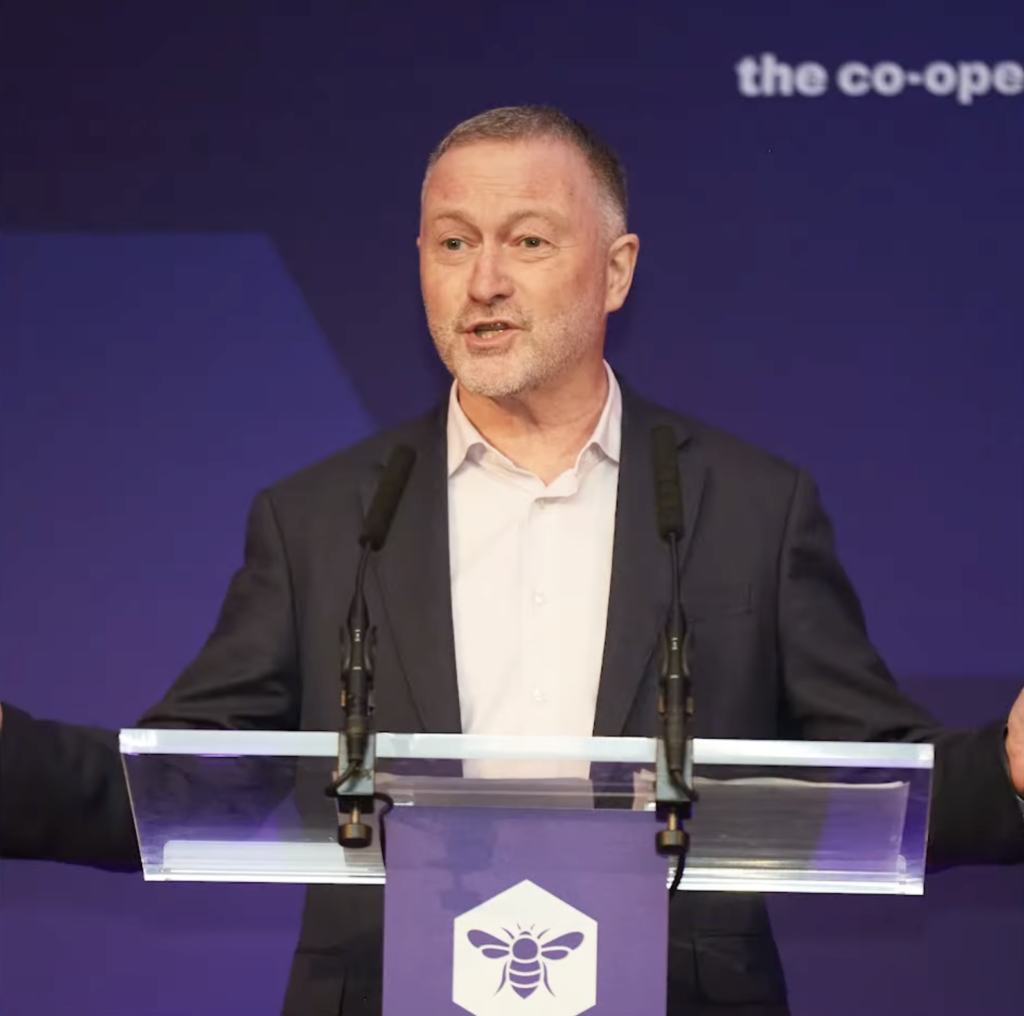
The conference also heard from Steve Reed, secretary for housing, communities and local government, who discussed Lambeth Council’s experience working with residents to set up Brixton Solar, a community-owned co-op to generate energy on the rooftops of a council estate.
“It’s now called Repowering [London],” he said, “and it’s become the country’s biggest community-owned clean energy generator.
“We found answers to the problems we faced in our own communities, but it was the principles of co-operation that unlocked those answers,” said Reed, a formed Lambeth councillor and honorary president of the Co-operative Councils Innovation Network (CCIN).
He described Pride in Place as “an expression of co-operative values in action”, with 244 of the poorest neighbourhoods in Great Britain set for funding to improve community spaces and high streets with local people deciding for themselves how the cash is spent.
Related: Labour’s £5bn community renewal plan includes co-op development unit
The scheme includes a new co-operative development unit and comes alongside legislation for a Community Right to Buy, currently going through the House of Commons, which, he said, “could bring new life to closed down pubs”.
“These are the answers,” said Reed, “and they’re co-operative answers to problems we hear about on the doorsteps.”
Looking at the government’s commitment to building the biggest number of social and council homes in a generation, Reed said an innovative approach will be needed to “explore how we can boost the role of co-operatives in the housing mix”.
New support measures for housing co-ops include new capital finance for community-led housing, and Reed confirmed the government is revising planning rules to open up who can build.
These co-operative answers, said Reed, will help rebuild trust and make “the politics of division” irrelevant.
But there is a long way to go, warned Trade Union Congress general secretary Paul Novak, with co-operative values such as solidarity, fairness and respect under threat from populist parties and the far right.
“If we’re honest, for millions of working people, change, that one word on the front of the manifesto, still feels more like a slogan than a lived reality,” he added. He hopes that investment in public services and infrastructure, seeing tax rises fall on those with the broadest shoulders, a windfall tax on bank profits and delivering workers’ rights would all help deliver that change.
Good jobs also help, he argued. Recalling a recent visit to a Co-op Group distribution centre in Nottinghamshire, he said: “I saw first hand what co-operative values mean in practice. Unionised workers in decent jobs with good terms and conditions, proud of the work they were doing. Good business can deliver for workers, for customers and communities, and not just send pop stars into space or pay for another super yacht.”
He praised initiatives such as the new industrial strategy, the creation of a publicly owned Great British Energy and moves to bring railways back into public ownership.
The conference also heard from Robin Fieth, CEO of the Building Societies Association (BSA).
Fieth, whose sector represents 35% of high street branches, said BSA’s main asks last year were a seat at the table to engage with the government, the modernisation of outdated legislation and regulation, and better access to startup and growth capital. This year, BSA has added a fourth ask: “Do no harm”.
Related: Building societies apex calls for reforms to help sector growth
“Don’t place unnecessary roadblocks in front of a sector that is actively delivering on the government’s manifesto commitment to double the size of the sector,” Fieth warned. “A clear example is our ongoing campaign against the reported proposals to reform the ISA regime”.
He said 47% of all cash ISA balances are held by building societies and “those funds are then used to support mortgage lending, helping people across the country to buy homes and build secure financial futures.
“I urge the government to work with us, not against us.”
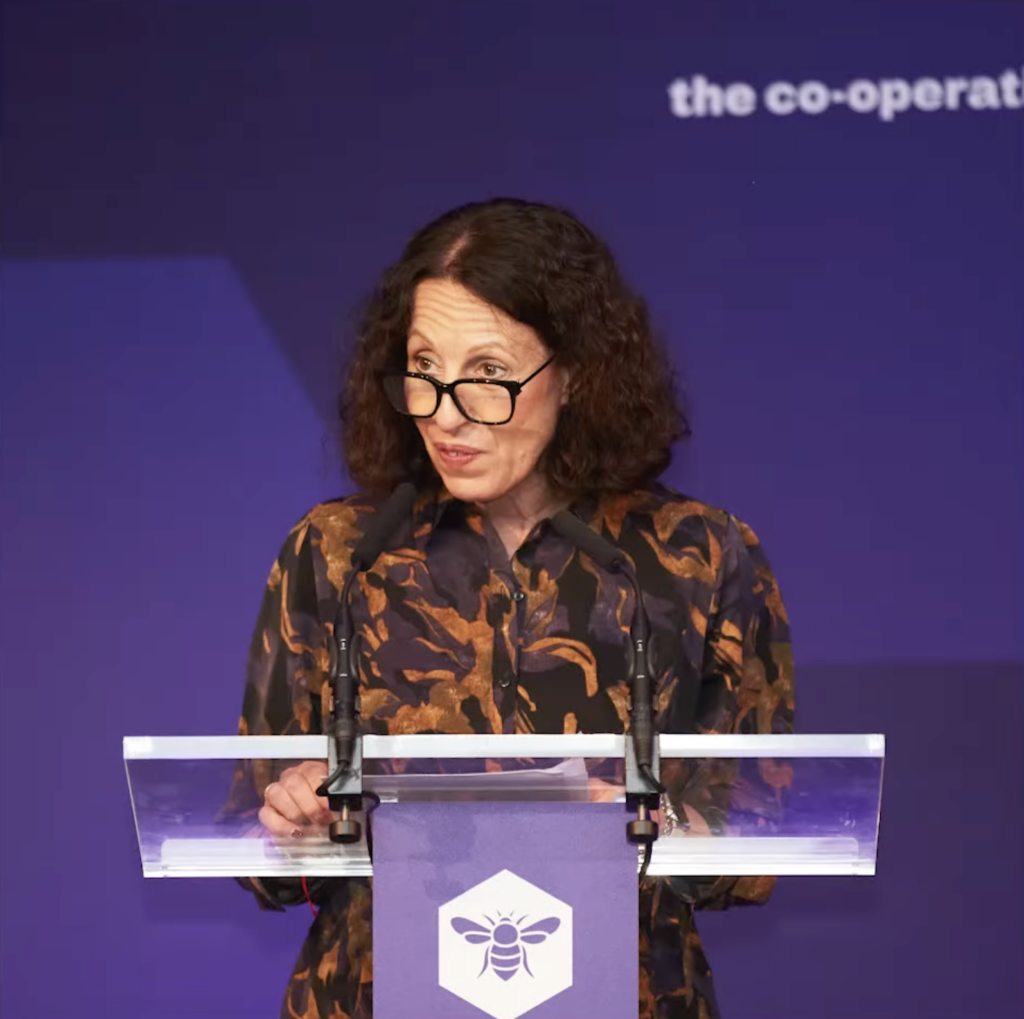
Co-op Group CEO Shirine Khoury-Haq discussed the retailer’s campaigns, including the promotion of peacebuilding and co-operation, and support for social mobility.
Meanwhile climate change, is impacting Co-op Group suppliers and food prices, she warned, but the 2050 net zero target enshrined in law “gives businesses the certainty and the long-term view that they need to invest in the transition to a cleaner, greener economy, which is the economic opportunity of this generation”.
“There is such a powerful role for our co-operative movement to play here,” she added, noting the potential of the community energy sector.
As to how the government cab support co-ops and their members, Khoury-Haq called for greater certainty and permanently lower business rates for all but the very largest retail, hospitality, and leisure properties. Research by the Group suggests that 60,000 small shops and 150,000 jobs could disappear if the government does not now follow through its reforms to business rates.
Related: Co-op Group launches social mobility tools as poll warns of class barriers
“I have been encouraged by the pace of progress that I’m beginning to see,” she said. “The creation of the Co-operative Development Unit, the forthcoming call for evidence alongside the Law Commission, and the support for co-operatives given by the government at the UN World Social Summit. But that pace has to quicken. We cannot stop. We cannot slow and now is the time for the co-operative move movement to press the faster button.”

Local government minister Miatta Fahnbulleh, who contributed to Co-op Party’s recent Grassroots Growth pamphlet, said the country was at a crossroads, with “a rising tide of something dark that threatens to tear apart our communities and pit people against each other … We have to confront this head on and offer a politics of hope and renewal that draws on the power of community and co-operation.”
Radical renewal is needed, she said, and “at the heart of this must be the pursuit of a new economic model that works in the service of the majority of people. One that will lift up living standards, yes. But more than that, one that is rooted in co-operative principles that gives people control, power, and a stake in the economy so they can ensure it works in their interests.”
Fahnbulleh promised “a radical devolution of power to regional and local government” – and local leaders should use this to build up the co-operative economy and create community wealth, with support from the Co-operative Development Unit.

The Co-op Party launched its Community Britain campaign earlier this year to tackle the lack of trust in institutions and politics. And, said party secretary general Joe Fortune, the campaign has been “a revelation”.
“This is a tipping point,” he told the conference. “This came from a vision of a country that we wanted to be in. We wanted to be in a better Britain, not a bitter Britain. It’s an absolute imperative for public policy, an imperative for our country’s future.”
Forthe campaign, the Party published an essay collection, Stories from Community Britain, offering solutions for climate change, economic stagnation and social cohesion – from a solar energy co-op in a deprived area of Bristol to community-owned Stretford Public Hall in Manchester.
“Something too often overlooked is the ability to tell the story of what’s happening already up and down your own high streets, around your friend’s corner, in your own street,” said Fortune.
The Party has grown its membership by 30% since 2019, and is now the biggest it has ever been – but it must go much further, said Fortune.
“I want to make sure we’re part and parcel of a Britain that I want to be part of, that you want to be part of, and the co-operative movement flourishes in,” he said.