Economic growth, a priority for Keir Starmer’s government, has been a central theme at the Labour Party conference in Liverpool, with the prime minister calling it an “antidote to division”.
Starmer also talked of putting working people in control of public services, boosting the clean energy sector, investing in rejuvenating high streets, and saving youth clubs and pubs – all areas where co-ops are active.
Other announcements include a new target for two thirds of young people to go to university or study a technical qualification after leaving school, an update of Blair-era target of 50% of young people going to university.
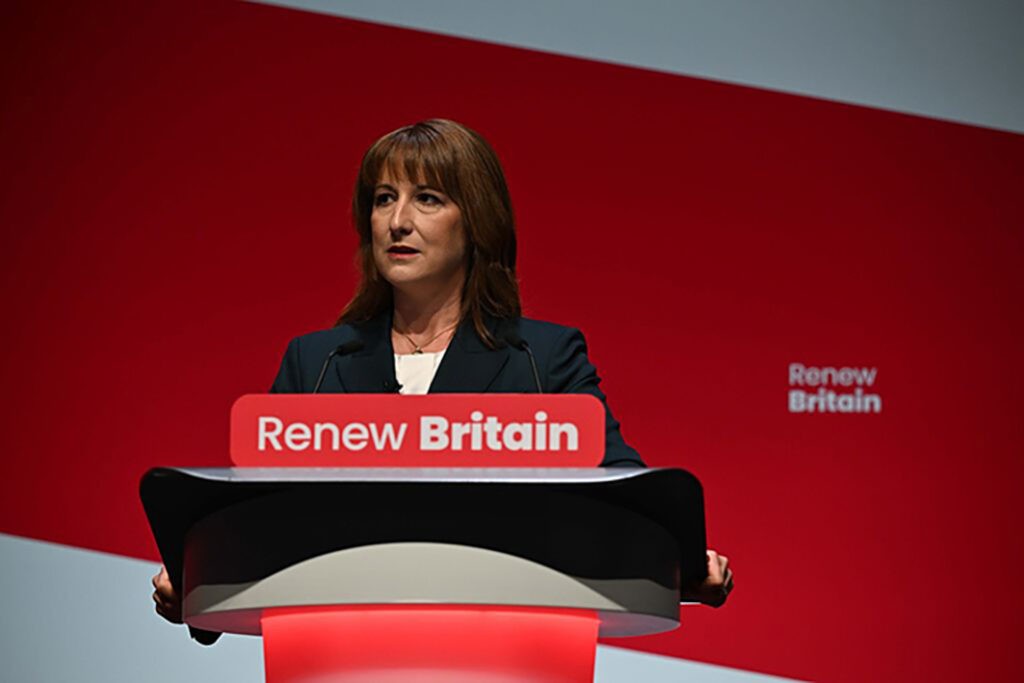
Meanwhile, chancellor Rachel Reeves promised to keep “taxes, inflation and interest rates as low as possible”, warning she would not “just abandon economic responsibility and cast off any constraints on spending.” She said the government will continue its commitment to build 1.5 million homes in this parliament, including a £40bn spend on new social housing.
These announcements all feed into the question of how inclusive growth should be delivered. Despite not being mentioned by the PM or chancellor in their speeches, the co-operative and mutual sector remains a strong focus for this government, which has pledged to double its size.
“Any vision for fair and inclusive growth has to be based around co-operatives and mutuals,” Nicola Morgan-Hulme, communications director for Arla Foods UK, told a fringe session. She argued that co-ops have a long-term vision, which, in Arla’s case, means spending money on innovations and helping farmer members become more sustainable.
Related: Arla doubles carbon reduction target for operations
Despite the benefits the model can bring to farmers, only 10% of agricultural turnover in UK comes from co-ops – compared with 40% in France and 60% in Denmark.
Community solutions
According to Better Society Capital, a social impact investor that aims to increase investment in tackling social inequalities in the UK, communities can play a key role in delivering inclusive growth through community energy schemes, community organisations delivering public services and community development financial institutions.
But its senior policy and advocacy manager Jovana Lalic warned that communities need access to capacity building support if they are buy assets.
Alistair Strathern, parliamentary private secretary to the Treasury, claimed the conversation around inclusive growth is reflected in different government commitments, from the Industrial Strategy to the Pride in Place Programme or the Clean Power 2030 Action Plan.
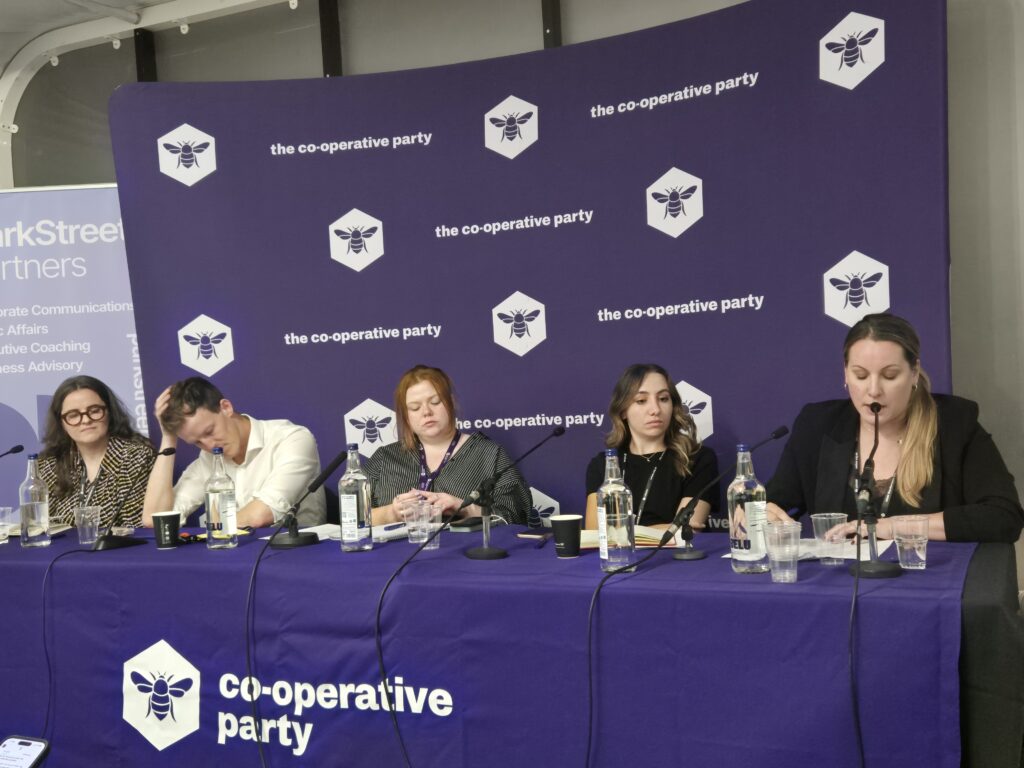
Devolution will also play a role in delivering some of these initiatives, he added, with local government empowered and given funding to drive inclusive growth, through skills investment or industrial strategy or the Pride in Place programme.
Devolved regional authorities “will also be crucial delivery bodies” in doubling the size of the co-op and mutuals economy, he said.
Jade Azim, head of policy and advocacy at Good Growth Foundation, said that people measure growth on the ground based on skills, and whether they have opportunities or access to education or health services. Voters are also nostalgic about community assets, she added.
Pride in Place, announced last week, sees the government pledge £5bn, with 169 areas receiving £2m every year for a decade, with a further 95 areas to receive an immediate £1.5m to upgrade public spaces with new green spaces, play areas and sports and leisure facilities.
Related: Labour’s £5bn community renewal plan includes co-op development unit
Coupled with the community right to buy legislation going through Parliament, these measures could help local communities acquire and run assets co-operatively.
Speaking to Co-op News, Jim Robbins, leader of Swindon Council and chair of the Co-operative Councils’ Innovation Network, said his town was among those set to benefit, with two projects due to receive funding.
“It’s brilliant for Swindon,” he said. “We’re really lucky to have two projects, one in Penhill, in Swindon North, and one in Walcott, in Swindon South..
“And those communities are the sort of places that do feel left behind by 14 years of austerity. So, it’s brilliant for us to have some genuinely transformational money and the opportunity to create the neighbourhoods renewal boards so that it’s going to be local people co-producing the solutions that really work for their area.
“It feels very exciting to us, and hopefully a chance to try and reconnect those communities to politics and believing that things can get better for them. We’re going to be making sure that our co-operative values right at the heart of working with those communities.”
Earlier this year, the Co-operative Party launched Community Britain, a campaign to highlight the role communities are playing in solving the national challenges. As part of this, it is calling for a new Social Clubs Charter.
Addressing a Hope not Hate fringe event, Labour/Co-op MP Kirsty McNeill argued that clubs foster belonging, bringing people of different backgrounds together and teaching them to navigate differences.
“It’s much better for all of us all the time when we club together,” she said.
Related: National decline, community pride – Co-op Party report looks at Britain
Nick Plumb, director of policy and insight at Power to Change, agreed, adding that the new Pride in Place programme is “a huge opportunity” for communities. But he urged the government “to make sure it lives up to the rhetoric”.
“If you’re promising people control, make sure they feel it,” he said. One way to achieve this, he added, is by helping to create organisations that have that permanence in place like community-owned businesses.
Other session speakers also pointed out that community empowerment is key to addressing the rise of the far right.
“You can’t fight the far right without community power,” said Caitlin Prowle, head of politics at the Co-op Party. “It’s community that brought the co-op movement together 150 years ago. People are yearning for this focus on community. Community Britain is about shared space and shared experience.”
Audience members warned there may be implementation challenges, such as groups not getting along or not knowing what to do. Solutions recommended by the panel included funding community development experts or setting up secondary co-ops to provide the support needed.
Related: CCIN calls to put co-op ideas into action at annual conference
When it comes to doubling the co-op and mutual economy, Peter Hunt, managing partner at Mutuo, said a holistic approach is needed because co-ops operate in so many different sectors.
“It’s an opportunity we can work towards over a longer period, not just five years,” he said, adding that building an understanding of what mutuals can do for people is “a big opportunity”.
“If we do that, the legislation or regulation will be obvious,” he added.
Mutuals and growth
Growth will not come from the government but the sector itself, said Hunt, encouraging mutuals to “use that permission note to grow the product offering, and have the self-confidence to communicate that to Gen Z”.
Sector representatives also had ideas in terms of how this policy can be realised. Stephen Noakes, director of retail at Nationwide Building Society, talked about the need for mutuals to access capital to grow – “a common theme across sectors”.
Other important factors, he argued, are making sure regulation is right for the sector and ensuring it speaks with a common voice. The latter, he argued, could be achieved through the newly set up Mutual and Cooperative Sector Business Council.
Related: Building societies discuss co-operation, growth and regulation
Beyond that, said Noakes, mutuals must ask themselves what it will take for them to double their size and strengthen efforts to appeal to younger generations, including via social media.
And there are lessons to learn from mutuals in other countries, something the Financial Conduct Authority. Sarah Pritchard, deputy CEO at the regulator, called on the sector to speak up and not simply assume the civil service will be familiar with its way of working.
“Demutualisation only occurs if legislation allows it,” said Hunt.
Australia offers lessons on how to make sure regulatory frameworks enable mutuals to scale without demutualising. Similarly, in France, demutualisations see assets transferred to another co-op or mutual or the state, meaning individual members cannot benefit from the sale of those assets. This provision, Hunt argued, results in strong market positions for mutuals, which account for 80% of mortgages and two thirds of insurance policies in France.
“If you invest in something, you have the right to that money,” he added, “but if you just became a member, not contributed over the 100+ years if its existence, why should you have the right to liquidate it?”
Lucy Rigby, economic secretary to the Treasury, said the government will soon release a series of recommendations, based on its recent consultation on the common bond for credit unions. Further changes could be suggested by the Law Commission, which has been asked to review the law governing co-operative and community benefit societies.
“The growth that can come from mutuals is significant, and societal goods come with that,” she said.
Community energy
One sector which has growth potential is community energy.
“We believe in this concept of ownership. It matters who owns things in this country,” energy minister Michael Shanks told a fringe event hosted by Labour Climate and Environment Forum and the Co-op Party. “We have probably done too much to communities rather than with communities in the driving seat. That’s changing.”
He reiterated the government’s plans to make Britain a clean energy superpower, which, he said, will include funding to get community energy projects off the ground and to the point of delivery. As part of this, the government will help communities come together and gain the necessary technical expertise.
Related: Community energy sector welcomes Labour plans to boost the sector
Growth in community energy can also help build energy security in an uncertain world, said Shanks. But he warned that “some of these projects will be more expensive and more technically complicated” – and it is difficult to change a system that is unused to thinking about community energy.
There is more trouble on the horizon, with audience members warning that public consent around climate action is beginning to erode.
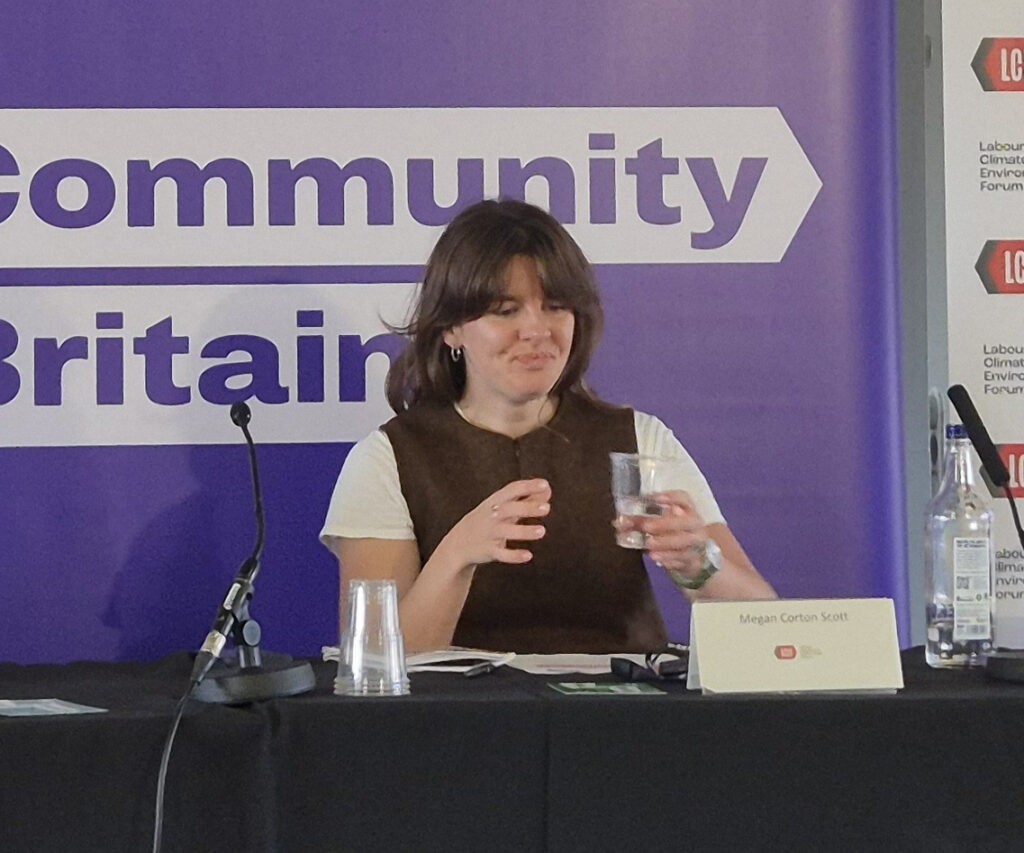
“The climate consensus is still there in general population but in four years’ time it might change,” warned Megan Corton Scott, deputy director of Labour Climate and Environment Forum.
“We can talk about big numbers and what we’re trying to do but doesn’t mean anything to people in homes worrying about bills,” Shanks admitted. “Community energy can address the view that climate action is a top-down ideology led by a liberal elite at the top, telling people it’s good for them but not allowing them to participate.
“The Local Power Plan and community energy has an enormous story to tell.”
During a Q&A, a Westmill Energy co-op board member pointed out that more positive incentives, such as preferential ability to connect to the grid, are needed to boost the sector.
Responding to this, Shanks said preferential rights require grid investment.
Other measures to support the sector will include funding for rooftop solar on social houses, and support for people who cannot invest in heat pumps.
Shanks also argues that defining community energy was a challenge, with the government keen to avoid loopholes for people to exploit the system; it is also important, he said, that communities benefit from projects built in their area, rather than something elsewhere that impacts other people.

With the right support from the government, community energy co-ops stand ready to deliver on the doubling pledge, said Josef Davies-Coates, heat and retrofit coordinator at Community Energy England.
The sector includes 600 community energy organisations across the UK, 125 of which are involved in retrofitting. “We have a strong base to build on,” Davies-Coates told a panel hosted by Co-operatives UK.
Another benefit to involving co-ops in retrofitting, he said, is trust. Plymouth Energy Community, for example, generates more referrals than British Gas when engaging households.
Retrofit, he added, brings wider benefits including poverty reduction, improved health, and lower costs, but unlocking these requires the right policies, such as long-term, multi-year funding; local authority partnerships with community energy groups; and support for holistic, area-wide retrofit schemes.
But many challenges remain, including the need for multi-skilled integrated teams, and the lack of funding for training courses on retrofitting.
Echoing these thoughts was Jonathan Atkinson, co-founder and business director of People Powered Retrofit, a community benefit society that emerged from a growing demand for practical expertise. Since incorporating in 2022, it has worked with more than 250 clients, including social landlords and housing co-ops. Atkinson emphasised that retrofitting is a collective and inclusive endeavour for which the co-op model is a perfect fit.
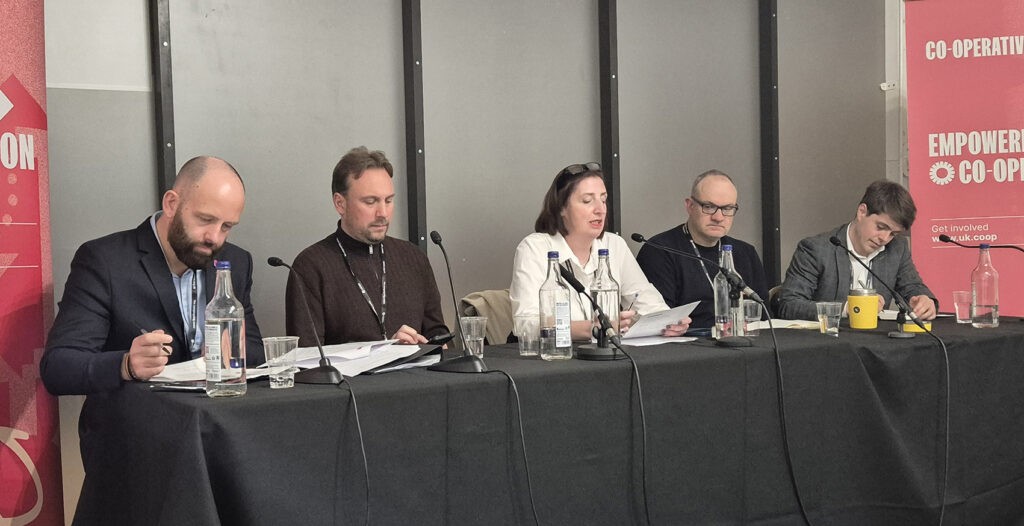
“We’re in it for the right reasons and that’s clear to the people we work with and the wider supply chain,” he said.
For the model to thrive, Atkinson recommended a holistic approach; energy and housing are run by two different departments and sometimes co-ops cannot access funding from both at once.
Strong political leadership and local authority investment is needed, he added – pointing to , Greater Manchester where credit unions working through the SoundPound consortium offer retrofit loans.
Another way the government can help is by offering paid retrofit apprenticeships, something the sector would welcome, said Atkinson.
The session also heard from Patrick Geddis, programme manager at the Labour Climate and Environment Forum (LCEF), who argued that co-ops are “not just a do-good business model” but also “an effective way of doing things”. He explained how co-ops work with individuals and tradespeople to share knowledge.
Retrofitting existing housing stocks is a huge challenge in Salford, Greater Manchester, said mayor Paul Dennet. Co-operatives must be part of the solution, he said, explaining that Carbon Co-op is already using community shares to finance local energy projects, returning dividends to members. Another barrier is the skills shortage, particularly in the context of an ageing construction workforce less able to recruit workers from abroad post-Brexit.
To address this, the mayor called for investment in training and for construction careers to be promoted more widely. He also pointed to new initiatives such as the Good Landlord Charter and local grant schemes, which, he said can incentivise landlords to upgrade properties.
Co-ops and conflict
Another fringe session explored the role of co-ops in addressing division in the UK and around the world. Hosted by the Co-op Party, it heard from Shirine Khoury-Haq, CEO of the Co-op Group; Halima Begum, CEO of Oxfam; Heather Staff, an islington councillor and policy advisor with the Refugee, Asylum, Migration Project (Ramp); and Labour/Co-op MP Anneliese Dodds, former minister for development.
“It’s a sad fact that globally, one in every four of the world’s population lives in a conflict affected zone, and all of this as a world order put in place since 1945 is changing rapidly as great powers redraw maps and the future of peoples,” said Khoury-Haq.
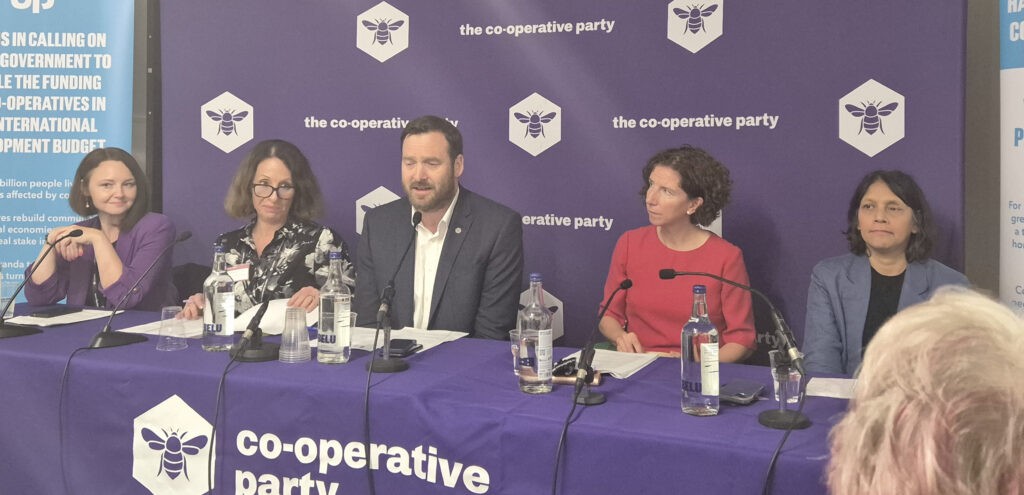
“And it’s not just overseas. It’s right here in the UK. You only need to look at what happened last summer and then again, this summer, or listen to the rhetoric from some politicians and others who have a platform and an agenda, to understand that hate and division and conflict isn’t just something that’s happening somewhere else.”
She quoted William Maxwell, president of the International Co-operative Alliance from 1907 to 1921, who said that co-operation is the antithesis of conflict.
“The White Poppy was created in 1933 and championed by the Co-operative Women’s Guild,” added Khoury-Haq. “More than that, co-operatives are builders of peace, because they help to lay and cement the foundations of that peace.”
Related: Co-op Group begins stocking lager created by Palestinian brewery
For instance, she said, co-ops provide livelihoods and stability for communities torn apart by conflict in Guatemala and bring together victims and perpetrators in Rwanda, creating a safe, practical ways for people to work side by side as they rebuild after the genocide – meaning peace is possible in fragile places.
“In each case,” she added, “it’s not grand gesture gestures, but day to day co-operation that makes progress possible.”
This was echoed by the other panellists. Staff shared her experience working with young people in post-conflict Balkan countries to build a sense of community – and challenged the co-op movement to lobby MPs who have expertise to speak out. “The best moment is now,” she said.
Begum appealed to delegates as “fellow humanitarians”.
“The hope is that this topic matters so much at a time when it feels like peace is threatened everywhere we look,” she said. “For the co-op movement, the challenge is not just to build solidarity for communities we have affinity with but also for communities we don’t have affinity with.”
Supply chains can show how to build peace when political roads are blocked, adding Begum, and empower consumers to send a message through ethical shopping choices.
She also warned about the need to address the toxicity of social media and argued that media awareness, literacy, and peace building need to be part of the national curriculum.
Dodds agreed that co-ops play a key role in peace building by building understanding and trust between communities, by enabling people to secure their livelihoods and delivering neutral support. Trade is an important pillar of international development, she said, but the role of co-ops is not well understood in international development policy circles.
“Winning the intellectual case is hard,” said Co-op Party secretary general Joe Fortune.
Audience members had some suggestions as to how co-ops’ development work could be supported further by enabling Co-op Group members to allocate funding via the Co-op app, something Khoury-Haq said would be explored.
And they pointed out that a local approach should lie at the foundation of international development, exploring knowledge of what works locally.
The Co-op Group and Co-op Party are campaigning to make co-operation a core part of building peace, with a petition calling for more UK government funding for co-ops as part of international development policy.
“What co-ops do here and around the world is give people shared opportunities, rather than use division to distract from the lack of real solutions,” said Khoury-Haq.
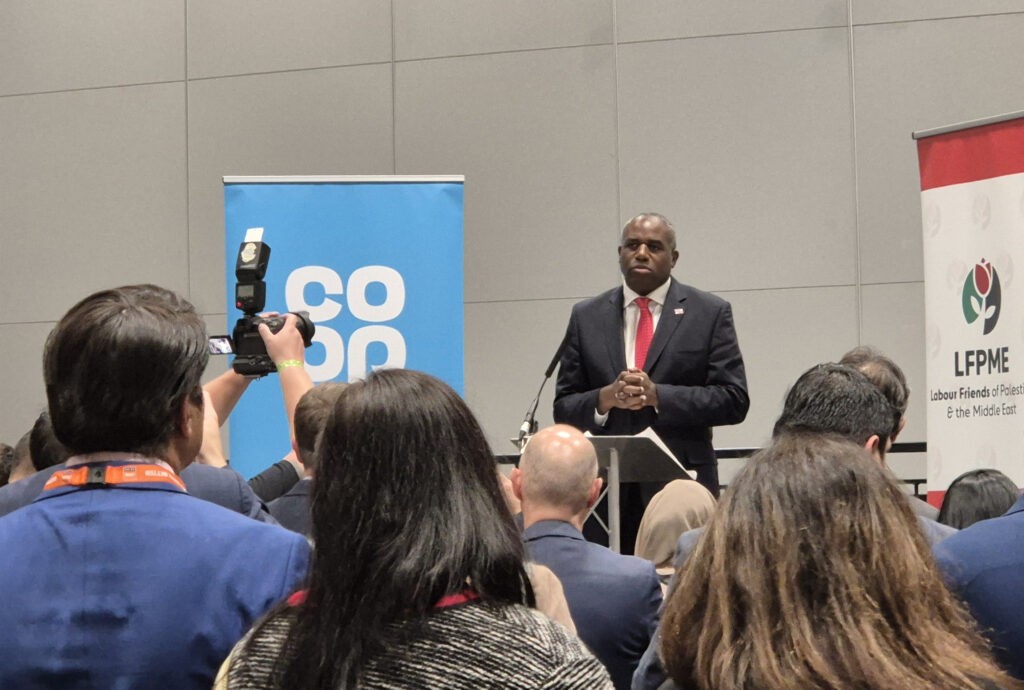
She also mentioned the potential of co-ops in peacebuilding during a fringe event held by Labour Friends of Palestine and the Middle East, with deputy PM David Lammy; Palestinian ambassador to the UK, Husam S Zomlot; and LFP ME co-chairs Sarah Owen and Andrew Pakes.
Khoury-Haq said Co-op Group employees have raised funds for Palestinian medical aid and the Disaster Emergency Committee’s Middle East Humanitarian Appeal. The Group has also recently updated its sourcing policy to phase out products and ingredients from 17 “countries of concern” by June 2025, in response to members’ requests.
The Group, now the biggest importer of Palestinian goods in the UK, is also working with suppliers to establish a tech hub in Palestine.
“For 100 years co-ops have been great advocates to peace,” added Khoury-Haq. “Because hate divides communities and we know that co-operation unites them.”
Joe Fortune delivered a similar message around the need for unity and co-operation in his speech at the conference.
Referring to Co-op Party’s Community Britain campaign, he said it “celebrates the strength of a Britain based on shared space, shared ownership and shared experience”.
This “won’t succeed by accident”, he warned. “To build a better Britain not a bitter Britain, politics needs to step up and be counted.”
Fortune welcomed last week’s Pride in Place announcement and the new community right to buy.
“We wholeheartedly reject the view, sometimes even repeated in our movement, that strong communities are a ‘nice to have’,” he said. “That is wrong, they are an important public policy tool for now.”
Fortune said the Party will focus on the upcoming local elections, with a thousand Labour/Co-op candidates due to stand.
He also highlighted the importance of the internationally adopted co-operative values and principles and that of 2025 being named the UN International year of Co-operatives.
“We will continue to fight for these [values] long into the future,” he said, encouraging attendees to join the party’s campaign to “build a more community Britain”.