An alarming 32.7% shrinkage in local newspaper coverage between 2007 and 2019 adds urgency to efforts to make independent news bigger and better. The Public Interest News Foundation’s (PINF) recent Local News Forum in Leicester looked for ways this can be done.
Set up as a charity in 2019, PINF provides research and capacity-building programmes for independent news providers, including some co-ops. In 2023, it published an interactive map of the UK’s 38 news deserts.
Salamander News
One of the largest news deserts by population was Lewisham, which, until recently, did not have a dedicated news outlet. This changed in February with the launch of Salamander News, a community benefit society that provides independent, local news for Lewisham and nearby boroughs in southeast London. The name, says founder member Dorothy Stein, a local green activist and journalist, symbolises the publication’s focus on environmentalism.
Stein, who has a background in tech, became aware of co-ops after meeting members of Cotech, a network of tech co-ops.

“I’ve always wanted to work for a co-op,” she told Co-op News after the Forum. “I believe that co-op working was a way of involving workers meaningfully but also co-operating and being fully democratic and collaborative, not just talking the talk but really implementing that.”
The existence of other co-operative and community benefit societies in the media also steered them towards the model.
“We were inspired by the news co-ops that are already out there and successful,” said Stein, “particularly the Ferret in Scotland, the Bristol Cable and the Leicester Gazette.”
Related: How a media co-op forged its own path in Argentina
Having formerly run a small green tech company, Stein was involved in climate communication – which, she says, convinced her that journalism is key to climate action. She switched careers, pursued a journalism postgraduate degree and started Salamander News. The website runs on 100% clean, renewable energy – and can be accessed by anyone for free. “Because we’re trying to be a benefit to all the community, whether they’re members or not, we decided that we won’t have a paywall,” said Stein.
“All journalism is a really precarious industry, and it’s very difficult to encourage people to pay for journalism. And that’s true across the sector, whatever model you have.”
Starting a news co-op is not the easiest task. Journalists looking to take that route should go to organisations like PINF and Co-operatives UK for support, says Stein – but even with that help, they should expect to do a lot of volunteering in the early years.
Currently, the content at Salamander is produced by a team of volunteers, including the three founding members.
The co-op has 24 members, who pay between £2 and £10 a month to join the community benefit society. Volunteer writers who contribute to the website can also become members. All members will be able to attend its first AGM later this year.
“Everybody has a voice,” said Stein, “and it really is a kind of joint project for everybody.”
One goal for Salamander is to inspire other communities to set up their own version. And Stein hopes local co-ops will back the project by becoming members.
Leicester Gazette

The Forum was hosted by the Leicester Gazette, a co-op set up in 2023 which now covers the whole of Leicestershire. Participants visited the Gazette’s new premises and were given an exclusive preview of its first print edition – due to be published later this year.
Journalist Rhys Everquill, one of the publication’s three founding members, works part-time for the Gazette alongside a team of volunteers, freelance journalists, writers and researchers.
The Gazette aims to provide “fearless investigative journalism”, says Everquill, pointing to this year’s investigation into homophobic, sexist and Islamophobic social media posts linked to Reform UK’s ex-Leicestershire County Council deputy leader Joseph Boam, who was later removed from his role.
Related: Great Central Gazette looks to revive local journalism in Leicester
With its content available for free, the co-op relies on grants for funding, with donors and 120 paying members contributing to its revenue.
The launch of a print edition, which will have a circulation of 5,000 and feature ethical advertising, is part of an attempt to diversify revenue. Despite these efforts, funding remains a big challenge, Everquill admits. But the Gazette’s team are determined to continue their coverage of crucial local matters.
“The Local News Forum this year was a fantastic opportunity for us at the Leicester Gazette to connect with other local news publishers,” says Everquill.
“It really emphasised the crucial role we all play in keeping our communities informed. Sharing ideas and discussing the challenges we face reminded us of the importance of collaboration in local journalism.
“It was a point of pride for me and the team, reinforcing our commitment to deliver quality news and work together to tackle the issues that matter to our readers.”
The team is “bursting with new ideas”, he adds – particularly around innovative ways to secure funding. “The Tenacious Journalist presentations were really inspiring, and we’ve already started brainstorming a series of journalism projects that will address some vital issues in our community.”
Bristol Cable
The inspiration for the Gazette came from Bristol Cable, a community benefit society set up in 2014 by a group of volunteers which has grown to include seven staff members, four of whom are full-time employees. The Cable team were at the forum to share updates on their new investigation into child imprisonment and the impact of excluding children and young people from society. Cable reporter Sean Morrison, who leads the investigation, received the Tenacious Journalist Award from PINF for this work. The Cable hopes to use insights from the investigation to launch a new podcast – one made for young people by young people.
Another recent project is the launch of a combined news and social networking app, available to Cable members.
“We wanted to do something which would be in line with our values, and in line with our concept of what an extension of this Bristol Cable into a conversation would look like,” Jaldeep Katwala, operations lead at the Cable, tells Co-op News.
“Some of the people that started the Cable 11 years ago were not journalists. They were community organisers. The app becomes a natural extension of all of that, it becomes a space where you can make stronger links with the community.”
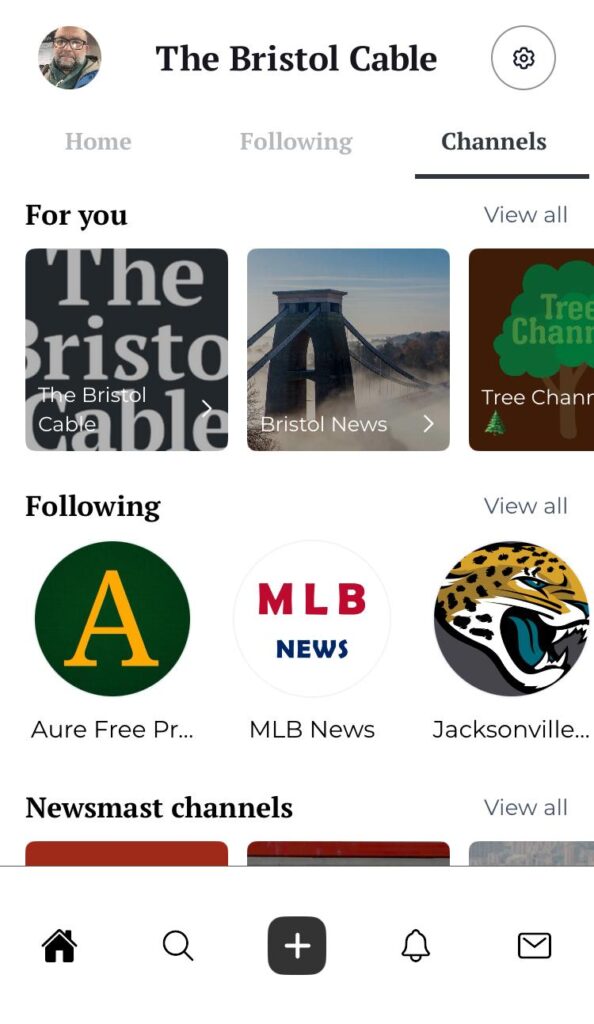
The launch of the app, which connects with Bluesky and Mastodon, also forms part of a move away from traditional social media and an attempt to engage with members directly.
“We hope that with this app, our members will be able to join in and participate in real, meaningful conversations which are not poisoned by algorithms,” adds Katwala.
“People are searching for something which is less poisonous and more fruitful, more useful which gives you more in terms of your discussion, your debate, expands your mind, but not in a way where you’re becoming polarised and you’re becoming the commodity itself.”
The idea for the app came from a conversation with educational charity Newsmast Foundation – which went on to develop it using open software – meaning that the Cable only had to cover server costs.
The app will be available to over 2,500 readers who have joined the Cable as member-owners, contributing £1, £5 or £10 a month. As part of its tiered membership model, the Cable also enables readers to become patrons by contributing £1,000 a year or more. This approach means the Cable generates 60% of its revenue from membership – but the long-term aim is to double membership to 5,000 by 2030 and become fully funded by members.
“If we have 5,000 members paying on average, five pounds a month, we will be fine financially,” says Katwala – although the app, still to be launched, is an experiment and it is too soon to tell whether it will increase membership.
“Everyone’s experimenting in some way or another,” he adds. “We’ve been going for 11 years, so clearly something about our experiment is working along the way, otherwise we would have folded up years ago. Any news organisation can’t afford to be standing still with this stuff.”
Related: Co-op media turns out for the Independent News Forum 2023
He is cautiously optimistic. “We know that we’ll build this community, we’ll have our content, and that will be what will drive people towards the app.
“If that drives our membership, well, that’s great. If it doesn’t work, we’ll have to try something else. We haven’t lost any money, but it might not work. It might not be the future, but at least we tried. That’s the point, isn’t it?”
The app certainly generated a lot of interest at the forum, with many participants keen to see it and learn from the Cable’s experience.
“We were talking to people all the time about the model, and you know, ultimately, we would like to see this model rolled out in other places,” says Katwala.
He has advice for those looking to launch their own version. “The app has to be consistent with your own values and your own look. And I think we’ve created something that’s really nice, but it is, essentially, the Cable. So, it becomes an extension of what we are already doing.”
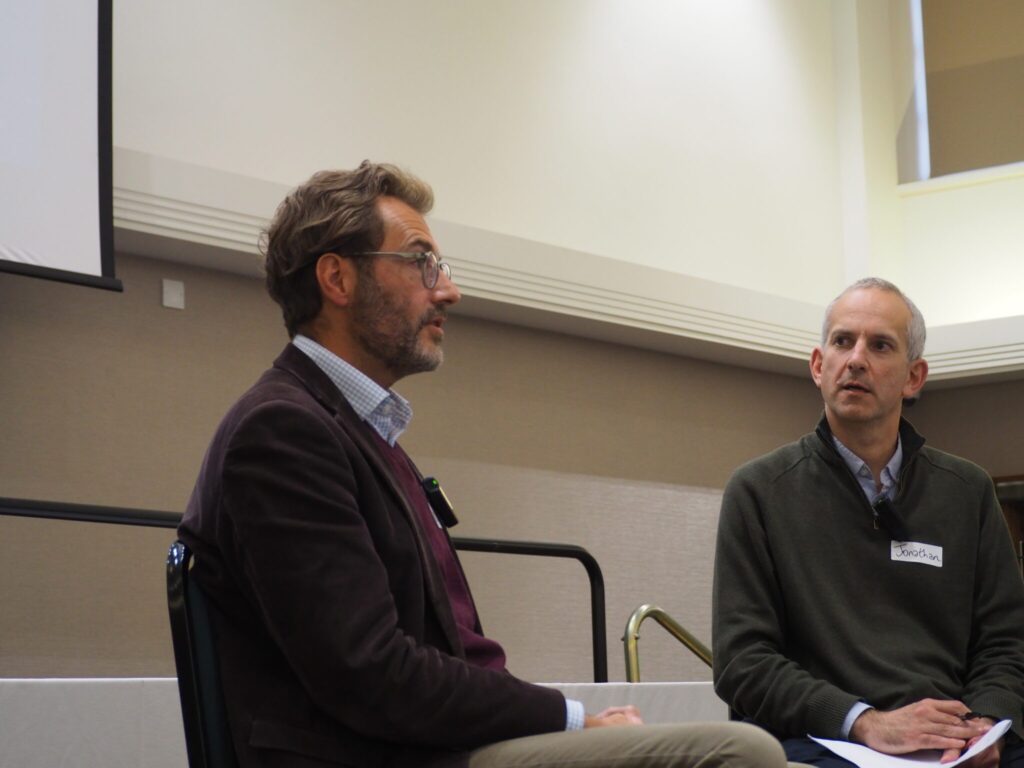
Forum participants engaged in discussions around the future of the BBC and local news.
“It’s important for us that we don’t become the last provider standing. That’s not good for democracy,” Matthew Barraclough, executive lead at BBC Local and Nations told the Forum.
The BBC’s current charter, which includes a Local News Partnership, runs out in 2027. The partnership includes a deal to employ up to 165 local democracy reporters to stories on behalf of the BBC and local news organisations.
Barraclough said the new charter is currently being developed, which means “this is the moment these big questions are being discussed”.
Ideas include the potential mutualisation of the BBC. “Nothing’s off the table,” he added, but warned that the priority, from the BBC’s perspective, is to guarantee universal access to programmes and services by maintaining the licence fee. A new charter will be proposed by the UK government after consultations with the public, the BBC, Ofcom, and other stakeholders.
Also on the forum agenda were disinformation linked to conspiracy theories, and public notice advertising.
Funding was a big concern for most publishers, regardless of their business model, with workshops exploring what a UK Local News Fund might look like. And a panel featuring social investors offered tips for independent media looking to secure grants: work together, focus on hyper-local news, and do your homework.
Negotiations with big tech continue to loom over the media landscape – with the forum held a day after the Competition and Markets Authority (CMA) slapped Google with a “strategic market status” and announced “proportionate, targeted interventions” to improve competition in the digital market.
Independent and local publishers attending the forum welcomed the news, which could give them more say in how their content is used by Google search engines.
Despite this small provisional win, the future remains uncertain for media co-ops and other independent local news providers. But while the challenges are many, from the decline in advertising revenue to news fatigue, what’s not lacking is the determination to keep going.
This article was amended on 4 November