If the UK is improve its food security – and if its agricultural industry is to prosper – the proportion of domestic food consumed needs to increase.
At this year’s conference of the Scottish Agricultural Organisation Society (SAOS), which represents Scotland’s agri-food co-ops, discussion focused around this issue – looking at supply chains, ways to increase market share and develop new products.
Allene Bruce (pictured), head of supply chain development at SAOS, pointed out that the UK imports more than £60bn worth of food and is only 62% self-sufficient, which “could make us vulnerable in times of crisis”.
The shortfall is also a business opportunity for agri co-ops: domestic farmers could earn another £2.5bn by increasing production, said Bruce. There is scope, for instance, to replace products like soya – the UK imports three million tonnes a year, mostly for animal feed, with implications for transport emissions and deforestation.
UK farmers, argued Bruce, can tackle this reliance on soya imports by developing home-grown alternatives such as pulses, peas, lupin, duckweed and hemp – although there are issues to overcome around nutritional profile, digestibility, taste, texture, scalability, price – and, in the case of hemp. regulatory restrictions.
More straightforwardly, there is scope to increase domestic production of eggs, cheese and pig meat. And thinking more creatively, domestic alternatives to matcha, the Japanese tea currently in vogue with young consumers, can be developed using fireweed.
Related: New supply chain manager for Scottish farm co-ops apex
Co-operation is key to making opportunities here, said Bruce, and SAOS is working with Scotland Food and Drink to develop new markets, looking at consumer data and supply chain capacity.
There are other challenges for food producers, warned Dennis Overton, chair of the Scottish Food Commission. Agriculture is hugely important to Scotland, he said: it generates 10% of Scotland’s economic output, and employs over 120,000 people through 17,000 businesses, “contributing massively to the fabric of rural Scotland”.
But it also has an impact on nature, with Scotland and the UK as a whole among the world’s most nature-depleted countries, ranking at the bottom 10% globally. Meanwhile, agriculture is second only to transport in terms of generating Scotland’s carbon emissions.
There are also health impacts from some of the food produced, warned Overton, and “few of us in the room are thinking enough about the impact of what we do and its effect in this domain … What we do today in the food sector is having a huge and unsustainable impact on the Scottish health sector in ways that have never been seen before. So we need to think in this holistic food system way.”
The problem, he said, is the increased amount of processed food eaten – rising by 2008 to just over half of the Scottish diet, contributing to a rise in obesity and diabetes wihich bring huge costs to the NHS.
“Data shows that Scotland has a higher prevalence of largely preventable non-communicable conditions relative to comparable European countries,” said Overton, “as well as the widest socio-economic inequalities in health in Western Europe. So that’s something that we really need to think about.”
Policymakers are trying to act on this, with the Good Food Nation Scotland Act passed in 2022, requiring the government to publish and implement a national Good Food Nation plan every five years, and similar obligations placed on local authorities.
This is a challenge for food producers but also presents market opportunities, and Overton called for collaboration between farmers, wholesalers, and distributors to create new models for getting products to local markets
His presentation was followed by a panel on the challenges of accessing markets and influencing procurement practices. Allene Bruce noted that a small producer with limited time needs to create “a small window of opportunity to actually do marketing and selling” and to develop marketing skills.
In terms of public procurement, institutions like schools may be looking to source healthier food but it is hard for growers – working in a system where food processing plants are geared to the needs of multiple retailers – to supply to them, said Bruce.
Related: Arla co-op to power all European sites with renewables
The discussion comes as food policy becomes important not just to UK policymakers but to the co-op movement – which, as Co-op news has reported, has initiatives ranging from GP food co-ops, neighbourhood food-buying groups to the co-op councils movement looking to drive community wealth building through procurement policies. In which case, these barriers are not just a problem for agri co-ops.
Public policy is key to fixing these barriers, the panel agreed – for instance by supporting local supply chains in Scotland’s island communities. And Bruce called for more collaborative efforts to develop supply chains to encourage new products.
The next session returned to Bruce’s theme of developing new products. Patrick Hughes, strategic services director at SAOS, said the introduction of novel crops offers multiple potential benefits, including improved financial sustainability, protection against market shocks, and the generation of new income streams.
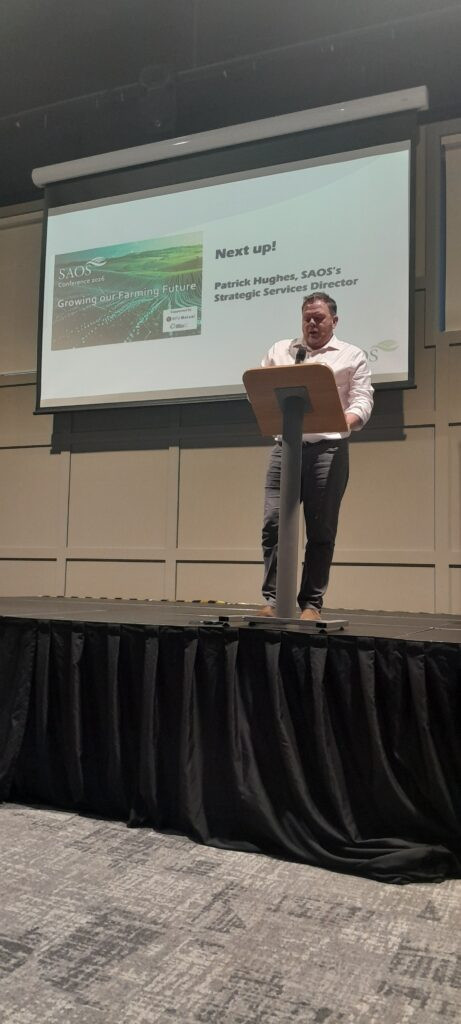
Novel crops could also offer environmental benefits in terms of soil health, reduced inputs and support for pollinators and local ecosystems – as well as offering viable alternatives to traditional crops that are potentially going to struggle as the climate changes. Examples being grown in Scotland include hemp, split peas and fava beans.
East of Scotland Growers co-op is diversifying int flax and hemp, said Hughes, with “a mission is to produce premium, fully traceable fibres for the global textile market”. Hemp can also be used as a construction material, to create carbon-neutral buildings, and as a peat-free growing medium in the soft fruit industry.
Another focus of innovation for agri co-ops, added Hughes, is the “untapped potential” of agricultural by-products, such as the leaves and stems of potato plants, with research being undertaken into extraction of compounds for the nutraceutical, pharmaceutical and engineering industries. There is similar potential to utilise waste products from fisheries – where half of every cod landed is currently thrown away. There is even the potential to use collagen from fish to develop a substitute for skin, for medical use.
Co-ops make ideal delivery partners for such projects, Hughes argued. “Working co-operatively can scale things up quickly. Once something works, they’ve got the network, they bring the trust factor to members who listen to advice that comes from their co-op … and they help make sense of new ideas, translating research or data into something you can actually use in the field.”
Partnerships are crucial to developing local supply chains and new products, said SAOS CEO Tim Bailey, closing the conference.
“We have a Scotland food and drink partnership strategy. We need a similar partnership in terms of the agriculture itself – and that’s where they move to agriculture driving the agenda and allowing government to ride it alongside it, rather than assuming government will come to their rescue.”
Political will is also needed, said Bailey – for the government to acknowledge the benefits of cooperation and offer support.
And “we need industry as a whole to step up and recognise that change is a necessary fact of life, and use that change to secure more commercial freedom and as a result of that, and deliver more economic, environmental, social change.”