Danaya Bogdanova is an energy communities coordinator at Azimut 360, a Barcelona-based co-operative founded in 2009, an engineering co-operative specialised on solar PV technology, and also expert in energy communities. She now coordinates projects between Azimut 360 and local second degree co-operatives and organisations, such as Batec, Civic Energy and Coòpolis, and has recently taken on responsibility for the co-operative’s communications strategy.
How did you first find out about co-operatives?
At first I had no idea about co-ops. I came from Eastern Europe, where co-operatives have a kind of negative connotation – like having no property, and violence. I migrated to Spain to do my Master’s in sustainable urban design, because I always knew I wanted to work in sustainability and energy transition. When I graduated, as a young migrant, it was quite complicated to find a job, even though I had a good education. Azimut 360 was doing a free course for energy community agents at the time when I was about to graduate, and I enrolled because I felt it was interesting. After that course, some time passed, maybe half a year, and we got in touch again, and they hired me. Now I’m on a trial period to become a full member of the co-operative, so I have been learning from scratch about the internal processes, such as general assemblies and voting.
Tell us about your role at Azimut 360 – what does a typical day look like for you?
Over the last five years, energy communities have appeared as a new concept, and in Spain they’re based mainly on solar energy. They need technical support, because solar installation is complex, and Spain still lacks a legal framework for community energy. Azimut 360 started providing that technical service, but we saw that we couldn’t just arrive and install solar panels – you need to talk to people, and educate them. That’s how my role appeared. Azimut 360 then started collaborating with two more local co-operatives – one doing legal management, one working on energy efficiency, biomass and other clean energy technologies – because energy communities are normally complex projects and each community comes to us with a unique set of needs and ideas.
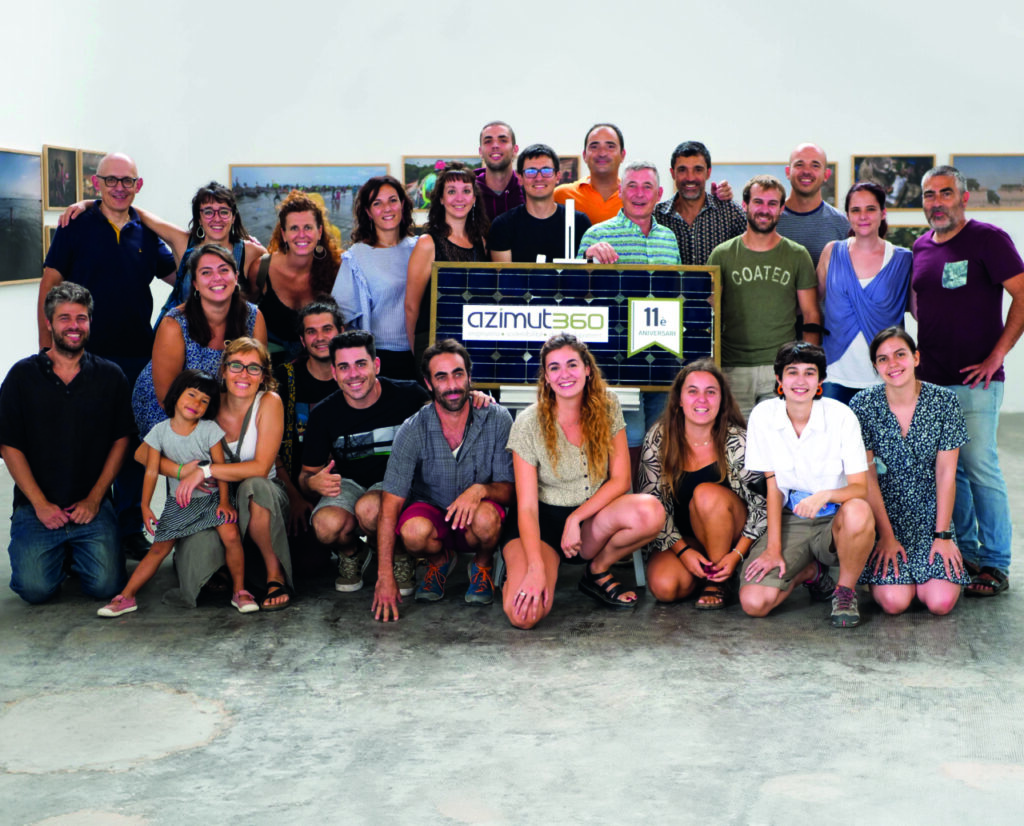
We have to design a tailored tech and legal strategy for each energy community, knowing that while one may prioritise solar PV, another would be more interested in biomass, the third essentially wants to have a co-operative shared electric vehicle and community owned charging points. The diversity is incredible, so as expert co-operatives, we prefer to work together in order to provide energy communities with all they need. That’s how Civic Energy appeared: Azimut 360 was one of its founders. Nowadays Civic Energy is entering another co-operative structure called Batec, where Azimut 360 also takes part as a member, to unite its forces with even more co-operatives. So, one of my current roles in Azimut 360 is to coordinate the projects between Azimut 360-Civic Energy-Batec teams.
As for a typical day, it is not an easy one to describe fully – my role has been constantly changing, as the reality of Azimut 360 has been as well. Right now I’m not only co-ordinating energy community projects. I’ve also recently taken on the role of communications manager, leading the transformation of our communications strategy. That matters because of two reasons: firstly, even in Catalonia, a co-operative can get the message that we are not as professional or organised as other companies – just because we are a co-operative. We have to fight against that and explain that we’re experts despite being self-managed and democratic (this may sound ridiculous but that’s a real prejudice sometimes) – we’ve been in the field for 17 years. We actually do have to explain that being a co-operative doesn’t mean we’re against the market system or that we’re rebellious or anarchistic organisation.
The second reason why we are working on our communications so hard right now is that Azimut 360 has grown a lot in the past few years. We have a big team, working in the National and International departments, our team includes engineers, installers, maintenance specialists, project managers and consultants. Now we are “learning” ourselves again, discovering this new upgraded identity of Azimut 360 – and, as a consequence, learning how to communicate us to the world. I feel that I am incredibly lucky to be a part of this challenge, leading this change side by side with my colleagues.
Finally, as a member on a trial, this year I have also given support to my colleagues leading the coordination of several internal projects.
What challenges have you faced so far?
Being a young migrant woman is a challenge in itself. From the first working day I had to learn a lot, and very quickly. When I arrived in Barcelona, I was a fluent Spanish speaker, but my Catalan was yet to be improved – and this language is crucial in Catalonia, especially for those who work with social and community projects, as I do! However, Azimut 360 still hired me when I applied for a project manager position, and gave me all the support I needed, even though there were risks for them as employers, because I was still learning the language and the legal systems of Spain and Catalonia. My position as an energy community coordinator means I have to work with neighbours and local administration, so my projects are all locally rooted, and I definitely don’t look “local”. Whenever I start a new project, my clients and I have to go through several days of getting to know each other and building trust. Now, after 5 years of migration and 2 years in Azimut 360, I’d say I feel more “Catalinized”, but when I just graduated in 2023, finding a job was extremely complicated. I’d say that in the whole labour market of Barcelona, my co-operative was the most progressive and open-minded in their hiring strategy, and I felt very welcomed from the first moment. Our team is very international, and culture mix is our reality – and you only fully understand the privilege it is if you are a migrant yourself.
Working with energy communities has been a challenge too. You can create a co-operative in Catalonia quite easily – ‘Social and Solidarity Economy’ is a common term here – but an energy community in the form of a co-operative is still a new legal body, so few experts actually know how to establish one. I remember founding a co-operative energy community in a rural village with fewer than 5,000 inhabitants, and when we went to register it, the legal advisor reading our statutes said: “I’ve worked in this field for 30 years, and I’ve never seen this kind of statutes” – because it was a co-operative that essentially wanted to generate and share energy.
What is your proudest achievement so far?
Working with energy communities, we’ve created several, it’s a long process. Last year I was looking at neighbourhoods in Barcelona, and one caught my attention: close to Collserola mountain, there’s a neighbourhood with no energy projects at all. I went to talk to the neighbours, and they were quite responsive. Within a year of hard work, meetings, and knocking on doors – we created a new energy community from scratch. They’re now an association – not a co-operative yet, we’re taking it step by step – and we’ve applied for several subsidies. The neighbours explained to me that even though their district officially belongs to Barcelona, they still experience regular power cuts and aren’t always sure they’ll have electricity at the weekend. That was a shock to me, because we’re talking about Barcelona, capital of a prosperous province of Spain.
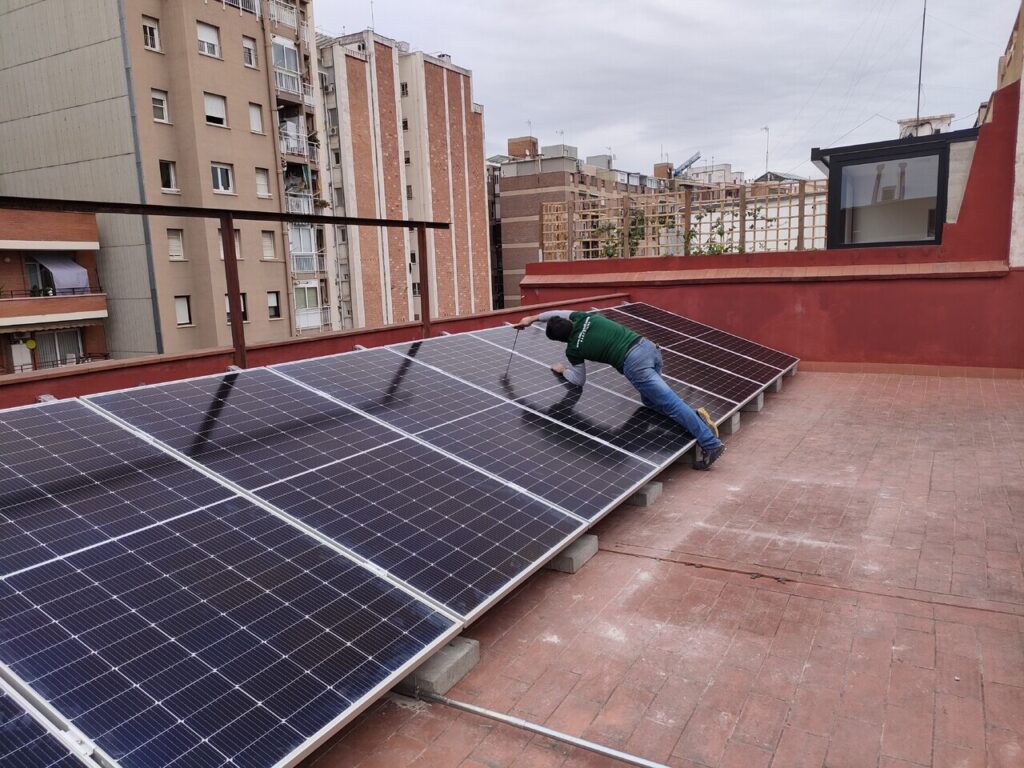
Our international department works in North Africa, on small islands of the Pacific, in Latin America regions where power cuts are usual. For example we help health centres to get off-grid PV installations and secure their access to clean energy. We know about this global challenge a lot. Still I wasn’t aware that this could be an issue in Barcelona too – but the reality is that Barcelona has these privileged central neighbourhoods, and the peripheral ones are sometimes invisible. For me, creating an energy community in the mountainous neighbourhoods of Barcelona was a great achievement, and I’m really looking forward to seeing this energy community grow and improve the local quality of life.
You recently attended the Youth Voices, Co-operative Choices event in Budapest. How do you feel as a young member of the co-operative movement?
I’d say inspired. Sometimes working in a co-operative you may be frustrated, because there are lots of tasks, but I’m very inspired, because within our co-operative I’ve always been able to communicate my doubts and my crazy ideas, to my responsible person and to the board. We never say “boss” – we have responsible senior specialists instead. When I detect a field where we could improve our internal processes, I’m really inspired by the fact that I can criticise it harshly, and I’ll be listened to.
One of the innovations in internal management of Azimut 360 is an annual contest where everyone is welcome to present proposals to improve internal processes, explore new technologies, or write an article, for example, and every year we grant a sum of money to the winners. This contest has allowed our workers to explore their potential and work on the initiatives that really excite them.
As a young professional still learning her ropes, sometimes I get a little scared, because there’s a lot to do, but I’m also inspired, because when you come with a proposal and you’re ready to work on it, your colleagues give you the space to experiment. I’ve worked in companies in my home country that were much less democratic, where you just had to finish the tasks you were given in a top-down way, and no one was interested in your voice. But here, you can talk to people who have 15 years of experience (I have two!) and tell them they’re not right, and we will talk about it. That’s amazing.
What are your hopes for the future of community energy, and the co-operative movement as a whole?
In terms of energy communities, I think about Catalonia first because that’s where I live and work. I hope the legal framework makes it easier for us to create and develop Energy Communities and other local energy projects. I hope energy communities will just become more common, and everyone will have examples to learn from, and everyone will be able to learn from the pioneers. Right now, all the energy communities we work with are pioneers – we start doing something that no one has done before. I hope we build up that practice until it becomes an established process. As for co-operatives – I basically fell in love with Catalonia because of its co-operative movement and its culture. If people don’t want a tree to be cut down by the municipality, they’ll gather, start a campaign, and surround the tree, and no one will cut it down. Catalan people are very empowered in this sense, and I love to see it. Co-operatives are very natural here, so I hope that will just keep growing, and that all the networking we’re doing with other co-operators will give its fruits.