Co-operatives UK held its inaugural National Youth Summit in 2024, aiming to empower young people. That year it also launched its Youth Advisory Group (Yag) – and through that established a foundational platform for members aged 16–30 to engage with the co-op movement.
Since then, the Summit has evolved – and this year for the first time it ran fully integrated with its annual Co-op Congress, rather than as a standalone event. Around 90 young people attended, helped by a new half-price youth ticket for the Friday, sponsored in part by the Co-op Bank, East of England Co-op and One Family.
“The key feedback from last year was that it wasn’t interactive enough … people wanted more workshop-based sessions instead of a mini-congress,” Louis Burnay, youth engagement officer at Co-operatives UK and summit programme leader, told Co-op News after the event. “Panels can be great, but you have to really get them right. And young people especially, they want to speak to each other, meet people, and solve problems.”
Empowering young people is a central pillar of Co-operatives UK’s strategy, and Burnay’s role is joining up the work of the Yag, the Summit and wider membership activities. Over the last year, he has been mapping co-op-adjacent spaces and finding new ways of introducing the model to young people who are already engaging or organising through other networks, such as businesses, charities or social enterprises.
Related: Young European co-operators gather to discuss economic democracy
“Setting something up as a young person and actually incorporating can be quite a stressful thing, especially if one or two people are putting their name as a director,” he says. “The benefit you have of incorporating as a co-operative is that you’re sharing that burden: co-ops formalise that organising energy amongst young people.”
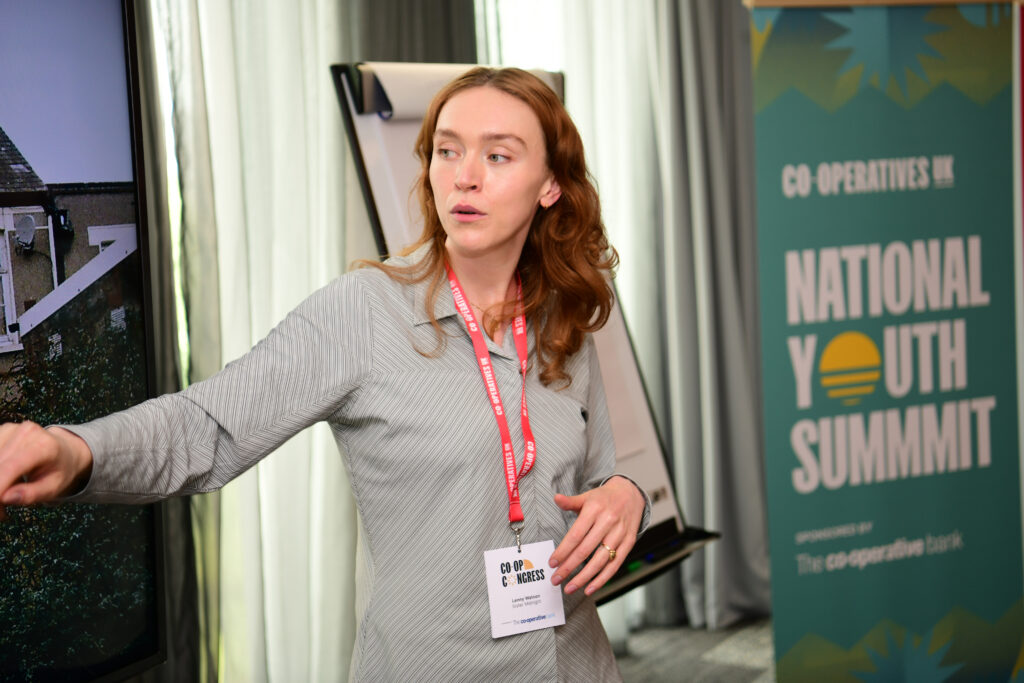
Burnay discovered co-ops after hearing Lenny Watson, co-founder of Sister Midnight co-op, speak about the model at a music festival.
Sister Midnight is working to establish South London’s first community-owned music venue, and Watson spoke at the Summit about community ownership and “third spaces” – the pubs, clubs, community centres and venues that exist outside home and work.
These spaces are seeing a sharp decline: since 2010, roughly 800 libraries, 1,200 youth clubs and 35% of music venues have closed. But, says Burnay, reclaiming these spaces through community ownership could be “a real opportunity for young people”.
Related: Q&As from the National Youth Summit
Other sessions at the Summit tackled specific problems – work and employment, place-making, health and social care – as well as active sessions on participatory democracy, setting up a co-op, community energy – and a badge-making session so popular it had to turn people away.
Dividing sessions into different challenges worked well, says Burnay. “It was good to see people go, ‘Okay, here’s the problem, and I’m in this co-op space not because I’m obsessed with governance or I love the history of co-ops, but I see it as a really viable solution to organise and solve this problem’.
“I’m always so impressed because [these young people] are taking out their Saturdays and coming to these events – they’re not being paid to be there, they just really, really care about what they do, and they’re working so hard to grow their own networks. I guess in part it’s also a reflection on how little opportunity there is out there at the moment.”
Positioning is key to attracting youth, he adds. “I know there’s some scepticism about positioning [co-ops] too far into the social enterprise movement because then you’re moving away from the key values and principles. But I don’t subscribe to that … It’s normalising co-ops, especially with young people who see the jargon and then think ‘Oh my god, that’s too much. I don’t want to do that.’
Related: Reports from the UK Co-op Congress
“There is so much value in co-ops – and it’s about uncomplicating it and sharing how they are successful, help with longevity, build relationships and democratise a lot of what people are already doing.”
Broadening access and pathways for young people coming into co-ops is a core workstream of the Yag, whose current members range from ages 17-25, and whose remit is to shape what Co-operatives UK does to ensure it aligns with the needs of young people.
Yag member Victor Agbontean (main image) told Congress: “Some of us work in co-ops, and some of us are involved in community organisations, and some have come through youth work or youth activism, education or local projects. But the main thing I always reflect on is that we’re all here because we believe that young people have a role to play in the future of the co-op movement.”
Agbontean made it clear that young people’s pathways into the co-op movement should sit “right at the centre of what this movement says and wants to achieve”.
Drawing on personal experience, he described how “too many young people feel invisible and disconnected”, often locked out of the spaces, resources and networks that helped earlier generations get started. It took a single youth worker who believed in him at 15 to change Agbontean’s story, he said, and challenged delegates to play that role for someone else.
Young people need spaces “created by them for them”, he added, including places to experiment and “fail in a comfortable way” without lasting consequences – and warned that too often these doors are being shut too early for young people.
He said: “Young people really need a future that feels accessible. I think this should matter deeply to the co-op movement. If we want to develop and grow this movement we must widen the entrance so that more young people can find their way in.”
This year, the Yag has been working on a Youth Charter. “This is about setting out what young people need specifically from the co-operative movement,” said Agbontean, “and what the movement can do to support the young people to participate, to lead, to build it.
“It’s not just about inviting people, it’s about asking what needs to change so that young people can get involved.”
Due later this year, the charter sets out a series of recommendations and project proposals that will bring together Co-operatives UK, the Yag and co-op members to create better pathways.
Key proposals include delivery of a peer-led mapping of the participation and experience of young people to co-operatives across the UK, led by young people; a practical toolkit to support co-ops in engaging young people; a movement-wide education in schools and universities and tools for those outside mainstream education; and a youth-led, co-operatively owned, democratically governed youth space.
“Essentially, the charter’s purpose is to work towards youth participation and improve access routes,” said Agbontean. “We will be opening a call for members who would like to pilot or support this work, and help us answer to question of how to make the co-operative movement more open, more visible, more tangible, and most importantly, more impactful for young people.”