Women are the backbone of Malawi’s agricultural economy but remain systematically under-recognised and under-supported. They make up over 70% of the agricultural labour force, producing around 80% of food for household consumption – but only 20% of women hold land titles in their own names, and they access just 10% of available agricultural credit.
This imbalance is driven by a combination of structural barriers: unequal land rights under customary systems, limited access to finance and agricultural inputs, lower access to training and extension services, and social norms that continue to undervalue women’s work and limit their decision-making power. As a result, the women who sustain Malawi’s food system are often those with the least control over the resources and opportunities that would allow them to thrive.
This glaring inequality lies at the heart of the United Nations International Year of the Woman Farmer (IYWF 2026), which is designed to recognise women’s roles in agrifood systems, and accelerate action on the barriers they face.
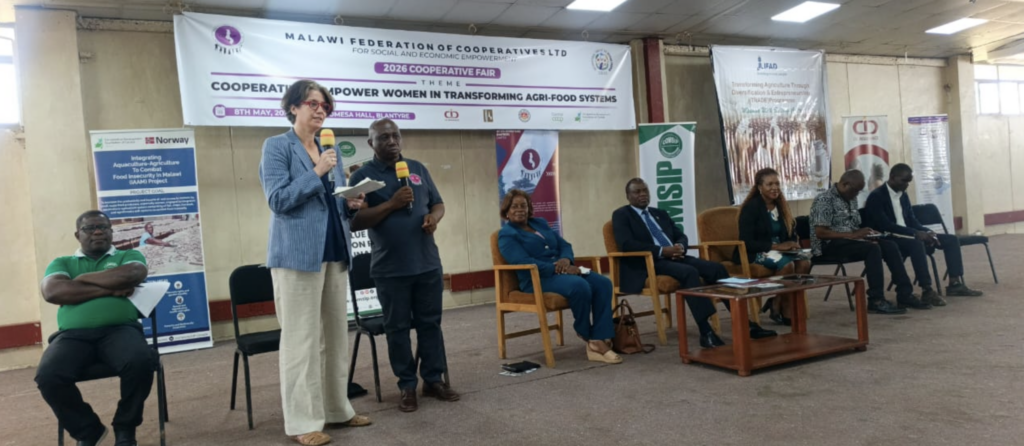
It’s a global call which resonated strongly at Malawi’s second National Cooperative Trade Fair, held last month in Blantyre, the country’s second city. I attended the event on behalf of OurCoop’s Our Malawi Partnership, which is working to strengthen trade between co-ops and build more equitable value chains between producers and markets.
Related: OurCoop marks International Women’s Day with look at Malawi Partnership
The event was honoured by strong national participation, including Dr Bright Molande, permanent secretary for Industrialisation; Jacinta Chipendo, director of co-operatives, and Ann Lipipa Chikoko, UN programme specialist on women’s economic empowerment.
As speakers at the Blantyre fair emphasised, IYWF 2026 is not an abstract global agenda in Malawi; it is a national reality. “Globally and here at home, women farmers remain undervalued and under-supported,” said Lipipa Chikoko, who called for stronger action to “make women visible, amplify their voices, and drive action for gender equality in our food systems”.
The choice to mark the IYWF through a co-operative trade fair was deliberate: it positioned women not just as beneficiaries of development, but as economic actors, producers, entrepreneurs and leaders within agricultural value chains.
Invisibility and structural barriers
A recurring theme was the need to recognise the full diversity of women’s roles across agriculture. Women farmers in Malawi are not a single group, said Lipipa Chikoko, they are a vast and varied constituency including “the smallholder growing maize in Zomba, the beekeeper in Mchinji, the fish processor at Lake Chilwa, and the young woman using solar driers in Thyolo”.
Critically, she added, this also includes women working beyond formal definitions of farming, from traders and processors to informal labourers and rural entrepreneurs. “Whether they own land or not, whether their work is paid or unpaid, they sustain families, communities, and our nation.”
This broader understanding challenges traditional assumptions about who counts as a farmer, and who is prioritised in policy and investment.
While speakers agreed on the common challenges, they also converged on a common solution: co-operatives as a practical pathway to economic and social empowerment.
According to Mafeco, co-operative structures provide women with tools to overcome systemic barriers.
“Co-operatives promote the mobilisation of human and financial resources, help women to share knowledge, and reduce business risks,” said John Mulangeni, executive director of the federation. “They also strengthen access to markets by enabling women to act collectively, increasing their bargaining power and creating more structured, reliable market opportunities.”
Crucially, co-ops open pathways to value addition, allowing women to move from raw production to processing, packaging and formal retail supply chains. Examples shared at the fair included cassava co-operatives supplying supermarkets and women-led dairy groups linking into national processors.
The impact goes beyond income. Zakiya Akimu, a woman farmer from Mikoko Cooperative in Machinga district, said: “When women participate in co-operatives, the benefits extend to families, communities, and the wider economy as women reinvest in household wellbeing, education and nutrition.”
While the fair celebrated achievements, speakers insisted the IYWF must lead to tangible change. At policy level, this means moving beyond commitments to implementation, ensuring national agriculture and gender strategies translate into real resources for women farmers.
“Recognition without resources changes nothing,” Lipipa Chikoko warned, calling for budget allocations that reach women in co-operatives and rural communities. At practical level, proposals included improving access to finance, expanding extension services, and investing in climate-smart agriculture and post-harvest technologies.
Related: Malawi Partnership continues to thrive
Lipipa Chikoko also suggested the introduction of monthly thematic actions aligned with Malawi’s farming calendar, from reducing post-harvest losses and improving seed access to strengthening financial literacy and market linkages.
In terms of the longstanding barriers facing women farmers, Bright Molande highlighted how “structural inequalities continue to limit women’s access to land, finance, training, technology, and decision-making spaces” – which undermines national food security and economic development as well as individual livelihoods.
Addressing them requires coordinated action across government, financial institutions, co-operatives and development partners, as well as a shift in social norms around gender roles..
The power of collective organising
A powerful theme emerging from the fair was the importance of collective organising.
Drawing on comparisons with faith-based women’s networks, Lipipa Chikoko highlighted how coordination and structure can amplify women’s voices and influence, adding: “Imagine that same organising power applied to economic life.”.
This is precisely what co-operatives offer: a space where women can build economic strength collectively, while gaining confidence, leadership experience and a stronger public voice.
Trade fairs like the one in Blantyre play a key role in this ecosystem, as marketplaces and platforms for networking, learning and visibility.
Beyond 2026
While the IYWF provides momentum, speakers emphasised that lasting change will depend on what happens next. Participants agreed on the need for stronger coordination through national platforms, ensuring that initiatives launched during the year are sustained and scaled over time.
And for Malawi’s wider co-op movement, this means embedding gender equality into long-term strategies, ensuring that women-led co-operatives are supported beyond 2026. The message was clear: investing in women farmers is not a niche issue, but a national priority with direct links to the country’s long-term 2063 development vision (MW2063).
“Malawi cannot achieve MW2063 without women farmers,” said Lipipa Chikoko, adding that women farmers are producers of food, drivers of rural economies, custodians of knowledge and key actors in building climate resilience.
The co-operative model offers a proven pathway to unlock this potential, but only if backed by sustained investment, political will and strong partnerships.
As one woman farmer said: “The co-operative model is a trusted vehicle to empower us, women farmers, in improving agrifood systems across Malawi.”