A 1.4MW solar co-op has opened in Goulburn, New South Wales, promising enough clean electricity to power 500 homes.
The site, which has 4MW/hr battery storage, is the first community-owned solar plant in Australia. It was developed through a partnership between local community members, the Goulburn Community Energy Cooperative (GCEC), Community Energy for Goulburn (CE4G), delivery partners and the state government.
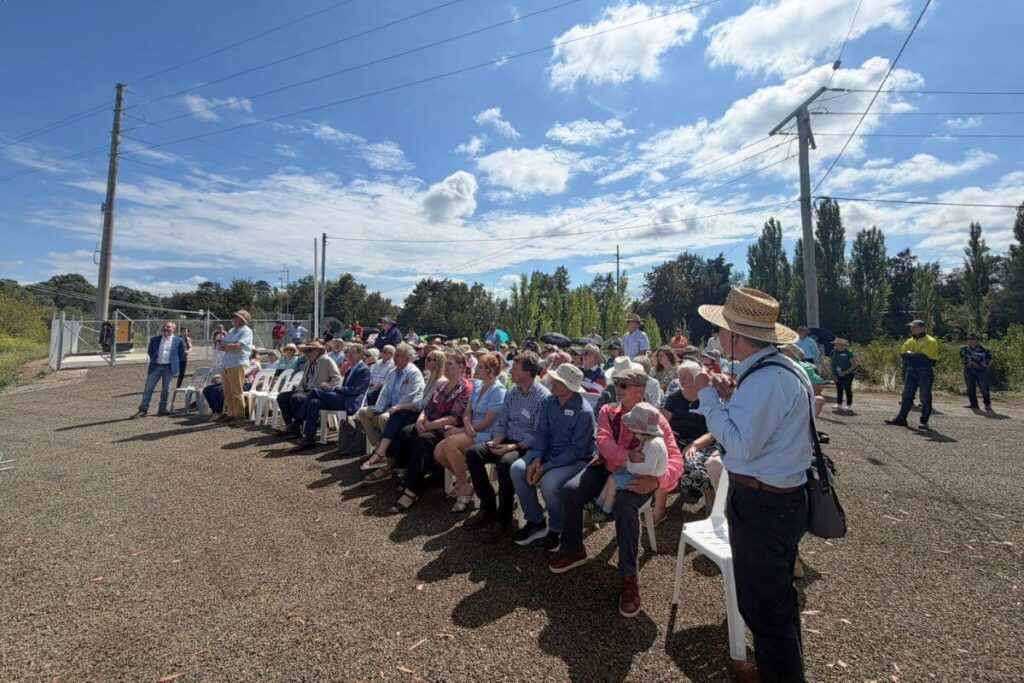
A ribbon-cutting ceremony at the plant, on the western side of the Canberra to Sydney railway line, was performed by Business Council of Co-operatives and Mutuals CEO Melina Morrison, GCEC chair Andrew Bray and MP David Mehan, representing the NSW treasurer.
“You started with an idea,” Morrison told co-op members in her speech, “and now you own an energy asset. Your idea was visionary – you were responding to the future crisis a decade ago.
Putting the launch in the context of the global and Australian co-op movements, she added: “You have walked together, showing together we are stronger.”
The gestation of GCEC began more than a decade ago, when locals came together to act on climate, energy and their community’s future. The team of volunteers faced a number of obstacles along the way, including shifting policy settings, regulatory delays, the Covid pandemic and rising construction and finance costs.
Related: Co-operatives and the global energy crisis
BCCM is highlighting the project as evidence of “the capacity of co‑operatives to mobilise community capital at scale”.
Around 300 local and community investors have contributed more than $2.5m to the project, alongside more than $2m in government grant support. “These member‑shareholders are the true and often unsung impact investors in Australia’s clean energy transition,” said BCCM. “Members invest not only for financial return but for place, purpose and future generations. Because the co‑operative is 100% community owned, value stays local and economic benefits circulate through the region.
“This is the co‑operative difference: capital aligned with community benefit, governed democratically on a one‑member‑one‑vote basis.”
The apex added: “This approach strengthens confidence not only in energy reform but also in other essential services where trust has eroded, including housing and social care. Co‑operatives provide a proven ownership structure for delivering services where communities feel excluded or let down by conventional models.”
David Mehan, parliamentary secretary to the NSW Tteasurer, highlighted the deep regional benefits of the co‑operative model and its central role in ensuring returns stay local.
“The co‑operative model has grounded this project in the region,” he said. “It has anchored it ethically and in the way it has been delivered – from using local businesses to keeping benefits local. Around 80% of profit remains in this community. Few renewable energy projects in NSW can say that. The co‑operative model has made it possible here in Goulburn.”
GCEC, a member of the BCCM, takes part in the apex’s Energy Co‑operative Forum to support other community energy projects.
Related: Guide launched for Australian community energy sector
“Far from being an outlier,” said the BCCM, “GCEC has become a pathfinder – showing what is possible when communities are trusted, supported and empowered to lead.
“The BCCM continues to advocate for a better policy environment so other communities can follow this model. This includes addressing barriers that GCEC and other co‑operatives face, such as the tax treatment of energy grants and regulatory systems designed for large corporations rather than democratic, community‑owned enterprises.”
Policy recommendations for state governments from the apex include strengthening community investment by modernising co‑operative legislation and streamlining approvals, ensuring communities do not face higher hurdles than large corporations when they invest collectively in their own infrastructure.
“International experience shows what supportive policy can achieve,” added the BCCM, pointing to the UK Labour government’s commitment to doubling the co-op and mutual economy, and its £1bn Local Power Plan.
“The lesson for Australia is straightforward,” it said. “When governments recognise co‑operatives as engines of investment, inclusion and resilience, communities lead and investors follow.”