Guatemala, a nation bracketed by the Pacific Ocean and Caribbean Sea, with Mexico to the north and Belize, Honduras and El Salvador to the east and south, is the only Central American republic where an indigenous culture constitutes a majority of the population.
The Maya are the largest indigenous group in the country, with 21 different Mayan communities making up an estimated 51% of the national population, while the wider indigenous community comprises 22 different peoples, including K’iche’, Kaqchikel, Mam and Q’eqchi’.
It has the largest economy in Central America, but also suffers from poverty and inequality; nearly 60% of the population live below the national poverty line. Indigenous women in particular face overlapping challenges of gender inequality, ethnic discrimination, rural poverty, and climate vulnerability.
“They have limited access to economic and financial resources, weak access to markets and the unequal burden of domestic and care work,” says Ileana Valeska Sarmiento Castillo. “At the same time, they are facing the impacts of climate change, migration and discrimination.”
Sarmiento Castillo works as marketing coordinator at Asociación de Desarrollo Agrícola y Microempresaria (Adam) – the Association for Agricultural and Microenterprise Development, established in 1998 to improve the living conditions of vulnerable populations in rural areas of Guatemala.
“We promote sustainable practices and programmes designed to support organised small-scale agricultural and non-agricultural producers by focusing on the sustainable development of communities, promoting actions that encourage economic growth, environmental conservation, and social wellbeing,” she says.
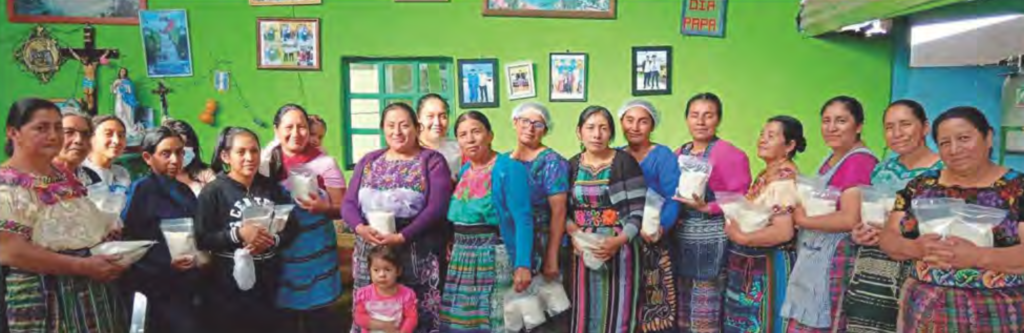
Its vision is to achieve local economic development that leads to a more just and solidarity-based world.
“We work with grassroots organisations made up entirely of indigenous women who are organised in groups of 20 to 50 members working in agriculture across several municipalities in Quetzaltenango, a department of Guatemala located in the western part of the country.”
Her main role is to support women’s groups throughout the entire process of solidarity economic circuits or value chains, to improve productive processes and ensure their products can achieve the quality and safety standards needed to reach market spaces.
Related: Woccu’s Rally the Movement campaign expands to Guatemala and Kenya
Alongside gender justice and product development, Adam also works in areas such as humanitarian aid and risk management, food security and sovereignty, nutrition and early childhood development, and water and sanitation. Currently, it works with 247 members in 10 indigenous women’s organisations.
“Being a member of Adam has many advantages compared to working individually or in isolation,” says Sarmiento Castillo, “like greater collective strength and the ability to access training and shared learning. By working together, they can pool efforts, knowledge, and resources to address common challenges in agriculture, marketing, and family economics.”
They also have access to more support, she adds, “because many institutions, donors, and government programmes prioritise supporting community organisations over individuals, as the impact is greater and more sustainable”.
But most important is the support and solidarity that comes from co-operating. “These women do not face challenges alone; there is emotional support, motivation, and mutual aid among peers.”
Challenges vary from structural barriers to complications caused by geo-political situations, including the current conflict in the Middle East. Guatemala has fertile soils and a number of different microclimates supporting a wide variety of crops. The agricultural sector represents over 10% of national GDP, and the United States is its largest trading partner, accounting for nearly 40% of its total trade. But despite its productivity, the sector depends heavily on imported inputs such as fertilisers, agrochemicals, irrigation systems, machinery, and improved seeds.
Because of the Hormuz Strait blockages, farmers in Guatemala are facing rising transportation costs (for agricultural products, inputs, and food to and from communities have increased), rising agricultural production costs (in particular, the fuel used in machinery, irrigation systems, and crop transportation) and higher food and basic product prices.
“International conflicts and rising fuel costs do affect us, though to a lesser extent than conventional agriculture,” says Sarmiento Castillo. “We also face various climate-related challenges that affect production, food security, and family economies.”
These include prolonged droughts, which reduces water availability for crops and consumption; heavy rains and flooding, causing crop losses, soil erosion, and damage to rural infrastructure; shifts in agricultural cycles due to climate variability, affecting planting and harvest times; soil degradation and erosion caused by deforestation, monocultures, and poor agricultural practices; and increased agricultural pests and diseases related to changes in temperature and humidity.
“Adam responds collectively and in a differentiated way to social, economic, and climate challenges through territorial, solidarity-based, and community approaches that strengthen the autonomy of rural and indigenous women,” Sarmiento Castillo adds.
“We support the collective organising of women through associations, producer groups, and co-ops that promote mutual support and community decision-making, and encourage social and solidarity economy processes that prioritise community wellbeing over individual profit.”
Promoting the participation and leadership of indigenous and rural women in organisational and community spaces is also vital, she adds, as is developing comprehensive training and accompaniment processes in leadership, organising, rights, production, and economic autonomy, and building territorial articulation networks among organisations, communities, and institutions to collectively address common challenges.
“Adam also plays an important role in the community by strengthening intergenerational farming processes, promoting the exchange of knowledge, family participation, and community sustainability,” adds Sarmiento Castillo.
“We facilitate the transfer of ancestral and agricultural knowledge, promote the participation of women, youth, and older adults, strengthen the continuity of agroecological and cultural practices, contribute to family and community food sovereignty, advance youth leadership and generational renewal.
“But most importantly, we promote the values of co-operation, solidarity, and collective work, and foster respect and appreciation for indigenous and community knowledge.”