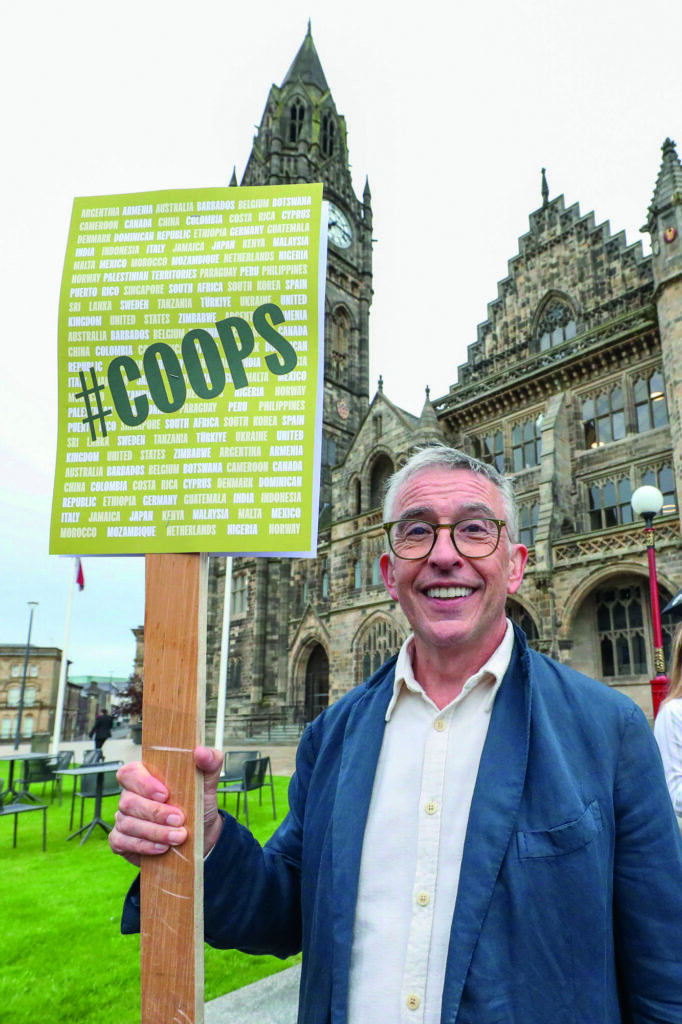
The UK’s Co-op Congress, hosted by Co-operatives UK at Rochdale Town Hall on 4-5 July, was part of a week-long Festival of Co-operatives in Rochdale and Manchester – a celebration that saw visitors from the International Cooperative Alliance (ICA) join UK delegates to explore, learn and celebrate how ‘co-ops build a better world’.
The co-operative movement “is not a relic” but a force in the UK and around the world, Rochdale Labour/Co-op MP Paul Waugh said in his welcome address to delegates.
The first Co-op MP for Rochdale, Waugh is proud to represent – and have grown up in – the town that produced the modern-day co-operative movement.
“No matter how tough things are, the one thing we’ve been able to say is we are the birthplace of co-operation,” he said. Waugh thinks the government can create the conditions that help co-ops thrive, building on recent developments like the expansion of community energy or the Bright Future Co-op, which helps victims of modern slavery into employment. Beyond this, he believes co-ops can play a role in tackling division within the UK and in countries experiencing conflict.
Steve Hughes, Group CEO, Coventry Building Society, also reflected on Rochdale Pioneers’ legacy, adding that the Coventry aims to continue their mission.
“We’re here to help people save for the future and own a home, safely, sustainably and affordably,” he said.
The building society, which acquired the Co-op Bank earlier this year, will continue to support ethically minded organisations, added Hughes. Since the merger, the bank has had its best service performance in six years and plans to invest in digital services.
Hughes called on co-ops to shout louder about the long-term solutions they provide to ensure co-op voices are heard in Westminster and every community in the UK.
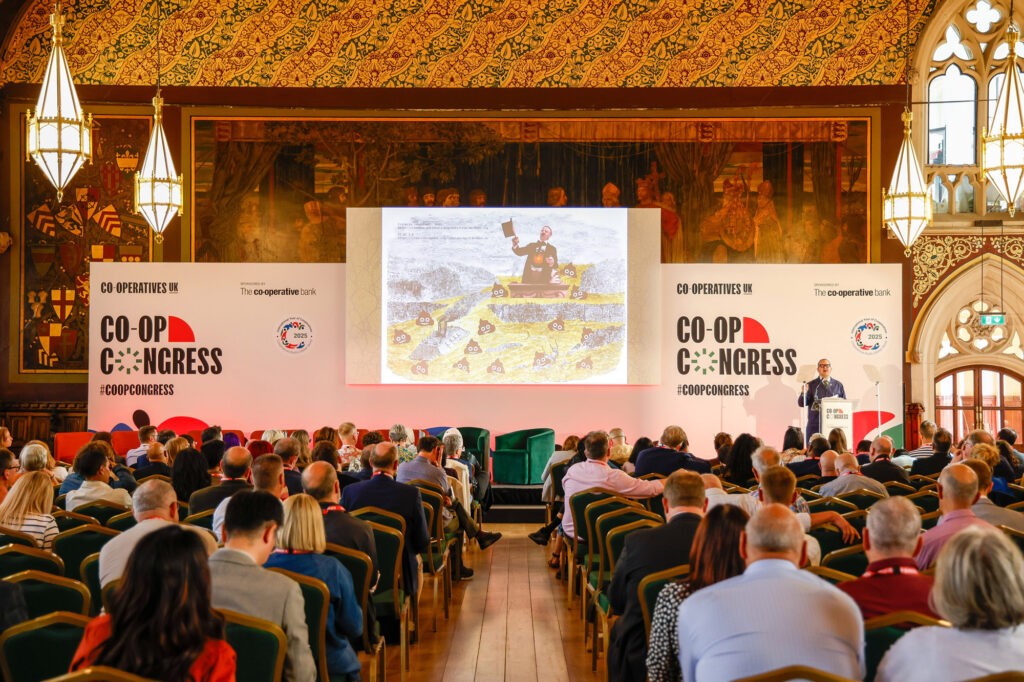
Co-operatives UK CEO Rose Marley made similar references to the Rochdale Pioneers, describing their fight to provide good-quality, non-adulterated food. “Building a better world demands more than good intentions; it demands courage,” she said. “Today we face a new monopoly of tech.”
Co-ops can address this monopoly, thinks Canadian blogger and science fiction author Cory Doctorow, who coined the term ‘enshittification’, which was recently included in the Oxford Dictionary. The word describes a decline in the quality of products and services offered by platforms, which had initially attracted users by providing good services. Doctorow, who spoke at last year’s Global Co-op Congress, explained how platforms follow a three-stage process of decay as they prioritise profits over user satisfaction and quality of services.
As a representative of the anti-enshittification movement, Doctorow argued that “the future of tech has to include co-ops, just as the future of co-ops has to include tech”.
“If we are to build a future that is co-operative we need digital infrastructure to support co-operation. And together, I think we’ll build it,” he said.
The conversation continued during a panel discussion featuring co-ops from different sectors, including Dominic Kendal-Ward, Co-op Group secretary and general counsel, who mentioned the need for advocacy and engagement with tech experts on what the co-op model is. He also pointed out that access to capital is an issue for tech co-ops, due to markets being focused on short-term financial return rather than long-term impact.
One pioneering tech initiative is the Food Data Collaboration, which uses data technology that enables thousands of agroecological producers and shopfronts to collaborate without changing their existing software.
Meanwhile, Food Data Collaboration founder and CEO Lynne Davis encouraged the co-op movement to build its own data infrastructure to enable commonalities without asking everybody to change their IT system.
Related: The global co-op movement makes plans for 2025 and beyond
Delegates also heard from Maria Young from Agile Collective, who described how her co-op had helped to set up Open Digital Cooperative, a multi-stakeholder co-op, to bring together local councils and tech suppliers to build and help maintain open-source products. Set up three years ago, the co-op is owned by 27 members, councils and suppliers.
But can co-ops take the lead in an industry dominated by a small number of large firms?
Violetta Nafpaktiti, CEO of DotCooperation, the registry of the .coop domain, argued that the movement can be a leader: “For any problem that digital capitalism has created, there is a co-op solution,” she said. Tech co-op networks such as CoTech in the UK and Patio work internationally to bring tech workers together to share information and work on joint projects, she added – but warned: “The bigger issue is that the co-op model is not known enough.”
The co-op movement can also help promote co-operative software, said Chris Croome from WebArchitects. Co-operative software is open software that is made to be shared, he explained, and can help co-ops move away from their dependence on big tech.
With access to capital being a challenge for tech co-ops, Coop Exchange aims to fix this by building a global network of co-operative stock exchanges, an international platform for raising capital and trading financial instruments.
“The top five ESG investments are the big tech companies. Why can’t we pour some of that money into co-ops?” said Stephen Gill, CEO of Coop Exchange.
Another panel, chaired by Co-op News executive editor Rebecca Harvey, examined the current outlook for our global movement, as it celebrates the UN International Year of Cooperatives. “This IYC comes together with a tipping point year, 2025 is a transition year when a large geopolitical paradigm shift is taking place,” said Jeroen Douglas, director general of the International Cooperative Alliance (ICA).
He talked about the CM50 leadership circle, a new group of co-op and mutual leaders convened by the ICA, which is working on a statement it will present at the UN’s Second World Social Summit in Doha.
“We believe we [CM50] are a new Davos, we need to not suffer from our inferiority complex any more,” he said.
Related: CM50 leaders discuss commitment plan ahead of UN summit
One of CM50’s members is Debbie Robinson, CEO of Central Co-op, who said the group has a clear call to action. Robinson is also the chair of the new Fund for International Cooperative Development, which aims to support co-ops in countries that have experienced conflict.
The panel discussed some of the challenges faced by co-ops, with Todor Ivanov, the secretary-general of Euro Coop, highlighting the issues faced by co-operative retailers in Europe.
Consumer co-ops are impacted by overregulation, as well an inadequate legislative and policy framework made for other types of businesses. He thinks co-ops can play a role in selling products at their true price, taking into account their social and environmental impact.
“More and more solutions mobilised to fix issues are privately owned and co-ops need to enter that space, but people drafting public policies need to understand the model,” Ivanov said, adding that co-ops often have to go to non-co-op solutions to get capital.
Noel Raboy, president and CEO of Climbs Life and General Insurance Cooperative in the Philippines, also talked about unfavourable regulations, adding that co-ops need to strengthen advocacy to address this. Co-ops that form part of Climbs aim to provide insurance products for as many Filipinos as possible, including those underserved by other providers.
“Insurance is not just about premiums but also how we can support farmers after losses,” he added. Raboy also warned that co-operative education is key for co-ops, as without it they can end up following the corporate model and become exclusive. Climbs put aside 20% of its surplus towards education, and each year conducts study visits to the UK in collaboration with the Co-operative College.
In the UK, the All-Party Parliamentary Group for Mutuals, chaired by MP Andrew Pakes, is currently looking for ways to double the co-op and mutual economy by creating the conditions for the movement to thrive. Pakes thinks two sectors in which more co-ops could emerge are housing and social care.
Related: MPs Patrick Hurley and Andrew Pakes talk APPGs
“There are many examples from around the world,” he said. “This is not about Britain projecting itself but learning and reaching out.” Pakes highlighted how laws around housing co-ops are archaic, with co-ops being charged more by banks, which can act as a barrier to starting a housing co-op.
Reflecting on the conversation, former ICA president Dame Pauline Green pointed out that some of the issues raised had already been raised in 2012 – the first International Year of Cooperatives. “There needs to be innovation within the context of maintaining control,” she said, giving the example of Coop Exchange.
Congress delegates also heard from economics and politics columnist and author, Grace Blakely, who delivered a speech on the current, troubled political context.
At a time when trust in political parties is low (9%) and one in five people are living in poverty, she thinks co-ops can be used to address the sense of powerlessness fuelling a “deep crisis of despair” in the UK.
“Nobody is coming to save us […] but we know that when we work together, we are capable of saving ourselves,” she said.
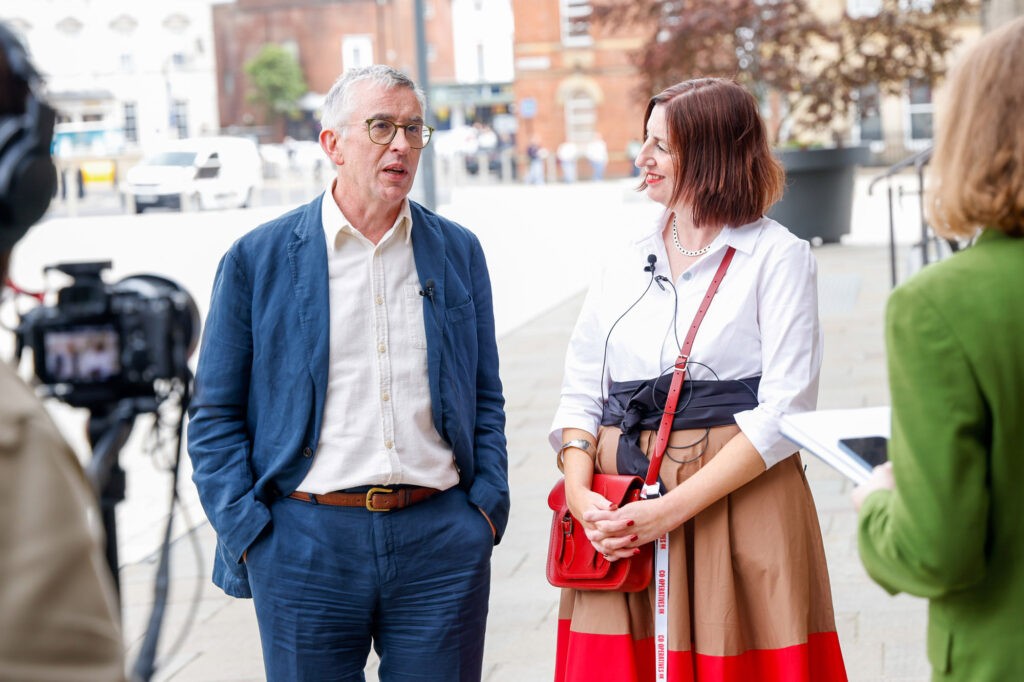
She was echoed by actor Steve Coogan, who is involved in Middleton Cooperating, a Greater Manchester project that works across housing, energy, digital and the arts.
“You can’t change the world, but you can affect change at the local level,” he said. But he warned that “people don’t want this middle-class, patronising, top-down benevolence” and argued that the neoliberal consensus had failed to deliver for ordinary working people.
There are other Manchester co-operative projects under way, too, including Beyond the Music, a music festival and industry conference which acts as a platform for new artists.
“The journey has not been easy,” admitted co-founder and co-CEO Sarah Pearson, who described the music industry as “a system built on extraction”. If they are to fix this, alternative models require policy support, education and funding.
Related: Steve Coogan on why he is backing Middleton Co-operating
Another challenge, said Beyond the Music director, Oli Wilson, is finding the right language to tell the co-op story to artists, investors and a general public who do not understand what a co-op is – particularly given how competitive the music industry is.
Other Greater Manchester initiatives include Cooperative Network Infrastructure, Social Adventures, Carbon Co-op, and Emerge Recycling, said Rose Marley, highlighting how local initiatives can also benefit from advice and support from Our Business, a Greater Manchester community hub that enables them to build their community, share knowledge, and access business help and support.
Co-ops and mutuals will have the opportunity to showcase some of the challenges they face and shape policy through a government call for evidence. MP Gareth Thomas, who serves as parliamentary under secretary of state in the Ministry for Services, Small Businesses and Exports, encouraged Congress delegates via a video message to take part in the consultation.
“Contribute to the call for evidence and help build a stronger fairer economy,” he said.
Lucy Powell, leader of the House of Commons, also encouraged Congress attendees to contribute to the call for evidence.
In her speech, she highlighted some of the ways in which the government is aiming to support the co-operative agenda, including a Right to Buy law to make it easier for communities to take over assets, an industry-led Co-ops and Mutuals Council, a Crime and Policing Bill to protect retail workers, and a review of the 2014 Co-operative and Community benefit Society Act.
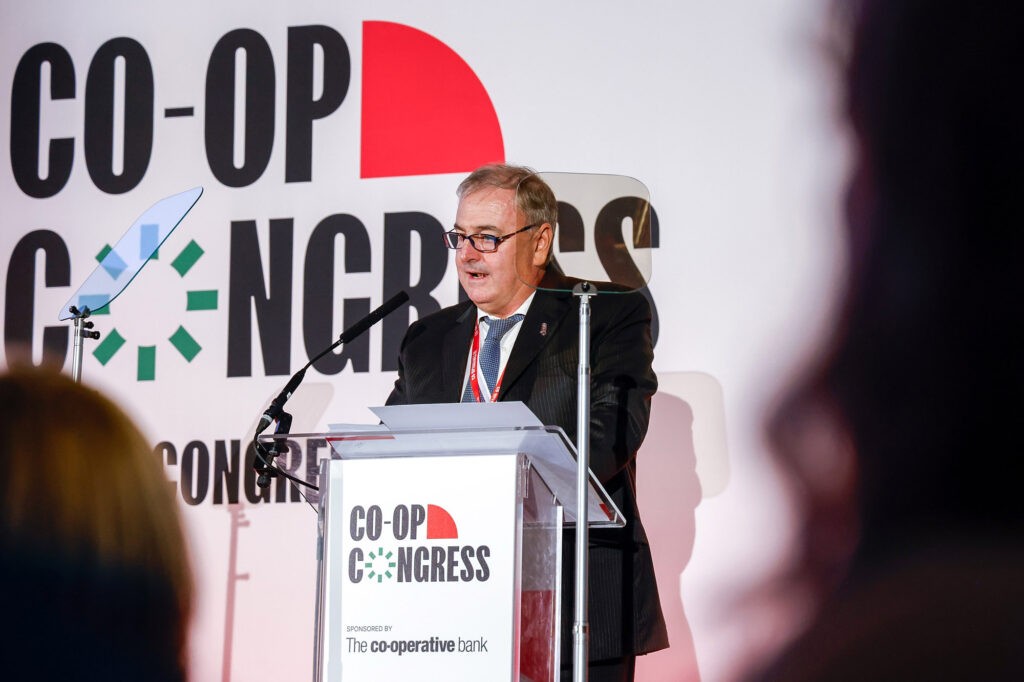
Congress also heard from ICA president Ariel Guarco, who talked about some of the world’s greatest challenges, highlighting the role of co-ops in addressing them.
“Let’s move forward with clarity, courage and with conviction,” he said.
Throughout the two-day Congress there were many examples of communities co-operating to empower themselves, including Community Clothing, a social enterprise established by TV presenter, author and founder of Community Clothing, Patrick Grant.
Set up in 2016, Community Clothing is a sustainable clothing brand that aims to make long-lasting clothing items rather than fast-fashion. Starting with one factory in Blackburn, it now works with 54 UK factories. Its main objective, says Grant, is to provide quality jobs.
“There is a great appetite for businesses that do things that are good for their community,” he said, arguing that businesses can be successful on a tiny margin if they set themselves differently.
Other community initiatives were explored during a panel discussion hosted by musician, author and campaigner, John Robb.
The New Internationalist, an Oxford-based multi-stakeholder co-op, is owned by 4,600 people around the world who want to support global justice journalism. Co-editor Amy Hall explained how readers are engaging with the co-op by attending its AGMs, voting on topics and contributing to crowdfunding campaigns.
“We’re a non-geographical community, we have readers all over the world,” she said, adding that readers were also the magazine’s critical friends.
Also on the panel, Matthew Otridge and Chris Sherrington shared how the Music Venue Trust is acquiring and managing venues via a charitable community benefit society. The bencom has purchased five music venues so far, which are still operated by people in the local community and provide affordable rent.
Related: Can community ownership save our struggling grassroots music venues?
This community ownership model was also used by locals in the town of Nefyn, in North Wales, who bought a pub via community shares. The Tafarn yr Heliwr pub is now the only piece of regeneration on the high street, which has witnessed many shop and bank closures.
“Community ownership is all about owning buildings and land and using it for the benefit of the community,” said Rhodri Evans, chair of Tafarn yr Heliwr.
Another way co-ops can help communities is by decarbonising the economy. People Powered Retrofit, a government-backed scheme to help more householders in retrofitting their properties, which is supported by the Carbon Co-op, is helping people retrofit their homes. Marianne Heaslip, co-founder and technical director at People Powered Retrofit, said that decarbonising the economy can achieve the
best results when people are actively involved in the process.
Congress was also an opportunity to celebrate co-ops such as West Granton Housing Co-operative, which aims to provide social housing solutions by putting member tenants first. “We’re honoured to work for the co-op, tenants are involved in everything we do,” said CEO Larke Adger.
Doubling the size of the co-op and mutual economy should focus on supporting both new and existing co-operatives, she added.
The co-op model is also being used by Glasgow-based award-winning Media Co-op.
Creative director and editor Vilte Vaitkute said that one of the co-op’s main aims is to make the experience of making or appearing in a film as pleasant as possible.
The Media Co-op is a women-led workers’ co-op and it operates a flat pay system, in an industry where women earn 98p for every £1 that men earn.
Another co-op trying to tackle inequality is Bright Future, which provides survivors of modern slavery with a pathway to paid employment. Non-executive director Alison Scowen explained how the co-op began as a project within the Co-op Group to try to secure jobs for victims of modern slavery. It then developed into a co-op whose members include a range of retail businesses. While Bright Futures has “a tiny budget”, opportunities with employers make the difference, she explained.
GLL, a worker co-op dedicated to improving the physical, mental and social wellbeing of local communities, was showcased by Alison Westworth, its partnership manager for Newcastle and Gateshead.
She said the co-op is trying to break down cultural barriers to being physically active. “We are proof that it can be scaled, it can be done,” she said, adding that GLL was happy to have conversations with anyone who wanted to find out more.
Delegates also heard from Glen Taylor, COO, Community Dental – a referral-only dental service – and Perry Blake, founder of 21UP Movement, a youth intervention and employment programme. 21UP aims to create opportunities and activities to offer support to young people trying to reach their full potential.

Blake said this is about allowing young people to feel recognised by providing a safe space and structured guidance to help those facing challenges such as low confidence, difficulty in social environments, or lack of positive role models. “If every person would make one change today, then we’d have a better tomorrow.”
Another way co-ops make a difference is through development – and their role in peacebuilding and responding to global crises. In a panel highlighting the successes and challenges of co-op development, speakers called for solidarity and support for bottom-up solutions across the globe.
Pete Westall, chief values officer at Midcounties, who chaired the session, said he was inspired by the week of co-op events in Manchester “because people are talking about action [and] about what co-operative solutions we put in place to facilitate self-help.”
Co-op News international editor Anca Voinea gave an overview of the publication’s role since 1871 in documenting and promoting co-operative efforts globally. Last month’s edition, which focused on development, detailed how the closure of USAID funding has impacted co-operative development. “Nine co-operative organisations have altogether lost $211m,” she said, “about 30% of their income.”
But, she added, there are reasons to feel optimistic, citing the “co-op movement coming together” and the positive power of storytelling. “Through raising awareness, we can get co-ops to get involved and support initiatives internationally.”
Francesca Ottolenghi, chief of international relations at Legacoop, highlighted the organisation’s national and international development efforts, including responses to crises like the war in Ukraine and rebuilding efforts in Palestine.
“When something happens around the world, our co-operatives are the first to give some support,” she said. “We start with emergency fundraising, then we converge to specific structures and advocate for long-term co-operative development.”
But, she warned, the co-operative movement needs to react to crises in unison. “It is together that we can make the difference.”
Ottolenghi also chairs the ICA’s International Cooperative Development Platform, working on practical actions and strategic donor-mapping. “We have just finalised our strategy,” she added, “and are ready to co-produce together.”
Donna Dizon presented the work of Climbs Insurance and the Cooperative College of the Philippines, which has recently had a specific focus on climate risk, education, and co-operative resilience. She explained how Climbs offers “parametric climate insurance [for] faster payouts during disasters” and is ensuring gender-responsive solutions and disaster preparedness with its Community Action Response Services (Cares).
Paul Gerrard, campaigns and public affairs director at the Co-op Group, described how the society’s recent campaigns were shaped by member mandates, not management decisions – and how “95% [of members] said they wanted us to take action to support those building peace.”
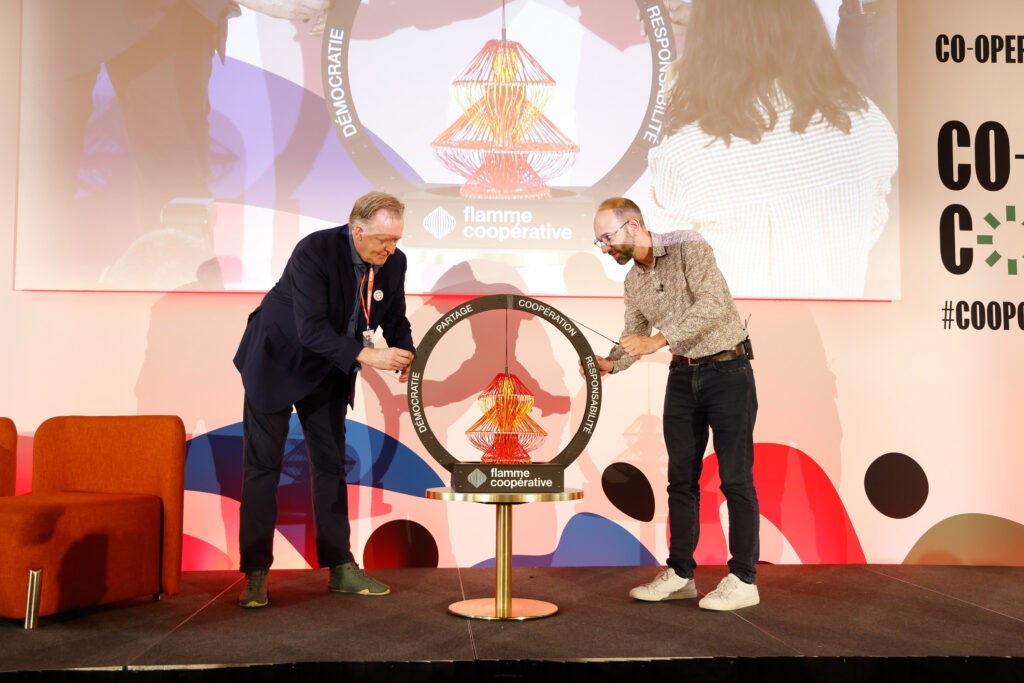
This is one of the founding mandates of the new UK-led Fund for International Cooperative Development, whose mission is to support co-operatives worldwide in rebuilding after crises and fostering peace through the power of co-operation. “The Fund is about solidarity, not charity,” said Gerrard.
Parallel to congress, Co-operatives UK hosted a youth forum; the final session of Congress invited youth forum participants to the stage to discuss the importance of intergenerational collaboration.
In her keynote, Riley Sweeney, a youth campaigner and policy advisor, spoke about how young people can be partners in shaping policies and systems.
“When young people are treated as genuine partners, we unlock better ideas, better decisions and better outcomes for everyone,” she said. “This isn’t just listening to young people, but building the agenda with them […] not just asking for input, but making decisions together.”
The youth summit was a good start, she added. “Young people shared not just their ambitions, but their realities, what’s possible and what they want to help shape.
“People always assume young people want something new, but most of them just want the basics to work.”
She also shared the success of the Children’s Commissioner’s Big Ambition, which collected input from over a million youth and resulted in 33 national ambitions being presented to Parliament, and ended with a challenge: “What would change if co-creation was your starting point? Who’s not in the room, and what are we going to do to change that?”
In a panel discussion, speakers stressed the need to integrate co-operative principles into education, and echoed Sweeney’s call to genuinely engage young people in decision-making and leadership, with Anthony Scott of Kitty’s Laundrette, describing how the co-op fosters intergenerational connection, where people aged 16 to 70+ collaborate as equals.
Sahar Alhakkak-Martinez of Cwmpas highlighted the value of creative, inclusive approaches, such as touring a youth-written play, to reach underrepresented communities; but Ana Aguirre, outgoing youth president of the ICA, warned against tokenism, saying, “We are not just youth; we have opinions, expertise, experience.” She advocated for embedding youth at all levels of governance and leadership.
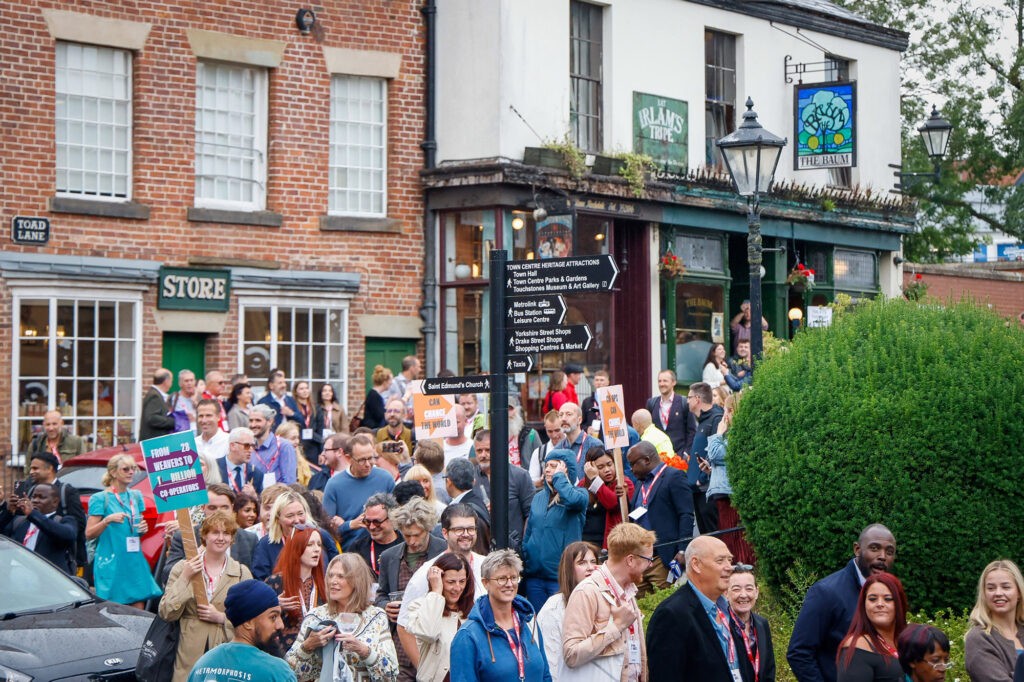
Congress also included side sessions on policy, and Woodcraft Folk and youth engagement, and a parade from the Rochdale Pioneers Museum on Toad Lane to the Rochdale Town Hall – as well as a closing performance by Littleborough Brass Band.
As the global movement passes the half way mark of the International Year of Co-operatives, Congress – as the culmination of the UK’s Festival of Cooperatives – was a welcome reminder of how co-ops in the UK and around the world are trying to build a better world.
This article was amended on 29 July. An earlier version referred to “ESG investors” instead of “investments” .