As British politicians continue to grapple with social and economic instability, as divisions widen between voters and populist voices continue to grow, alternative ways forward are being sought – and some say co-operation, community-focused models and green economics are the answer.
They include former Green Party MEP and lifelong co-operator Molly Scott Cato. Throughout her career, she has seen how a loss of community and frustration with the two-party system have left many people feeling unheard and unrepresented. That sense of political abandonment, she argues, is pushing voters towards Reform – but it could also create space for a renewed interest in co-operative models.
The trouble, she tells Co-op News, is that people cannot turn to an alternative they have not heard about. With so little mainstream education about how co-operatives work, most people simply do not know that a different model of ownership and community governance is available.
“When people get to that point of feeling disgruntled, that’s when you know this alternative should be made clear,” she says. “But it’s just not.”
Scott Cato taught economics at universities for several decades and says it should be made a statutory requirement for universities to include alternative ownership models in economics courses. “When I go to my Co-op shop, most of the people shopping there don’t have a clue that something is going on there that’s actually deeply subversive of capitalism.”
Co-ops could offer an antidote, she thinks, to the problems of the digital age – with a breakdown in human connection and community. “That’s another really important thing about co-ops,” she says, “ the importance of being a part of something, rather than just being exploited through some online community that just reinforces what you think and sucks you in and radicalises you.”
Scott Cato sees her own connection to the co-operative movement as a generational phenomenon. “My grandma was really political: she was a lifelong socialist, and a Christian, and was fervent about both those things.”
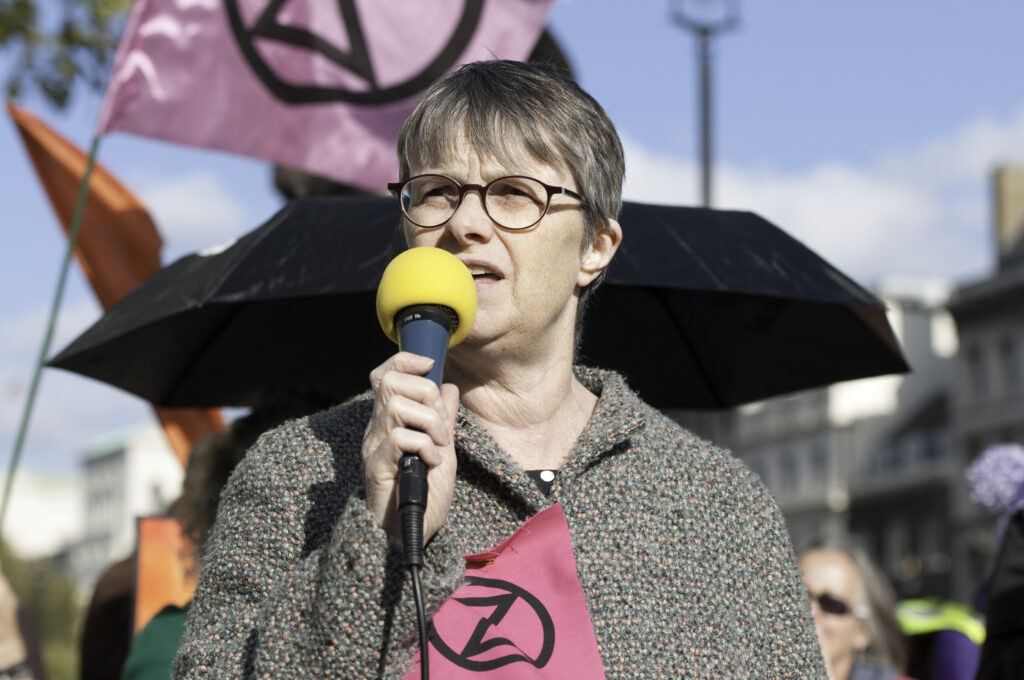
This was at a time when co-operatives were far more widespread and offered a viable alternative to the capitalist economy.
“The reason my granny was so into co-operatives,” adds Scott Cato, “was because, in the 1930s, a significant chunk of the economy was organised co-operatively. Your food, your housing, your holiday, could all be organised outside the capitalist economy. So most of her life was run by co-ops. She would do everything she could to avoid any type of private business. And I do the same.”
Previously serving as director of the Cardiff Institute for Co-operative Studies and having extensively studied the co-operative sector and the green economy, Scott Cato has continued her family legacy of involvement with the movement.
Quaker values also play a large role in her activism and desire for a more equitable society. As a faith group committed to working for equality and peace, Quakerism makes a natural companion with co-operation in her politics, she says. She views the faith as “radical because it’s based in you and your divine inspiration and your conscience, so it kind of supports you in any other radical action you want to take”.
Related: Greens include co-ops and mutual banks in small business charter
“Nobody tells you what to think, and part of the reason I came to co-ops is that I didn’t like people telling me what to think.”
Scott Cato was arrested in 2019 for protesting against nuclear weapons at an air base in Belgium. “I got out of the police station and looked on my Twitter, and I had support messages from the Green Party and Quakers in Britain saying ‘Hooray, good for you!’
“But the co-op movement is like that as well, it’s radical outsiders challenging a dominant system.”
However, this sense of being outside the mainstream can also be a problem, she warns. Although the modern co-op sector has been around for 181 years, and now employs over 1.3 million people and provided a combined income of £165.7bn in 2024, the co-operative sector still sits on the margins of government policy – even though it has its own political party. It wasn’t until last month that co-operatives had their first mention in the national budget, following Labour’s 2024 manifesto pledge to double the size of the co-operative and mutual sector.
Scott Cato has her reservations about this pledge. “I’m not terribly interested in targets,” she says. “I’m interested in effective policy.” And she is frustrated by a lack of clarity about what, exactly, the government is promising.
“If you say we’re going to double the number of trained medics, you actually just have to put in the right amount of money to make that happen, that’s public sector,” she argues. But with co-ops, “you’re talking about the private sector. They can’t make that happen. I don’t think, as a politician, you should ever promise something you can’t control.”
Meanwhile, she fears, the UK runs on a fundamentally ineffective system which is not working in the interest of the people – something that a vague policy is not going to fix. “The theory around markets is that new entrants come in and compete with the existing ones, and it is that competition that is supposed to create innovation and efficiency. We’re not living in that economy. We’re living in an economy of mass consolidation.
“Genuine political competition is also important, and could help co-ops achieve more supportive policies, rather than maybe the Co-op Party strategy of just aligning itself with one of the two big players.”
Related: Why co-operatives are key to climate and development
The Co-op Party has had an electoral agreement with Labour since 1927 due to their shared interests, being a part of the same broader movement. But Scott Cato maintains that only one nationwide party is putting forward substantial, workable policies to support the co-operative sector: her own. She represented the Greens in South West England in the EU Parliament from 2014 and served on its national executive committee after losing her seat because of Brexit in 2020. She remains confident in the party’s direction: “I just think the green economic policy is spot on”.
She adds: “When I look at people like [co-operator and social reformer] Robert Owen, he sat down, figured out what was wrong and made a very simple, practical suggestion. I think the Green Party works in a similar kind of way; if you look at the policy, it’s just good.”
Scott Cato remains committed to green economics and policy, but recognises the value of a representative plurality of left-leaning parties. “In most European countries, there’s a social democratic party, a socialist/communist party, and a green party. And honestly, I think we probably need all three.”
She also believes that Labour is no longer working in the interests of working people. “I think the Labour hierarchy just has a habit of taking for granted people who are supportive, whether that’s voters, members or indeed organisations like the Co-op Party and trade unions. If I were still a union member, I wouldn’t be happy that my union was affiliated with Labour.”
One man who is working to change the allegiances between unions and Labour is Green Party leader, Zack Polanski. Elected in 2025, he has overseen a threefold growth in membership – and explicitly stated in an interview with Left Foot Forward that he would like to see union affiliation and funding directed towards the Green Party. Accusing Labour of becoming “corporate captured,” he is trying to position his party as a grassroots, working-class choice.
Now a grandmother, Scott Cato is intensely concerned about the looming climate crisis. A member of community-supported organic/biodynamic farm, Stroud Community Agriculture, she speaks passionately about the challenges modern agriculture faces, and how the sector requires support and investment.
“That’s a way Labour could double the size of co-ops,” she says, “if they just supported community farms. They could direct subsidies to co-operatively owned farms.”
Urbanisation adds to the problem, she says, with a loss of local connection in the food supply chain and its loss of locality feeding into the wider loss of community and ownership.
“Most people’s experience is so far from the land that it doesn’t make any sense to them”.
She adds: “It’s obviously absolutely true that people should have a stake in their own economy and ownership and control of their own production of value and consumption of products as much as possible: that will definitely make a better world.”