The importance of co-operation in early childhood has long been recognised – and a new publication from the Sheffield Childcare, Play, Childminding and Family Support Community Benefit Society provides a timely reminder.
Rooted in the Early Years Foundation Stage (EYFS) statutory framework, the Guide to Support the Promotion of Cooperation through the Delivery of the Early Years Foundation Stage Statutory Framework demonstrates how co-operative values and practices are vital for children’s development. It argues that by weaving co-operation into the fabric of early years education, practitioners lay the foundations for lifelong learning, empathy, and citizenship.
In early childhood, the definition of co-operation extends beyond simply “getting along”, it says. It is the act of working together towards a shared goal or purpose, and is integral to how children learn, form relationships, and develop a sense of belonging within their classrooms and communities. By learning to share resources, solve problems collaboratively, take turns, and show empathy, the document argues, children begin to embody the very values that underpin co-operation.
The report resonates with one of the most enduring co-operative principles – education, training, and information – and with the values of self-help, democracy, equality, equity, and solidarity that the International Co-operative Alliance says underpin the definition of co-ops. These values mirror the aims of EYFS, says the guide, particularly within personal, social and emotional development and communication.
Related: A year in the life of the Co-op Academies Trust
For example, when children make group decisions during play, they practise democracy. When practitioners ensure every child has a voice, they promote equity and inclusion. In this way, the guide argues, co-operative values provide a moral compass for EYFS practice.
One example sees the story of the Rochdale Pioneers explored by young children through age-appropriate storytelling, role play, and classroom activities. Through this, practitioners can teach about history – but also nurture an understanding of fairness, collective action, and the power of working together.
“Practitioners can use age-appropriate language and visual aids to share this important story, helping children explore how co-operation can lead to positive change in communities,” the guide suggests.
Related: Woodcraft Folk and a century of co-op education for social change
The power of play is a recurring theme. Playful learning is not just enjoyable; it is one of the most effective vehicles for teaching co-operation. As children engage in role play, group puzzles, storytelling, or outdoor den-building, they naturally encounter opportunities to negotiate, share, empathise, and celebrate joint success.
The report also places co-operation within the wider statutory and social context. “Promoting British Values in early years settings is a statutory requirement under the EYFS and contributes to children becoming responsible, respectful, and active citizens,” it says. “The values of democracy, the rule of law, individual liberty, mutual respect, and tolerance are all strongly linked with co-operative principles.”
Democracy is nurtured when children make group decisions and vote on ideas, it adds. The rule of law is reinforced when they learn that rules are for everyone’s benefit, mutual respect grows through collaboration, and tolerance emerges when children appreciate diverse perspectives.
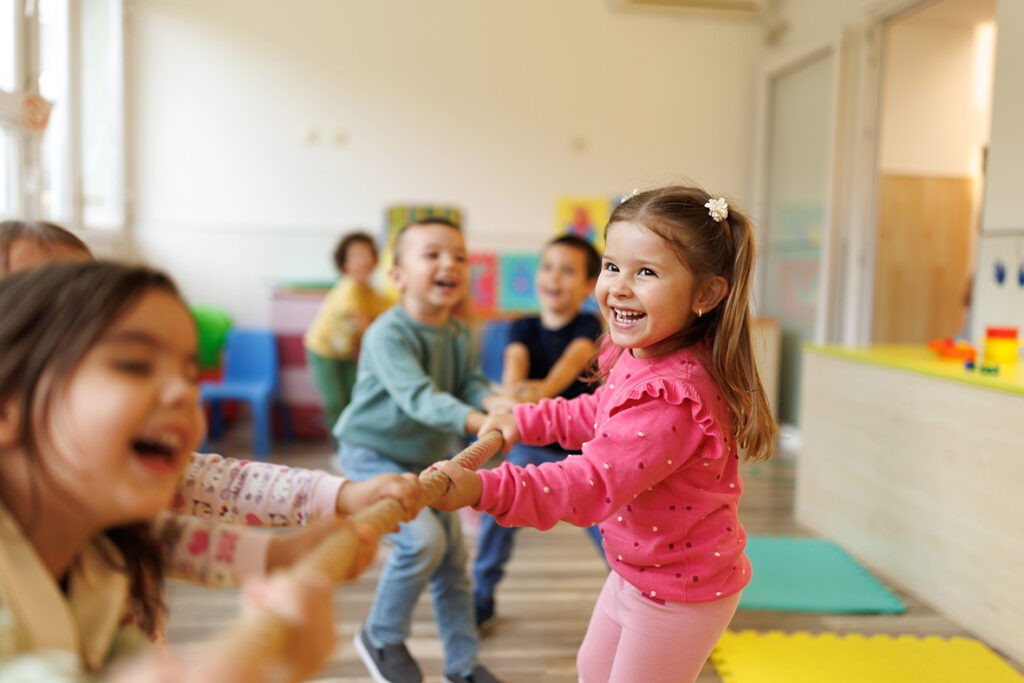
Citizenship is actively fostered through examples such as democratic group choices, creating classroom promises, litter-picking, or welcoming new peers into the setting.
“Co-operation is also essential to fulfilling the duties of the Equality Act within the EYFS,” the report notes. “It creates inclusive learning environments where children work together, respect difference, and learn to value each other’s contributions.”
But for co-operation to flourish among children, it must be modelled by adults. The guide emphasises that early years staff should embody co-operative behaviours themselves: engaging in shared planning, collective problem-solving, and transparent communication. By observing adults working co-operatively, children see these values lived out in real time.
Related: The fight to get co-operation on the curriculum
The guide also suggests that education as a co-operative principle extends beyond the classroom, offering practical ideas to nurture co-operation at home – such as cooking together, playing team-based games, or creating a kindness jar. “These activities strengthen consistency between school and home, showing children that co-operation is a value that transcends environments,” it says.
Another strand of education explored in the report is environmental learning through forest schools and outdoor play. Building dens, co-planting gardens, or creating art with natural materials are not only engaging but also teach responsibility for the environment and for one another, helping children see themselves as part of wider communities. “Well-designed spaces encourage shared discovery, team projects, and reciprocal communication,” the guide points out, underlining how environments can intentionally foster co-operation.
In a world facing rising individualism, inequality, and social fragmentation, the guide argues that embedding co-operation into early years practice is more than a pedagogical choice – it is a moral imperative.
“By embedding cooperation into everyday practice, practitioners lay the foundation for lifelong skills – critical thinking, teamwork, communication, and emotional intelligence,” it says. Co-operation fosters empathy, confidence, inclusion, and community, laying the foundations for responsible democratic participation and equipping children with the skills to think critically, collaborate compassionately, and contribute meaningfully to their communities.
This publication is more than a set of classroom activities: it is a call to action. “Co-operation is not only learned,” it says, “it is lived and it begins from the earliest of years. It begins with all of us as early years practitioners modelling co-operation for the children in our care and settings.”
It urges practitioners to see co-operation not as a theme to be occasionally highlighted, but as a value to be woven into the daily life of early years settings. Through playful learning, inclusive practice, home-school partnerships, and outdoor exploration, co-operation becomes a lived reality.