Food resilience is increasingly on the agenda in the UK, as government guidance advises people to stockpile emergency supplies and experts warn that the country is underprepared for potential food shortages. Amid these national conversations, residents of a UK market town are turning to one another to build a more secure food future, with co-operation at its heart.
Food and Community Oswestry is a grassroots initiative formed by people in and around the Welsh border town who “think there is a problem with our food, believe change is possible and that we are the ones, together, that can make it happen”.
The group came out of a series of food-themed community assemblies and meetings held this year in partnership with Humanity Project. Humanity Project assemblies offer a facilitated space for communities to connect, make decisions and plan action together around issues concerning them, at a time when people are feeling increasingly disenfranchised by conventional politics.
Local community organiser Michael Bastow described the assemblies as “taking power back into our hands as a community. You could call it ‘power across’ people rather than over”.
At the events, “everybody had a say and everybody listened to each other,” says Bastow, to explore the question: What does the future of food in Oswestry look like, given the challenges that are coming?
“What we thought when we came together, was that this needs to be addressed by the whole town and all people that are involved in food – not just people that are growing food or buying food, but everybody together needs to address some of the challenges that we’ve got.”
When exploring solutions, two key priorities came out of the assemblies.
“We decided that it had to be about neighbourhoods, about people locally connecting with where they live – that’s what was important. And the other thing was about co-operatives – people coming together and finding the solution themselves.”
Enter Cooperation Town, a network of small neighbourhood buying co-ops that enable groups of up to 20 households to pool their money and bulk buy food together, according to their local need.
Cooperation Town is a national movement of these co-ops, self organising on streets and estates across the country. There are at least 70 autonomous co-ops in the network – while a small worker co-op offers support to the independent groups, it is possible that more groups have set up using Cooperation Town’s freely available online resources, meaning the actual total is unknown.
Related: Co-op Group and Co-operatives Wales join call for Good Food Bill
A number of the existing Cooperation Town groups source food from charity FareShare, which redistributes surplus food from supermarkets, wholesalers and farmers to those who need it.
However, Oswestry’s rural location makes that route more challenging, explains Bastow.
“In London, FareShare is great – you know, four streets away is your local food pantry or hub where you get the supplies. Here it’s not so easy, because the nearest FareShare distribution point is Shrewsbury, which is some round trip.”
But there are other options in Oswestry, says Bastow. “There’s a food hub. There’s a fruit and veg wholesaler on the industrial estate. And there are local farms here – two we know quite well, that are involved in the community.”
One of these farms, Babbinswood, is currently on its own co-operative journey. A community campaign to save the farm was launched in 2023 when a family break-up meant it had to be put up for sale.
Earlier this year, Babbinswood Farm Community Benefit Society put in an offer to buy 18 of the farm’s 176 acres (with hopes to purchase more in the future), supporting owner Barbara Jones’s mission to keep it dedicated to both organic farming and community benefit.
“My driver was to keep the farm together as much as we could, but also to keep it organic,” explains Jones, who has also been involved in the development of the Food and Community Oswestry group.
“For me, when we talk about food resilience, which is what [Food and Community Oswestry have been talking about] – looking after the planet, looking after the land, this is the only way that we can get really true food resilience, because all the time industrial agriculture is degrading the land. And apart from all the political and global problems and climate change and all the rest of it, if we don’t look after our land, then we are not going to have any proper food going forward, so that’s one of my drivers.”
Jones believes that models such as Cooperation Town could help increase access to organic food for those who may not normally be able to access it, either through collective purchasing, gleaning or even community growing projects.
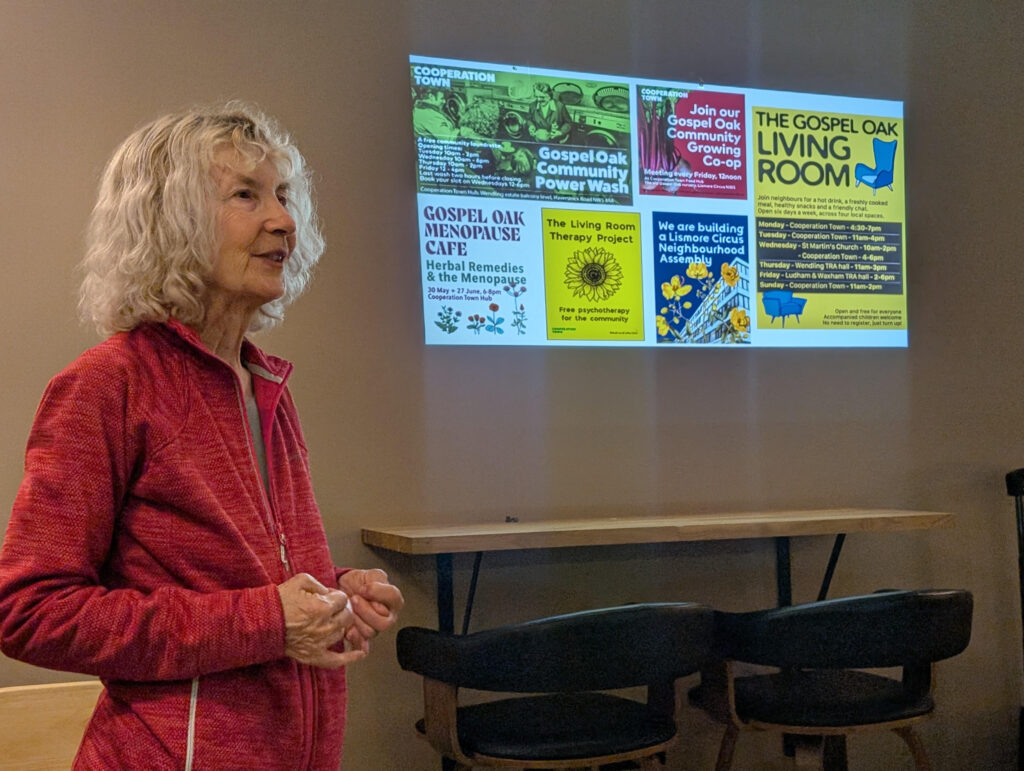
These decisions are yet to be made, and will ultimately rest with the buying group members who will collectively decide how they want to source food for their co-ops. This level of autonomy for the co-ops is key, and something that differentiates co-ops from other interventions, says community organiser Steph Friskney.
“Very often, people don’t have a say in a lot of what goes on, especially in the current situation. If you’re using a food bank, you don’t have control a lot of the time over what you’re eating that week. If you’ve got a low budget, your little bit of control over what you eat is what’s on the supermarket shelves marked down at the end of a Thursday night, or whenever whichever supermarket it is, marks it down.”
As well as giving people control over their food, forming neighbourhood-level co-ops builds a small, resilient community of people that wouldn’t otherwise have come together, who can support each other in various ways, says Friskney.
“Once you’ve got your co-op up and running, you’ve got a group of people, all with different skills, who bring different things to your group of people. So you’ve got a very resilient small group. Some people are going to do the driving for you. Some people are good at organising. Some are good with money … You learn by doing, you learn as you go. But the main thing is you’re working together for the benefit of that co-operative – for yourself, but for everyone else as well. There’s a mutual benefit in it. So you’re building a kind of community resilience.”
For Jones, her experience at Babbinswood has shown her the importance of communities connecting with one another and “growing together” in different ways. “Growing food, but also growing friendships and growing relationships. That’s where I see the future of food being – that’s where I think resilience can come in.”