From democratic governance to value sharing, and from data management to resource stewardship, the co-op movement has an opportunity to play a leading role in shaping the development of AI. The Cooperative AI programme and the international bootcamp in Rome mark the first steps towards a global initiative to embed co-operative identity throughout the AI value chain.
Artificial intelligence is set to have an increasingly profound impact on people’s lives and the way businesses operate. For the co-operative movement – including its 1 billion members worldwide – this transformation raises a fundamental question: what role do we want to play in the future of artificial intelligence?
Today, communities affected by the extraction of resources needed to develop AI bear the costs without sharing in the economic benefits. Those performing essential tasks in training AI models may work in precarious conditions with little protection. Areas hosting data centres may face the environmental impacts of these infrastructures without adequate safeguards. Data is collected by platforms for private purposes without users being properly informed about how it is used. More broadly, technological power is increasingly concentrated in the hands of a few players.
Co-operatives emerged nearly two centuries ago to offer a different way of doing business – one built around people’s needs. Their history, their work and the people behind them have demonstrated over time that businesses can succeed by putting people before capital accumulation. Today, this same commitment can be brought into the field of artificial intelligence, helping shape its rules, governance, applications, and the generation and distribution of value. The goal is to make innovation possible while placing the needs of people, the environment and communities ahead of technology itself.
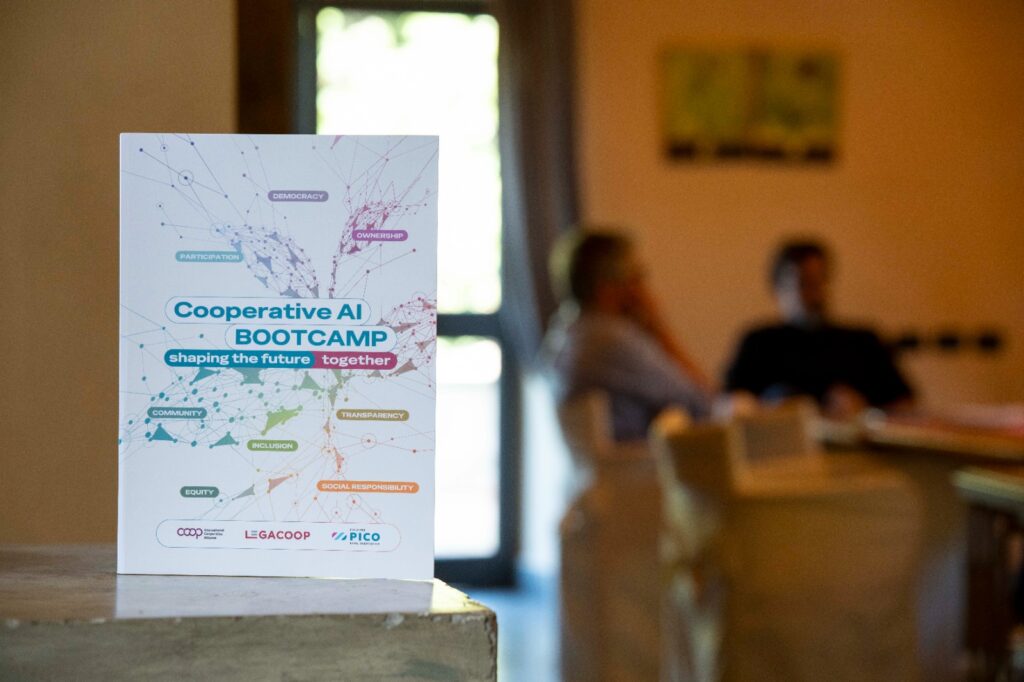
This conviction led to the launch of the Cooperative AI programme, jointly presented by the International Cooperative Alliance (ICA), Legacoop and PICO Foundation (Legacoop’s Digital Innovation Hub) on 17 September 2026 in Panama, during the ICA’s Global Conference.
The programme aims to build a shared foundation of knowledge and definitions, foster a community of co-operative experts who can work and collaborate together, and develop AI tools grounded in co-operative identity.
This vision is already giving rise to a Community of Practice on Cooperative AI. In Rome, from 12 to 16 October, ICA, Legacoop and PICO Foundation hosted an international Cooperative AI Bootcamp, bringing together representatives of the co-operative movement from 18 countries across 5 continents.
Related: Co-ops and their allies gather in Bangkok to shape AI
The international and cross-sectoral nature of the bootcamp was reflected in the diversity of participants and the organisations they represented. From North America and Central America, Justin Hammons of The Principle 6 Cooperative and David Beauchemin of Baseline joined from Canada, alongside Maria José Elizondo of Cooperatives of the Americas in Costa Rica. From South America, Nicolas Dimarco represented FAROX, FATTIC and PATIO in Argentina, while Nilton Cesar Campos Araruna brought the perspective of OCB System in Brazil.
African perspectives were represented by Ronald Nyamukuwa of TechUnity Service Cooperative in Zimbabwe and Melvin Khabenje of ICA Africa in Kenya. Allan Njoroge, representing ShiftNex AI and bringing connections to both the United States and Kenya, added a further international perspective at the intersection of technology and AI.
From Asia, participants included Akkanut Wantanasombut of Tamsang-Tamsong in Thailand, Mary Rose L. Gob of NATCCO in the Philippines, Jungsik Jung of NACF in South Korea, and Ayushman Madhwal of ICA Asia- Pacific in India. Together, they represented co- operative organisations and regional networks across a diverse range of Asian contexts.
Europe contributed 11 participants from seven countries, representing a broad range of co-operative, research, technology and international network organisations. Italy was represented by Luca Guandalini of Euricse, while Dorleta Urrutia Oñate joined from Mondragon University in the Basque Country, Spain. From the United Kingdom, Simon Chapman represented Agile Collective and Shaun Fensom represented dot.coop. Sweden was represented by Cate Broussard and Anna Karlberg of WeEffect; Bulgaria by Naska Yankova of Camplight/PATIO, Dimo Dimitriev and Bogdan Marinski of CCU; Germany by Felix Weth of Cosy AI; and Belgium by Marc Noel of ICA.
Bringing together these diverse experiences created an opportunity to connect perspectives spanning co-operative research and education, digital innovation, technology development and international co-operative representation.
The expertise represented ranged from research into co-operative models and alternative forms of enterprise to digital platforms, AI-driven initiatives and the work of co-operative networks across different regions. This combination of perspectives is particularly valuable in exploring how co-operative principles can translate into practical approaches to AI development, governance and ownership.
The collective dimension of co-operation is its most valuable asset: a vast global network of businesses and people, a strong presence in local communities, and organisations operating across different sectors that can benefit from economies of scale, share infrastructure and expertise, and experiment with alternative models that respond to real needs.
By connecting technological experimentation with the co-operative movement’s experience in democratic participation, collective action and shared value creation, the bootcamp marked an important step towards a shared vision of Cooperative AI. The next challenge is to establish a strong, shared theoretical framework that can quickly pave the way for technological experimentation.
Speaking at the Cooperative Economy Biennial in Milan just days before the bootcamp, 2025 Economy Nobel Prize Philippe Aghion highlighted the importance of reconciling innovation with social cohesion. Reflecting on Europe, he stated: “We are medium-sized countries. We share democratic values and social models, but we need to unite. With AI, we can truly become masters of our own destiny and shape our future”.
Artificial intelligence is neither an autonomous nor an inevitable phenomenon. It is the result of human, economic and technological choices, and those choices can still be made differently. The future of AI is still ours to shape.
Piero Ingrosso is director of innovation, promotion and digital, at Coopfond (Legacoop’s mutual fund) and president of the Pico Foundation. Francesca Ottolenghi is chief of international relations, internationalisation and development co-operation at Legacoop Nazionale