The Co-op Group is urging the government to deliver business rates reform in Rachel Reeves’ autumn budget to avoid the possible closure of 60,000 small shops – with 150,000 jobs at risk.
The call comes as 77% of small high street shop owners in England warn that business rates reform is essential for survival.
Over half of people say local shops and businesses are vital to their community identity or wellbeing, but research from YouGov reveals seven in 10 people doubt ministers will deliver on rates relief, despite pledges in previous budgets.
Chancellor Rachel Reeves (pictured) is set to present her autumn statement on 16 November. Last month, the government issued its interim report on business rates reform, which suggests ministers will explore fixes to sudden jumps in business rates – known as “cliff edges” – that can discourage small business investment and growth, and making rates fairer.
On the document’s release, Reeves said: “We want to help small businesses expand to new premises and building an economy that works for, and rewards working people.”
Retail leaders continue to put pressure on ministers, including the Group, which has launched its On Your Corner, In Your Corner campaign. It warns that if reforms are not delivered, 10% of small high street business owners say they would need to lay off staff, and one in eight say they would be at risk of closure. That equates to tens of thousands of closures nationwide, with significant economic and employment consequences.
YouGov research also reveals that over 56% of UK adults – equivalent to over 30 million people – see local shops as important to their wellbeing. Without them, three in four people say they “feel their community would lose part of its identity” (74%).
“The high street still matters,” said Benedict Selvaratam, owner of Freshfields Market in Croydon, Surrey. “It’s where people meet, work, and live. Without rates relief and reform, we’ll see more closures, more risk-averse owners, and less investment in our towns. We were expecting government to follow through on their manifesto commitments, to look at redistribution, to ensure online giants pay their fair share, and to support bricks-and-mortar businesses.”
Retail: Co-op Group signs new wind deal as CEO attacks Tory climate policy
Jack Matthews, owner of Bradley’s Supermarket in Quorn, Leicestershire, said: “We’ve always played an important role in the community. For many elderly people, sometimes we’re the only conversation they have in a day, and we’re proud to play that role. We need the government to deliver rate relief in the autumn budget. Losing a convenience store in a rural community could have a huge impact – and those are the stores that need government support the most.”
The Group says its 6.9 million members want thriving local shops, safer high streets and stronger communities, prompting its campaign.
It points to its Big Survey of members, which found that 67% believe their high street is dying, 78% say it’s worse than five years ago, and 83% see it as vital to community wellbeing. Members also want more independent shops and community spaces, the Group adds.
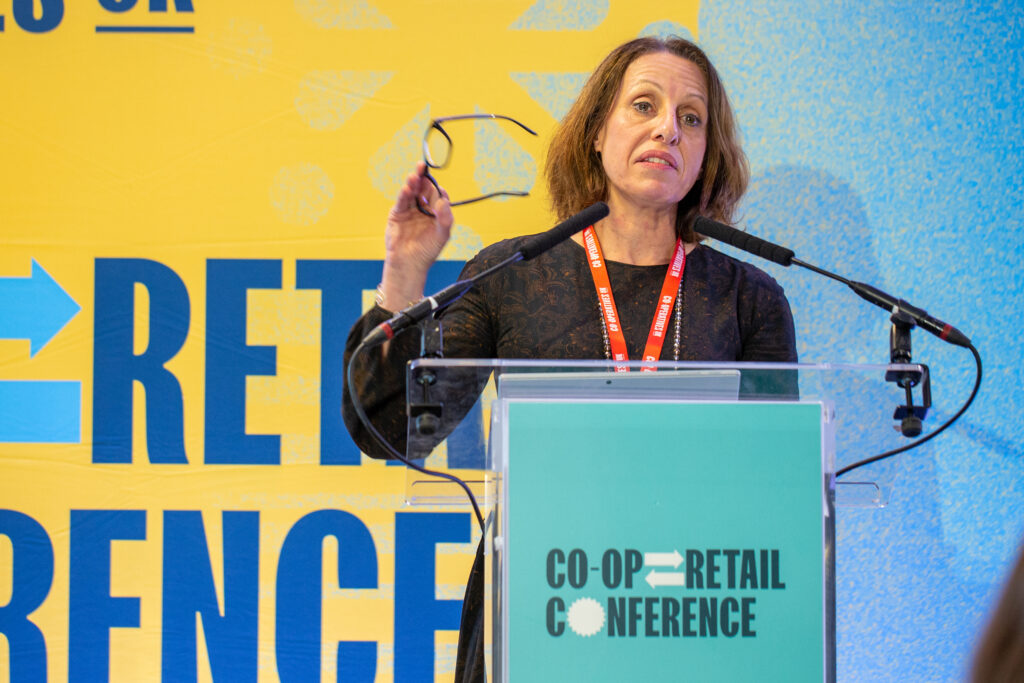
“As we approach a critical Autumn budget, there’s a real danger that the voices of small shops – and the communities they serve – are not being heard,” said CEO Shrine Khoury-Haq. “Local shops aren’t just businesses; they’re part of the social fabric of Britain. For some, a visit to a local store is one of the few chances they have to chat to someone and feel connected.
“This research shows a clear public mandate for action. Regardless of how they vote, the majority of people want the government to do more to protect their high streets. This is an opportunity for the government to really prove to people that they will do what it takes to make a difference to people’s communities and to their wellbeing.”
She added: “The proposed system would improve the financial situation of 99% of retailers. How much they are protected from tax rises depends on decisions made in this Budget. To boost local economies, create jobs and provide community cohesion, we need inclusive growth. That means supporting the businesses on the corners, in the precincts, on the parades and the high streets of every community. In order for them to not only survive, but to thrive, the Government has to commit to the maximum levels of relief.”
Related: Co-ops position themselves as inclusive growth enablers at Labour conference
Association of Convenience Stores chief executive James Lowman said: “In the last year alone, business rates bills for convenience stores have increased by over £100m. These essential local shops are now facing significant further increases with the expected reduction of the 40% Retail and Hospitality Relief, coupled with next April’s revaluation, unless the government commits to the full use of new powers to introduce a permanently lower multiplier for local shops.
“We’ve been calling on retailers throughout the summer to write to their MPs on the impact that business rates increases are having on their investment plans and have engaged directly with the Treasury to outline the difficult decisions that retailers are already having to make as a result of higher bills. It’s essential that the Budget includes a meaningful long term reduction in rates bills for convenience stores to incentivise investment and provide much needed certainty for the future.”
In terms of policy asks, 77% of small high street shop owners say business rates reform is essential for survival. Nearly half (44%) warn they would struggle to grow without protections; 36% would freeze pay rises; 26% would halt hiring – and 77% back an online retail tax to level the playing field with online giants.
The government’s current proposal is to provide permanent business rates relief for small retail properties, replacing temporary pandemic measures.
The Group has called on the Government to “commit to the maximum levels of relief in the Autumn budget and to implement swiftly to give small shops certainty”.