Passed down from mothers to daughters, Tatreez, the traditional Palestinian embroidery, dates back over 3,000 years, being a central part of the nation’s cultural heritage.
In the Kalandia refugee camp, located near the main checkpoint between Ramallah and Jerusalem, this practice is being kept alive by a women’s co-operative which has been a source of income for local families since 1958. Back then, the Kalandia Camp Women’s Handicraft Cooperative (KCWHC) was the first women’s co-operative registered at the Palestinian refugee level in the Middle East and only the second women’s co-operative in Palestine.
Two of the leading figures behind the co-op were Khadejah Farhan, a refugee from Lifta, and Fatmeh Jibril, a refugee from Yazour, who met at the Kalandia Refugee Camp. Both had been trained by United Nations Relief and Works Agency for Palestine Refugees in the Near East (UNRWA), which they later joined as employees, Farhan as head of the vocational woman training centre and Jibril as head of the overall vocational woman training centres in the West Bank.
Established by the Red Cross in 1949, in the aftermath of the First Arab–Israeli War, the camp is run by UNRWA and provides a home for over 16,000 Palestinian refugees.
“My aunt was a very strong woman and had a lot of impact in the community,” recalls Sahar Farraj, who lost her mother at the age of two and was raised by her aunt Khadejah. After moving from place to place and living in precarious conditions, Farraj’s family settled in a tent at the Kalandia Camp.
“My oldest aunt took full responsibility for raising both me and my sister, despite all the difficulties and high commitments she had”, she adds. “My upbringing was within the co-operative movement from a very young age, and I had the privilege of being raised by the leading founders of the Palestinian co-operative movement.”
“The women gathered together and started sewing clothes from home, tailoring, and started earning an income from sewing,” says Farraj.
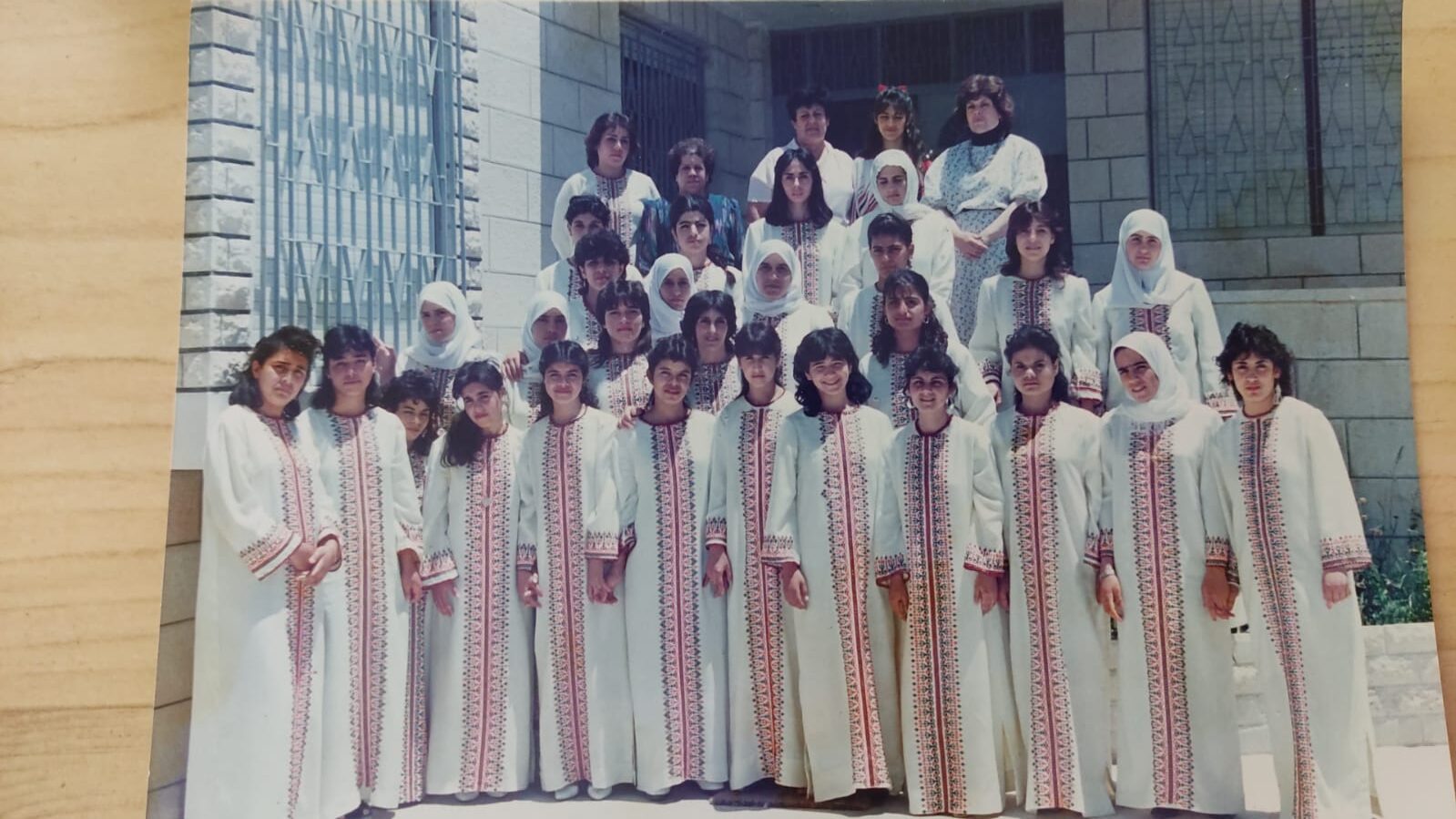
Some of the co-op’s members who graduated from an embroidery course along with the co-op’s executive committee and teachers in the mid 1980s.
Products included knits, crochets, embroidery and straw crafts, all sold from a five by five metre exhibition room within a UNRWA building. In time, with funding from donors and the labour of local volunteers, the co-op was able to expand and now occupies two three-storey buildings. The founding members remained involved in the co-op until their deaths.
“The founders were very active, very strong women,” adds Farraj. “The main objective of the co-operative since its establishment, beside serving its members, has been to empower women through its vocational training in handicrafts, tailoring and sewing, knitting, and hair dressing. In 1984 the co-operative launched a nursery as a response to the needs of the local community. This year, there were 70 young nursery graduates, predominantly coming from the Kalandia refugee camp.“
Nowadays, the co-op also employs six women representatives to distribute products and provide training to women in the region, working across refugee camps in the middle area of the West Bank and in remote villages. Five other co-op representatives with the co-op assist in developing income-generating projects and providing humanitarian assistance.
Despite numerous challenges, including the Covid-19 pandemic and the conflict in Gaza, the co-op has continued to operate, providing employment to 13 full-time staff members, 11 of whom come from the refugee camp. In addition to its production unit, the co-op runs a nursery, a vocational training unit, beauty salons, a dry food department and a humanitarian aid department. “Whatever we can make an income from, we try it,” says Farraj.
The main production section is dedicated to Palestinian traditional embroidery, which it sells via its website and and an online marketplace platform. Some members choose to knit, sew or embroider from home, in which case the co-op provides them with fabrics and designs. While embroidery is an all-year round activity, the production of knitted and sewn items varies depending on the number of orders placed.
“It’s a very low price for Palestinian embroidery,” says Farraj. “It’s a piece of art, it’s a heritage, it has a lot of meaning for the women who are working on it. They put their soul in it, and their feelings.
“We are searching for international markets to sell it and seek help to market our handmade artisan products. We understand the importance of connecting to other global handicraft co-operatives, and are looking forward to opportunities to work and collaborate together.”
After pursuing a BA in the USA and marrying a British citizen of Palestinian origin, Farraj returned to her home in Kalandia and, like her aunt, works for the co-op, where she heads the international co-operation department. As a board member of the General Co-operative Union of Palestine she attended the recent General Assembly of the International Cooperative Alliance (ICA) in Manchester, UK. This was the first time a representative of the Palestinian Co-op Union attended an ICA event. The union’s chair did not receive a visa to travel to the UK but Sahar and her daughter Dunia already had visas so they were able to attend, make new contacts, share their experiences and learn what other co-ops are doing.
“We are calling for peace all over the word, a peace that is just. We are calling for the end of the genocide in Gaza. Our people are suffering and it’s hurting us a lot,” says Sahar.
She also hopes to be able to build collaborations with co-ops in other countries.
“Our coordination with other co-ops should be mutual, we should change our way of thinking. It should be mutual interest, to give and take. And there are a lot of ways to do that. If you like my product, and you need this scarf, and I can produce it for you, and you are happy with it, this is a mutual benefit.”
She argues that sometimes aid money is spent on workshops, seminars and lectures and projects tend to focus on Palestinians as aid receivers, rather than equal partners.
“The people in Palestine are very intelligent, very educated, they have access to internet, to information, they have new ideas. Let us together think how we can have mutual benefits.”
In her view, all programmes should be mutually beneficial and practice-based.
“Let’s say I’m a poor fisherwoman. I know how to fish, I’m a fisherwoman. But my boat was destroyed and my tools were stolen. So what do I need? Do I need you to teach me how to fish?
“We should think of projects that are mutually beneficial. For example, ready meals. Maybe I contribute a Palestinian dish, I give you the recipe but I will sell you a dry mint to put in the recipe so they income will come from the dry mint.
“But then how about not being able to export dry mint due to the occupation? In that case, you can pay me for the recipe. So we have to think this way about mutual benefit.”
Farraj’s life and those of her family were shaped by the co-operative, which is why she views co-ops are one of the main anchors to build a society and solve community problems.
“When we want to talk about the development and the growth of the Palestinian co-operative movement, we are looking at a unique experience that is difficult to compare to any other co-operative in the world,” says Farraj.
And while she believes co-ops should be able to generate their own income, she knows that challenges beyond their control can make it difficult for co-ops to continue operating.
KCWHC, which has grown to include 58 members, is just one of Palestine’s 336 active co-ops. The movement dates back to 1924, when the first Palestinian co-op was established in Akka, bringing together tobacco farmers. That co-op has ceased operating, as have hundreds of others.
“Support from governments is a must,” Farraj insists, “as co-operatives hold a huge burden on their shoulders, especially in our case, as a grass-roots organisation, working with the community and sharing their life, sometimes deviating us from concentrating on us being an economic enterprise.
“So while we want to be economically independent, we need to do fundraising. We need to be a receiver and that also leads to accepting donor conditions which sometimes are limiting, and result in wasting a lot of the donation on logistics and not on the ground, also here we lose our freedom and equality.”
In 2001 the United Nations Educational, Scientific and Cultural Organization (Unesco) recognised the significance of tatreez by inscribing the practice on its Intangible Cultural Heritage of Humanity list.