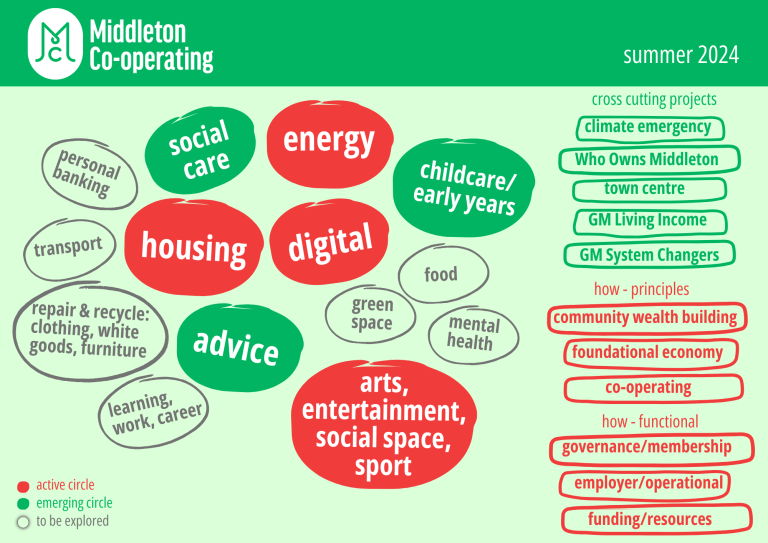
Middleton is a town in Rochdale, the borough that gave birth to the co-operative movement – and it’s now home to Middleton Co-operating, a grassroots project aiming to bring people together to drive positive change. They want to use co-operative ideas to improve the affordability and quality of the things that have the biggest impact on people’s lives, from housing and energy to child care, social care, food and transport.
One of the town’s most famous sons is actor, comedian and producer Steve Coogan – who is a wholehearted supporter and patron of Middleton Co-operating, and who spoke at Co-operatives UK‘s Co-op Congress in July about the state of the nation and how people need to rise up and effect change.
“I grew up in Alkrington, Middleton, and feel fortunate to have had such a good childhood,” he tells Co-op News. “I went to a local state school, which was a pretty good foundation. There was a lot of greenery around. I think I was part of an aspirant working class where you’re encouraged to try to better yourself and be a responsible member of society. My parents fostered children. We had Encyclopedia Britannica before we had a colour television. So that was always sort of ingrained into me: that knowledge is power and you try to do your bit.”
There was an awareness of co-ops, and a knowledge that “it wasn’t just the shop, that it had roots in the community and helped empower people,” he adds. “I probably didn’t know much of the details, but I knew that co-operatives were people getting together to help each other.”
Before Middleton Co-operating, Coogan was involved with the Lighthouse Project, a charity in the town that works as a one-stop shop for people who need help. “It’s a stepping stone for people who are in a hole and need help to get out of the hole, whether it’s a health, psychological or financial one,” he says. “I found that quite inspiring, the idea of local people being helped by other local people who know what they are doing. And that, in and of itself, was quite a revelation to me.”
Related: Co-operators gather in Greater Manchester
Joining Coogan at Congress was Mark Fraser, who is working with Middleton Co-operating to transform the local community and economy – and who persuaded the actor to get more involved.
“Mark told me about his plans to get this thing going, this Middleton Co-operating. And it sounded really interesting,” Coogan says. “I quite liked its ambition, as there is this myth that people who want to help people are naive and have no organisational skills. But I always say that maybe you can’t change the world from the top – but you can change the world from the bottom. History has proven that time and again, that you can have quite a tangible and immediate effect by doing things a different way – a way that is based on something that was founded 180 years ago in Rochdale and is needed now more than ever.”
The Middleton Co-operating launch event took place last year. “Steve came, Andy Burnham [mayor of Greater Manchester] came, Rose Marley [Co-operatives UK CEO] came, and it was a lot of fun,” says Fraser. “This was followed up with a fundraising festival – lots of drinks and music. We have this mantra we borrowed from Cormac Russell [from the Asset-Based Community Development Institute], which is, ‘Why would you go to a meeting when you could go to a party?’ In terms of getting people engaged and interested, that’s how we do things. We do things that are fun, that are interesting, that people can enjoy.”
The deliberate name choice reflects this, too, Fraser adds. “We’re called Middleton Co-operating [rather than Co-operative] as we’re not about promoting co-ops as a business model in particular, but more about people across Middleton coming together and working together. One of your previous articles about us called us ‘crazily ambitious’. And I think when we started, yeah, we were crazily ambitious. But now the things are getting done and it doesn’t seem so crazy any more. It’s happening.”
The project “sort of aligned with my disillusionment with national politics,” Coogan adds. “And therefore it seemed to me that all roads led to Rome. Rome, in this case, being Middleton Co-operating.”
Related: ‘Crazily ambitious’ plan to make Middleton a co-op town
He is highly disappointed with the central government and the current Labour administration. But, he admits, “we might thank them in the long term for proving the point of the lack of efficacy when it comes to changing the lives of ordinary people, because it’s empowering them. People are thinking, ‘Well, there is actually a choice out there. ’ And it’s not a voting choice. It’s a choice of getting involved in your local community and empowering yourselves as a group.
“Individuals sometimes feel like they’re going to lose something if they get involved in helping other people. They don’t realise there’s a net gain for everyone. And that myth is put about by other vested interests who don’t want those kinds of community initiatives to thrive – because when they thrive, everyone benefits, except big multinationals. That’s the biggest legacy of Margaret Thatcher, that we’re all supposed to think of ourselves as individuals and as islands. No man or woman is one.”
Middleton has a fascinating architectural history and is home to the Golden Cluster – a collection of heritage sites and historic landmarks. The town and the surrounding countryside contain 45 listed buildings, including the Grade II listed 100-year old Warwick Mill that has sat empty for decades. Just before the Covid-19 pandemic, a residents’ action group looked at developing a bold vision for the mill as a community-owned space, with community wealth building at its heart. The council was on board, but a planning application submitted by the building’s owners – a Chinese conglomerate – stalled progress. Greater Manchester Combined Authority and local authorities encouraged the group to expand the idea across the town – and so the idea of Middleton Co-operating was born.
“The people that are taking money out of the Middleton economy are at a distance,” says Fraser. “They haven’t got a connection with local people. So the way we build and engage is about individual conversations and relationships, and developing trust and friendship. We’re growing slowly and organically, but it’s a really solid base, because it is about people, friendship and connection, and that, in itself, builds power and a sense of agency that we can do good things together that will make our lives and community better.”
He believes ownership is a key word, because a lot of Middleton is owned externally by wealthy individuals and organisations elsewhere. “People think it’s our shopping centre or our Warwick Mill – but when you look at how ownership maps out, we don’t own much.”
“I think,” Coogan adds, “there’s also a mentality which is encouraged, which is, ‘You don’t know how to do this. It’s not your place to take initiative or ownership or to have initiative.’ But when someone points out that if they do something they’ll find people around them to support them, it’s almost like people have an epiphany. They are so used to being disempowered that their mindset takes a while to adjust to the fact they have autonomy. It’s a culture shock.”
Middleton Co-operating works across housing, energy, digital, the arts and music, with community-led ‘circles’ focusing on different projects through sociocratic decision making. The energy circle, for example, received funding from Community Energy England to do feasibility studies for a wind turbine on a local secondary school and a solar array at Rochdale Hospice. The culture circle has connected with the Arts Council-funded Rochdale Culture Co-op to improve community access to arts and culture opportunities – and to be their delivery partner organisation in Middleton.
“We talked to local people who were interested in arts and culture, who said: ‘The town needs a space that’s visible, that can be ours, that people can see and come to’,” says Fraser. “We’ve now got Art House Middleton, a community art space led by cultural pioneers – essentially local people who are interested in the arts and culture – and have funded an engagement person to help people connect with it, and a community artist to help run an artistic programme.”
Coogan’s comedy creations – from Alan Partridge to Tommy Saxondale – often address tensions found in communities and institutions. How does he see projects like Middleton Co-operating work, in terms off building communities and easing those tensions?
“Class tensions and the attritious polarisation of people and their tribes benefits social media owners, but doesn’t benefit communities, because tension and discord is the stuff of drama and comedy,” he says.
“Pitting people against each other is in certain institutions’ interests, but it’s not in the interest of local communities. A lot of the time, if people who have distrust of each other start organising together, they realise that the whole thing of having more in common than divides us is true. You don’t have to agree on every single thing, but if you agree on a few common parameters, you can start moving in the same direction and that creates a creative momentum.”
“There’s a mutual interest for the whole of Middleton in having a healthy and cohesive community,” adds Fraser. “You’re never going to get everybody on board, but it’s about getting that critical mass.
“It’s about saying to people, we understand if you feel disempowered, disengaged and ignored, but there’s an alternative to just trying to elect people to local and national government. There’s another way to effect change.
“People can change their lives. It seems insurmountable, but hope creates its own momentum.”