A hundred years ago, in 1925, a group of young people led by writer and journalist Leslie Paul became frustrated with the scouting and Kibbo Kift youth movements. Vexed by the rigid hierarchy and emerging nationalism and militarism of these groups, they founded something different: the Woodcraft Folk. Their vision was simple yet radical. Children, they believed, should not just be trained for obedience or patriotism, but nurtured as confident, curious citizens who valued co-operation, equality and peace. The Woodcraft Folk would give young people the tools to shape society, not just slot into it.
A century later, the movement is still going strong, with thousands of young people attending weekly group nights, taking part in local, national and international camps, and engaging in education for social change.
For Seren Waite, who co-coordinated this summer’s international camp – Camp100 – at Kelmarsh Hall, being in Woodcraft Folk has been transformative. “I got roped into stewarding at the last international camp, Common Ground, in 2022,” she recalls. “Then one of the co-ordinators asked me if I wanted to do more [for Camp100] and I said yes – with the caveat that I had no experience and hadn’t really organised anything before.”
Three years later, aged 21, Seren was overseeing a camp for 2,000 people. “So many people here would say that they can’t really imagine what they would be doing or who they’d be if it weren’t for Woodcraft,” she says. “Some are in their career because when they were 16, someone said, ‘Hey, do you want to have a go at running this thing and see if you like it?’ And either they found a passion and did it their whole life – or decided, nope, I’ll try something else. But they were given the opportunity and had a bit of ownership over a thing, which you don’t really get anywhere else at such an early age.”
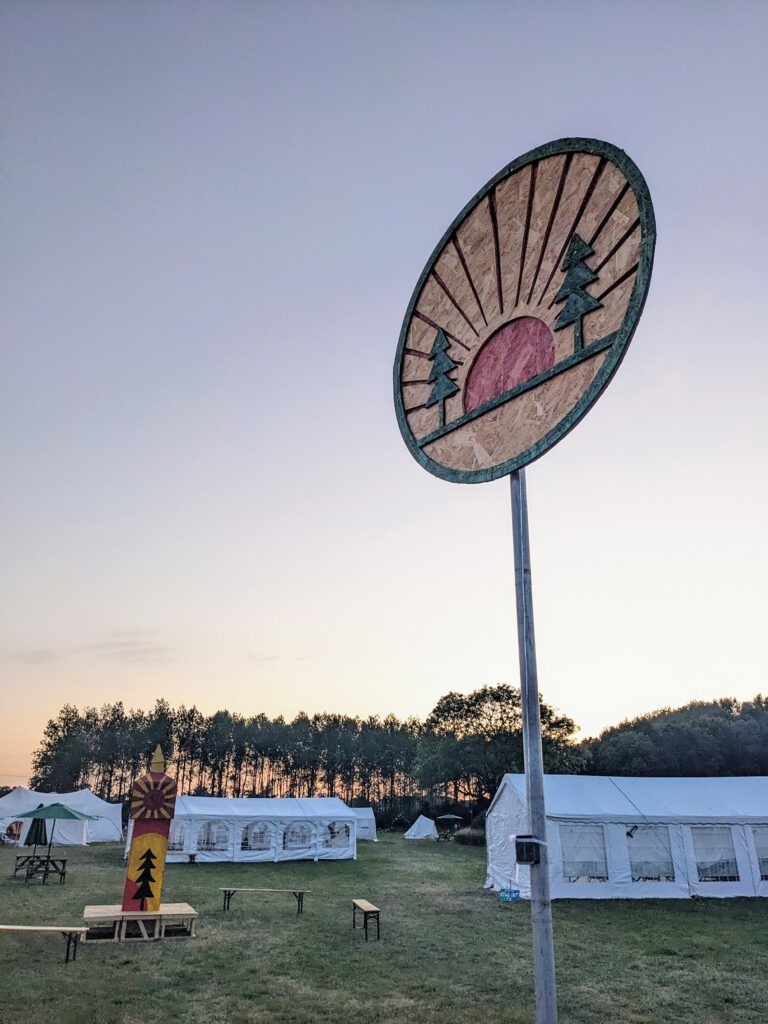
The movement’s age-group structure – Woodchips (under 5s), Elfins (6-9), Pioneers (10-12), Venturers (13-15) and District Fellows (16-21) – creates a pathway from play to leadership that extends to governance of the organisation.
For Eedie, a 20-year-old trustee, Woodcraft Folk has been a constant presence. “It was a big part of my childhood,” she says. “When I started, it was about playing games and learning how to co-operate – and about peace and what that means. But as you get older, it’s more about volunteering and working with younger people to make the principle of education for social change a reality.”
Now, as one of several under-25s on the General Council, she helps shape national strategy. “We’re quite big on young trustees. I wanted to be on the other side and make sure that it keeps doing what I loved doing – and that other young people get the experiences I’ve had.”
Governance is no token role; young trustees participate fully in finance and strategic discussions. “We’ve been looking at our values and what we really want to focus on to keep Woodcraft strong and happy,” explains Eedie. “There’s a particular focus on sustainability and equality, diversity and inclusion. When something happens in the world, we make a statement. But it’s also about running camps and having centres where people from different countries and backgrounds can come together and learn.”
International camps have always been at the heart of Woodcraft Folk’s practice, designed as miniature societies where co-operation is lived as well as taught. The sites are arranged as villages, towns and a central gathering space. At Camp100, each village brought together around ninety people who not only sleep and eat alongside one another but also share practical responsibilities like cooking, washing up and other communal tasks (‘clan’). Several villages form a town, each complete with its own library and spaces for play, while the central area includes a main stage for performances and assemblies, a café, a pub, and tents dedicated to themed activities and discussions. From crafts and STEM projects to alternative economy debates, a post office, printing press, FM radio station and media space producing a nightly newsreel, everything was designed, built and run by young people.
Samuel was in the radio tent. “My mate Tyler put the sound stage together, but I show up and do a couple of radio slots,” he says. “I like getting as many young people on as I can to have lovely conversations – it’s great to put a smile on a young person’s face, and seeing how your input can affect them.” For him, Woodcraft has been life-defining. “It’s impacted me massively, it’s been a backbone for me,” he says. “To me, Woodcraft Folk is about co-operation, caring for each other, loving each other and helping people grow. It’s made a massive impact on how I look at life and how I want to live my life.”
At the Camp100 post office, Hufi and Zoe were sorting mail. “I love the post, and I love arts and crafts and sending letters,” says Hufi. “It’s a really fun way to foster new friendships, particularly internationally.” At the post office tent, campers could pick any of the donated postcards – or draw or craft their own envelopes – address them to villages and towns around the camp, stamp them with the pigeon stamp and post them in the post boxes. Each evening, mail is delivered to village marquee letter boxes.
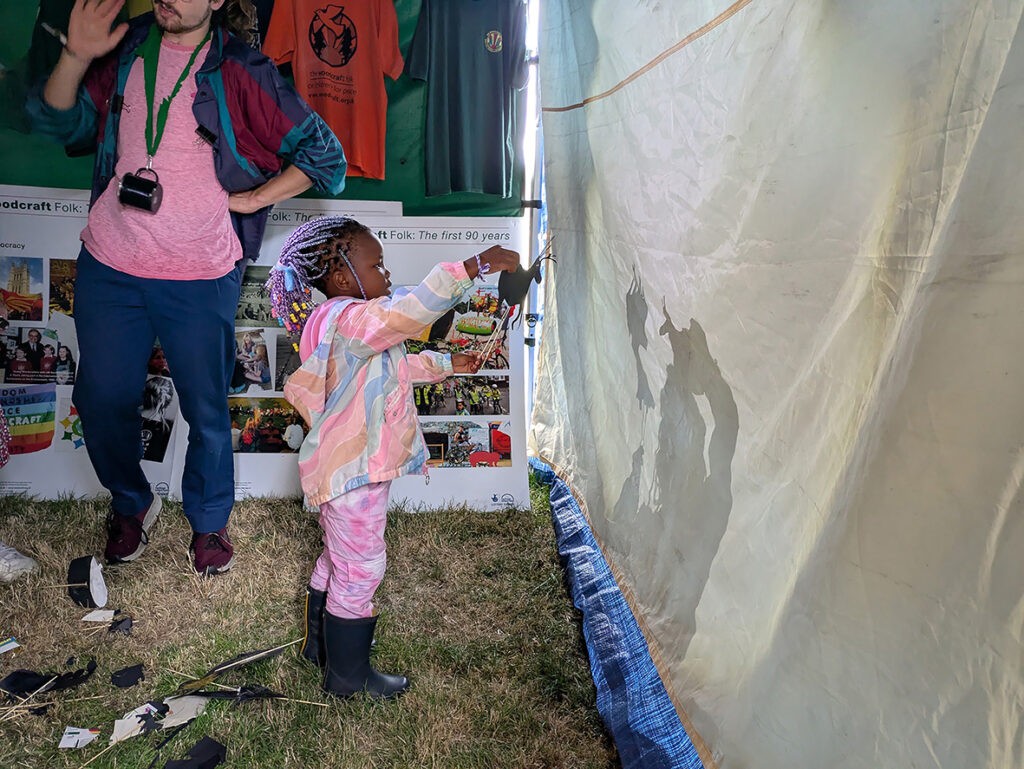
“We just received a scroll written in Arabic,” says Zoe, “from a member of the Leeds delegation to the Western Saharan delegation, wrapped in the colours of the Western Saharan flag. We also had some stuff in Welsh sent to the Welsh district, who then couldn’t read it until their Welsh speaker arrived!”
There were also groups of young people who travelled from Ghana, Chile and Peru. Two of the librarians travelled from Nicaragua and the USA.
For many, Woodcraft Folk has also been a place of personal discovery, explains Eunice, a DF working in the printing tent. “I think I started to meet other trans people in Woodcraft, which started to make me realise my own identity. It’s given me confidence. The youth empowerment element really comes through – you get to run stuff and contribute.”
Jackson, now 21, first joined as an Elfin. “One of my friends did it and I brought some others along; it just stuck,” he says. “It’s nice being in co-operative environments dedicated to acceptance. That positive energy rubs off on people and makes them better people.” At Camp100, Jackson was part of the nightly newsreel team. “We teach people how to film and edit, and then show the videos every evening. Kids love it—there are comedy clips alongside informative ones. Audiovisual media is one of our greatest achievements – it’s a fun way to engage children creatively, and it’s a useful skill.”
Camp100 also placed particular emphasis on reducing its environmental impact. The menu was deliberately “meat-light,” while compostable toilets were introduced for the first time. Food was sourced through a mixture of wholesalers and co-operatives such as Suma, with Central Co-op delivering bread and milk every other day. Alongside the environmental focus, accessibility was built into the camp’s design. A dedicated accessibility team was on hand throughout, four mobility scooters were available for hire, and quiet and sensory zones were created to support neurodiverse campers.
Woodcraft Folk’s uniqueness lies in its combination of joy and justice. Lloyd Russell-Moyle, confirmed as the new General Secretary during Camp100, puts it plainly: “Having fun is a political act in a miserable and sad world. Playing games that aren’t about winners and losers, but about enjoying ourselves together, is political. It brings communities together.”
For Russell-Moyle, a former Labour and Co-operative MP who grew up in Woodcraft Folk, the next century is about growth without losing values. “If we don’t grow, we risk withering,” he says. “Growth means reaching more working-class communities, building partnerships, and putting our centres on a strong financial footing. We must continue to lead—especially now, as hostility to young people’s rights, migrants, and internationalism increases.”
And he insists the method matters. “Group nights are where relationships are built, where children learn to trust each other and gain the confidence to change the world. Camps are transformative, but without the weekly rhythm, we’d just be a summer programme. Our strength is in both.”
For Seren, another future challenge is strengthening the District Fellow age group. “We’ve lost numbers,” she admits. “It’s a weird age – some are at school, some at uni – and maintaining links is hard. I’d love to see more DF events: music fundraisers, protests, social nights. That would encourage people to join without the big leap of a summer camp.”
For Zoe, now 30, it is about connection. “Every time I’ve moved, I’ve joined a local Woodcraft Folk group to volunteer – that’s how I’ve built community. I’d love Woodcraft to collaborate more with other co-operative organisations. We have this rich history of music and protest – why not share it with the world?”
And for Eedie, the activist heart remains vital. “There are lots of youth groups where you go once a week, have a nice time, even go camping. But the extra element of activism is what makes Woodcraft special. And it’s not forced—it just comes naturally from learning about peace, justice and cooperation. That’s my favourite bit.”
Woodcraft Folk has evolved over the last century, but its belief that young people, trusted and empowered, can change the world, remains. For Jackson, this is the essence of the movement: “Its principles are good – even when the world isn’t in the best place. It would be great if more people learned the Woodcraft way.”
As the organisation celebrates its centenary, Camp100 showed how co-operative principles can be lived in practice. A hundred years on, the Woodcraft Folk is still proving that fun, friendship and co-operation can help build a better world.