The origins of the UK’s co-operative movement are firmly rooted in working class history. But today, co-ops explicitly using the language of class politics appear to be the exception rather than the rule, and co-operativism in general is often viewed as an ethical shopping option or political hobby for those with the money and time to spend on it.
With equity and solidarity core co-operative values, how does the issue of class factor into the country’s co-op landscape today?
A Revolting Class (Arc) supports co-ops and other social change groups looking to better understand this topic, through its Exploring Class workshops.
“We’re at a point now where we get so many housing co-ops across the UK reaching out to us,” says Arc’s Elle Glenny. “We get plenty of people showing up that are involved in the worker co-op movement as well.”
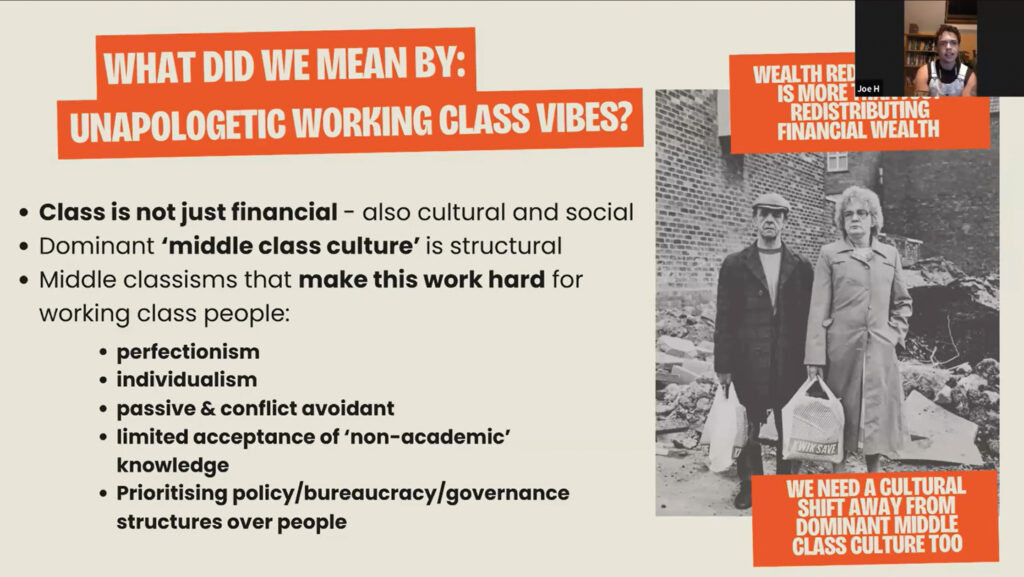
The level of interest Arc receives from co-operatives points to a widespread issue of the movement being “culturally, economically and socially dominated by the intermediary and middle classes”, says Glenny.
“I think undeniably, the culture in the majority of worker co-ops, housing co-ops, co-operative spaces, overwhelmingly, is this quite liberal, middle-class way of being … There is a certain way of dealing with conflict, and bureaucracy is used to silence and minimise people. If you show up in a dysregulated way, in a traumatised way – all of these things that we see in working class communities – that is not welcome in those spaces. They might say it’s welcome, but I think if we really interrogate co-operative culture, it’s not the done thing.”
This understanding of class, which encompasses more than just economics, is one Arc is keen to develop in social change spaces.
Related: How a housing co-op is working to foster unity and cohesion in Leicester
“What’s hard about this conversation is that when we’re talking about class people are always coming at the topic having their own different class analysis. The orthodox Marxist one tends to piss me off a bit. I find it reductive when we’re talking about co-operatives and worker power.”
This orthodox Marxist view, says Arc, minimises class difference into a ‘99% vs the billionaires’ dichotomy “which allows those who sit between the working and owning classes to ignore the role they play in perpetuating a violent class system, not just in wider society but within our social justice spaces too”.
While class struggle exists in workplaces, it also takes place in communities, in the household and on an interpersonal level, and needs to be acknowledged and negotiated in all of these spaces, says Glenny.
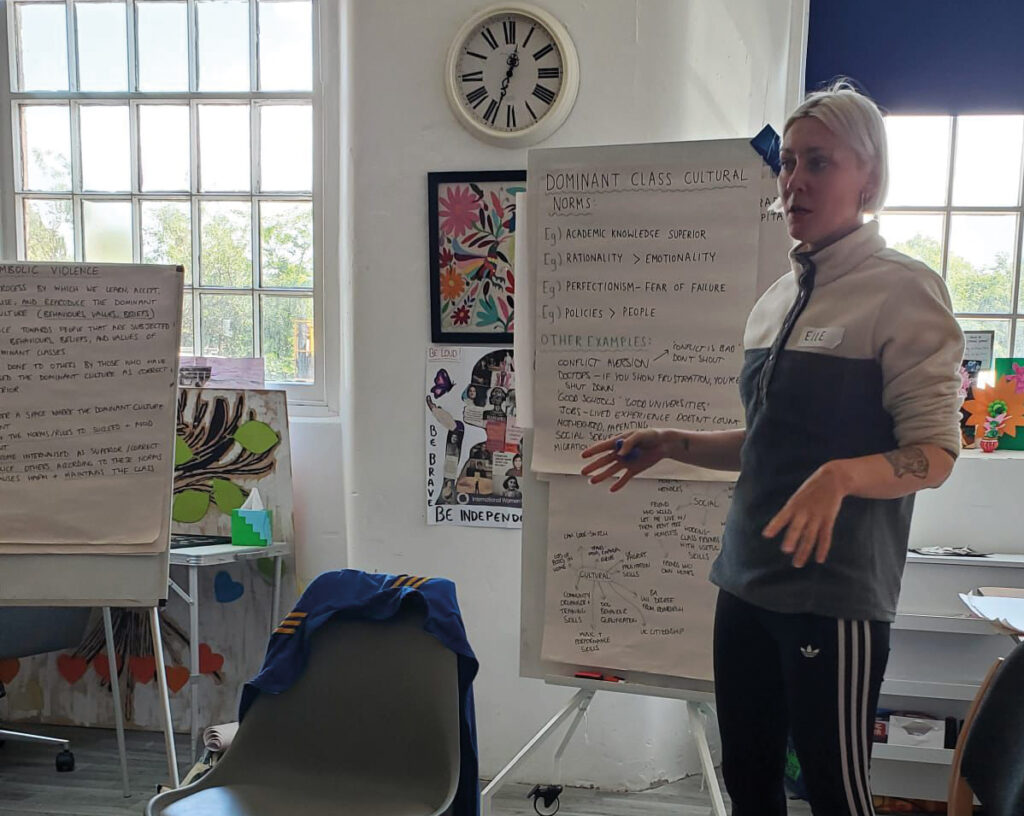
Main photo: Joe Hamiliton and Elle Glenny delivering Exploring Class workshop
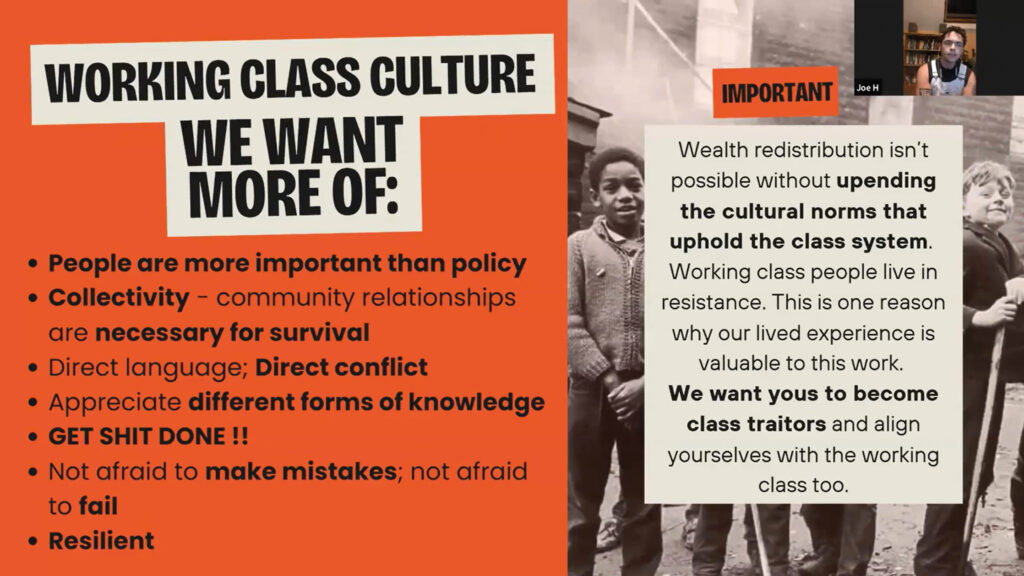
Arc’s Exploring Class workshops take 20-25 participants through an experiential learning process where they are able to reflect on their class identity in relation to others in the room.
“In an ideal outcome, the working class people in that space leave feeling hopeful, angry and like they’ve had a practice of doing cross-class conversations in a way that is empowering to them and is on their terms and is aware of the lives in which they have lived, which is always amazing to see happen.”
Glenny’s own experience in the co-op movement is of being “one of the very few working class people in those spaces”, and these were spaces she didn’t even know about until reaching university.
“[Growing up in Liverpool] I didn’t know what co-ops were. It just wasn’t something that was spoken about. Whereas when I chat to my middle class pals, they’re like, ‘yeah, of course we knew what co-ops were’. I’m like, ‘why did you know that when it was rooted in working class culture?’”
Related: Co-ops find space in exhibition on working class culture of 19th century Lancashire
Despite the clear links between the UK’s co-operative and working class movements, their relationship has not always been straightforward, even from the beginning.
“There have been debates for a lot of years, among labour historians and others, about whether the co-op was part of a so-called ‘labour aristocracy’,” says Tom Woodin, professor of Social History of Education at University College London.
But by the 1960s the co-op movement started to see “a quite precipitous decline”.
“And what happens in movements that go into those kinds of decline, is people tend to hold on to their jobs, and so sometimes you get people who come from working class origins in good or quite well-paid jobs, or in elected posts, and then they just hold on to them, and it can ossify a little bit.”
This process took place as consumer co-ops in working class communities were being out-competed by bigger retailers with lower prices.
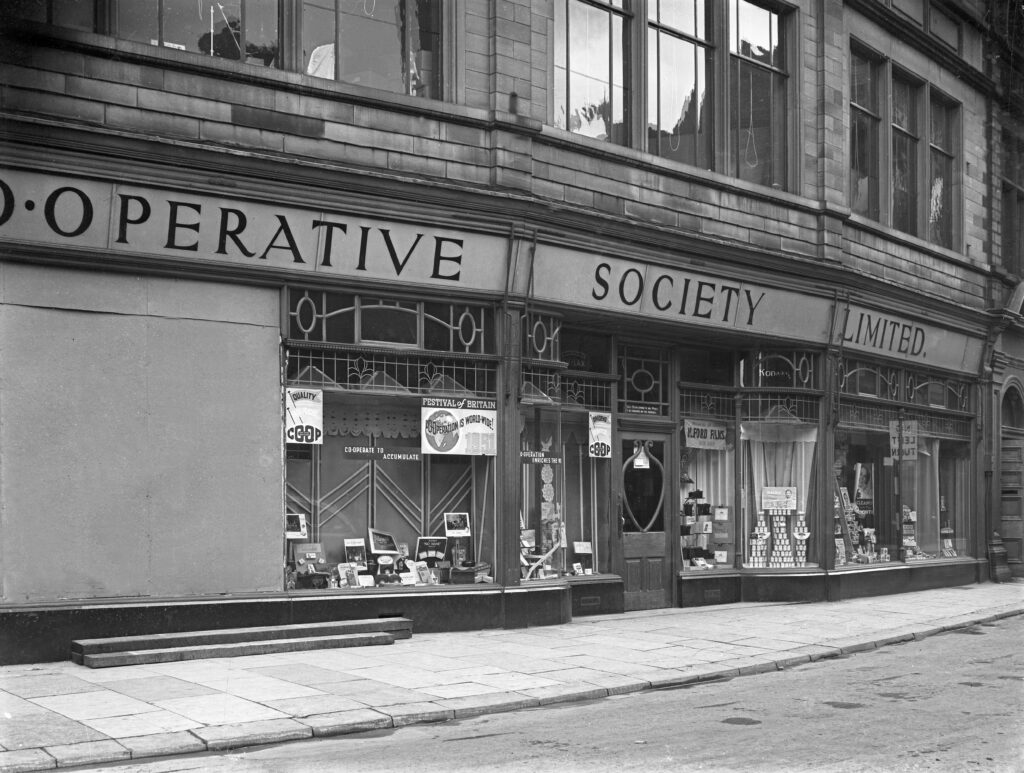
“The 1960s is a massive decade in some ways…it was the beginning of very significant changes, and in a way, that bypasses the consumer co-op movement. That’s where you get other types of co-ops born, because co-ops and collectives become very much part of the ether in the 60s and 70s, some of which may be the health food co-ops and others, [that attract] certain types of people.”
Then national conversations about class declined as Thatcher’s government weakened the labour movement and halted research on social class and poverty in the UK, and class became a topic people and organisations were more hesitant to talk about.
Related: How Nepal’s co-ops are minimising caste-based discrimination
“When I worked for the Co-op College in the early 2000s, I did a project with some consumer co-ops about improving their membership and attracting members. I wrote up a brief thing about one of the co-ops, and I went through the detail of how it had been established. I said, you know, it’s established formal working class self-help, or something like that, about the people who had established it. And one of the co-op’s marketing guys asked me to take out that reference to the working class, because they like to appeal to everyone nowadays – he was quite wary.”
All of this presents the question: are co-ops even of use to working class communities anymore? For Glenny, the question is one worth seriously considering.
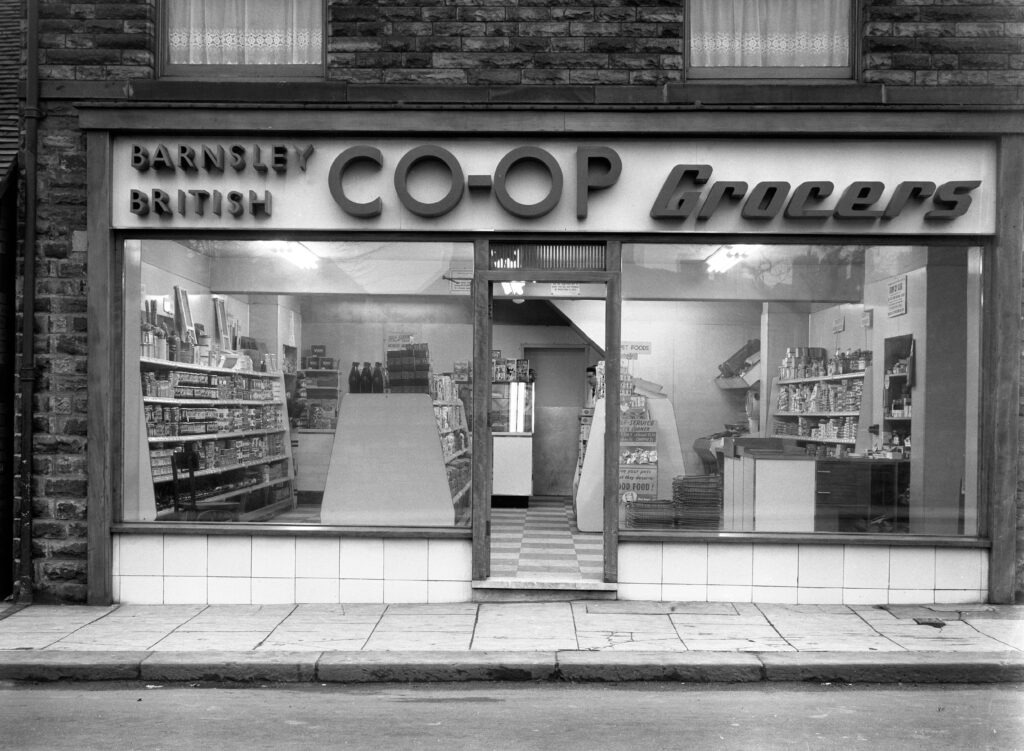
“The community I live in, up in Glasgow, is one of the most deprived neighbourhoods in the UK, it has the highest rates of childhood poverty anywhere in the UK. And I was born in the UK’s poorest constituency.
“They’re the two communities that I’m thinking of, and honestly, I think that worker co- ops, for at least for those communities, are more of a hindrance than they are a benefit.
“I know that from being a part of co-op – it’s a lot of upkeep, there’s a lot of admin involved, certain structures, certain principles you have to adhere to, and a lot of interacting with other co-ops, which I think can be quite alienating, depending on the culture of those co-ops.”
Woodin recognises this critique, but believes the co-op model still offers something uniquely valuable.
“What always attracts me to the co-op vision is the ownership models. They’re much clearer on the need to create models in which working class people could potentially have a greater stake and long term ownership. … That’s what’s always appealed to me, that co-op models could provide more sustainable support structures away from the state for working class people.”
He adds: “The huge benefit, I think, of the co-op model, is that you can potentially lock long term resources and knowledge into communities, rather than putting all your resources into helping people temporarily. All those resources can be stripped.
“What hasn’t been done is all the educational work, all the creative work that’s needed to take that model and make it useful for today, for the post-war world. You can’t just take a model off the hook and apply that to working class communities. … There’s a lot of work that would need to be done, and people have to take ownership over it, you can’t force it.”
This idea of agency is key for Glenny as well.
“A common trope we see again and again in social justice spaces is assumptions about what working class people want and need.
“No – what working class people want and need is autonomy and resources. And those resources need to be given not on the terms of the middle classes.
“The whole point of wealth redistribution, for instance, is not to just give away your money, it is to also give away the decision making and the power that comes with that money.
“Because working class people know best where working class people should be putting money, because we’re already doing it.”
In addition to the Exploring Class workshops, Arc facilitates events for working class organisers, as well as holding a number of wealth redistribution groups across the UK, called Common Treasury.
“We do a two-hour training session on redistributing inheritance, and the amount of money in the room every time, it’s just disgusting. We’ll have 120 participants, and there’ll be like, £60m. And that’s our point – what are we struggling for within the left? There is so much wealth.”
These conversations around wealth and class more broadly have real implications for the future of the co-op movement. But, says Glenny, “the end goal of raising class within co-operative spaces is not to fragment the co-operative movement and break it down and silence some voices and highlight others.
“The point is to name what’s not being named. The point is to visibilise the wealth and class inequalities within a space… and through doing that, hopefully create a movement which is stronger, more cohesive and led by and for those who have experienced capitalism at the sharpest end.”