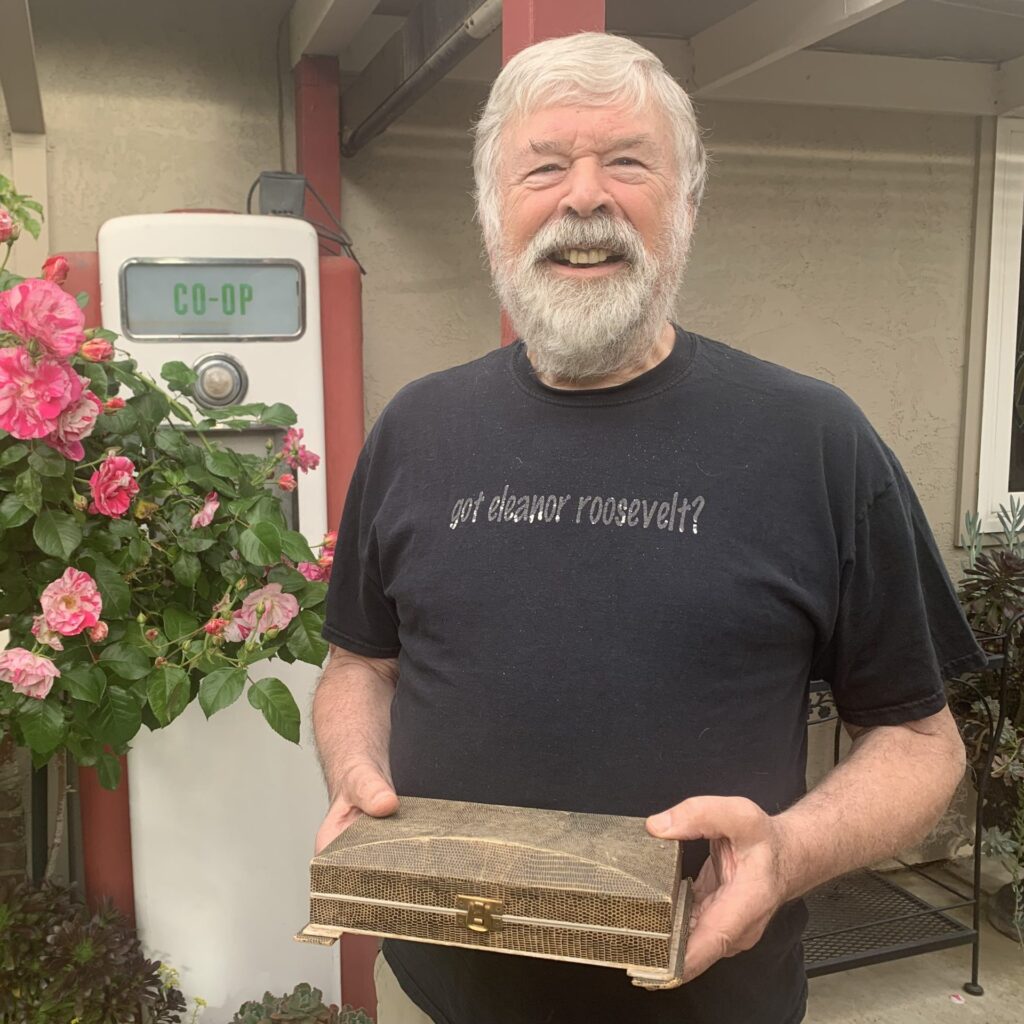
David J Thompson has been gathering books and co-op memorabilia since the late 1970s – and is now looking to pass on his historic collection to a new generation of co-operative collectors
and educators.
“Education is, for me, the most important element of the co-operative principles that we have,” he says, “because it’s the only principle that actually tells you that you ought to do something about the other principles.”
Thompson has dedicated his life to educating others about co-operation, through authoring four books and over 400 articles about affordable housing and co-operatives – many of which have been published by Co-op News. During his professional career, he has developed or co-developed co-op and nonprofit housing that is home to over 10,000 people. In 2010, he was inducted into the US Co-operative Hall of Fame.
His library of over 5,000 books on co-operation and collection of nearly 1,000 pieces of co-operative memorabilia came about because of a drive towards the pursuit of knowledge and personal betterment, he says – a driving force that was ignited after he left school.
“I was at a UK grammar school and left at 15 before taking General Certificates of Education (GCEs). I got a letter from my headmaster, which basically said ‘He is not academically inclined, but he will make a good employee’! For the rest of my life, I have been trying to build a vocabulary that I didn’t have, [to] write better, write books, and it’s all to show that headmaster what I could do.”
Related: David J Thompson on a pioneering co-op of the Civil Rights movement
Born in 1942 into a co-op family from Oswaldtwistle, 18 miles from Rochdale, Thompson grew up in Blackpool, where “mum worked in the Blackpool Co-operative department store, dad worked in the co-op bakery, we had co-op milk delivered to the front door and co-op coal delivered to the back door! I loved it as an institution.”
This love only grew when he left home at 15, moving to London and working at the Grosvenor House Hotel as a teaboy, living in a hostel for hotel employees. “I became afraid of messages that Russia could send an A-bomb that could land in 10 minutes, and became interested in the anti-war movement,” he says. “I participated in the first ‘Ban the Bomb’ rally where the Peace Sign was first revealed, in Trafalgar Square on the Easter weekend of 1958. The trucks that brought the barriers and chairs for the demonstration were from the Education Committee of the London Co-op. The leaflets were printed by the co-op, the microphone and sound equipment were supplied by the co-op and I thought ‘Wow, my co-op does this? Fights against wars? This is something to be really part of.”
This set the course of his life – and his professional motivations. Thompson immigrated to the US in 1962 and soon became active in the US co-op world. In his support for civil rights, he was a bodyguard for Robert F. Kennedy and Cesar Chavez and worked with John Lewis. While he was regional director of the National Cooperative Bank (NCB), which he helped create, it funded 2,251 units of co-op housing and developed 1,190 units of non-profit affordable housing in a partnership he founded.
“Throughout my life I’ve tried to be a practical idealist, and I’ve really felt this as a responsibility,” he says. “We have to educate people about how to build a co-op economy that doesn’t have an army or missiles, but focuses on trying to get people to do the right thing, better, without hurting others.”
For him, books were a core part of this education. “Having books, which I didn’t have as a kid, was important to me. And at some early point in my co-op career, I decided that I would start collecting books on co-ops – that collection now covers around 64 linear feet of a library.”
Thompson used the books as sources for his book, Weavers of Dreams and other articles he wrote about the histories of the Rochdale Pioneers and of co-operatives in Europe and the US. “I found that nobody else had them,” he says. “There’s no US university that has a dedicated collection of books on co-operatives that it makes available to the public.”
He also started collecting anything else that said ‘co-op’ on it, from badges and posters to Pop Art co-op milk cartons and commemorative anniversary cups and plates.
Related: David J Thompson on how Mussolini could not kill the co-ops
“I have a bust of [George Jacob] Holyoake in my living room, God bless him, [and] I have a few books by him and others about the beginning of the Rochdale Pioneers. I have combed through their books so often – and had them leather bound in Portugal because they’re so meaningful. They are probably my pride and joy. I also have a copy of Weavers of Dreams signed by Ban ki-Moon, then-secretary general of the United Nations.”
Thompson is now 83 and, with a recent Parkinson’s diagnosis, he is pragmatic about the future. “I didn’t want to leave dispensing all these things to my wife after I’m gone. I felt that was a terrible responsibility to give to her.”
To this end, he wants the book collection “to go to where it’s the most useful to the most people who want to use it,” citing co-op libraries in Japan, big organisations such as Desjardins or co-op departments in universities as potential homes. “I’d like them to go where they will be used, not stored,” he says, adding that digitisation of the collection is something he would also hope for.
Thompson’s memorabilia collection has many historic pieces from the first co-op in Rochdale and other English and Scottish co-ops, some dating to the 1850s, as well as many pieces from the US, Asia, Europe, Latin America and countries behind then Russia’s Iron Curtain, where he travelled professionally whilst director of international relations for the National Cooperative Business Association (NCBA).
Although some items from the collection have been reserved for people in the co-op movement in the US, the majority has been made available on eBay with the help of his brother, Philip – who is also creating an online virtual tour.
The books, however, he would like to disperse as the David J Thompson Co-operative Collection to an entity that is a co-op or serves co-operatives. He is inviting applications, asking institutions to share information about where the collection would be kept, why they would like to have the collection and whom it would serve.
Two decades ago, the collection (which has since doubled in size) was valued at US$27,000 (£20,000), but he would also consider institutions who do not have funds, although shipping would need to be covered.
“Letters from co-operatives or institutions that have no funds to offer are welcomed as those will also be seriously considered if they provide other benefits, or perhaps they could find a co-op that will sponsor the acquisition,” he says.
Preliminary responses should be received by 1 November 2025. “At that time I will choose three finalists to follow up with. One of them will be a co-op entity that is not able to purchase the collection but has good reason to be awarded it.”
One of these reasons has to be around education. “I’ve seen it happen in so many co-ops,” he says, “where as a co-op tries to exert tighter control over their finances, the first people that get let go are the writers and communicators, the libraries and librarians, the educators. They stop educating people about the co-op. They carry on for another two-three years, but the end of the education of the members is often a sign of the coming end of the co-op.
“I’ve always felt [education] is a critical element that should be honoured and practiced. I do measure the UK co-op movement by how much it supports Co-operative News.”