“The older I get, the more I realise life is a team sport,” writes Alan Milburn in the opening of his landmark independent review into why nearly one million young people aged 16-24 in the UK (13.5%) are not in education, employment, or training (NEET).
The former Labour MP, who served as Secretary of State for Health from 1999-2003, was referring to the team who made the report possible – but co-operatives themselves are arguably the epitome of ‘team sports’ and, with education and decent work as cornerstones of their existence, co-ops have been included in, and responded to, the review.
In From a Welfare State to a Working State: a new settlement for the next generation, Milburn argues the UK’s youth NEET rate represents a “systemic failure” rather than a lack of ambition among young people, and sets a 10-year plan to achieve “NEET Zero” by introducing several measures to encourage young people into education and work, and encourage schools, training providers and employers to support them.
His proposals include a statutory opportunity and support guarantee for 18-to-24-year-olds (and at-risk 16-to-17-year-olds), delivered by regional mayors through a new Youth Opportunity Service that provides tailored advisers and guarantees a state-funded paid job after 12 months. To generate these roles, the report introduces statutory school work experience, reforms the Apprenticeship Levy, and launches a “First Chance” employer deal featuring lower National Insurance thresholds, simplified digital support, and an expanded £3,000 hiring grant.
Alongside this, Milburn proposes a merger of health and employment services, offering rapid mental health support, while under-25 benefits are replaced by a conditional Youth Allowance and a reformed disability support system. Requiring upfront investment rising to £5.8bn a year by 2036/37, the reforms are projected to pay for themselves through £6bn in combined welfare savings and higher tax receipts. This, he says, will deliver a net saving of around £200m annually by the end of the decade.
____
Responding to the report, sector body Co-operatives UK reshared research from 2025 showing that 94% of young people would consider working in a co-operative once they know what one is – and 76% would consider starting their own.
“The [Milburn] Report sets out a 10-year plan to make sure every young person can earn or learn,” said youth engagement officer Louis Burnay. “It warns of a generation at risk of becoming detached from work, and calls on employers to open up more first jobs, apprenticeships and work experience.”
Co-operatives are well placed to answer that call, he added. “Young people get a real say and a share in what they help build. In return, co-ops get the fresh ideas and energy every business needs. We’re working on how we can support our members to give more young people that experience.
“An empty CV can be the most daunting thing a young person faces. As a movement, we need to step up and give young people the experiences that build their confidence and open the way to fair, good work.”
Co-operatives UK will soon be announcing a series of youth engagement webinars to launch in the new year, covering opportunities such as governance and offering work and job opportunities.
A similar message was shared by the UK’s Co-op Party, which highlighted the importance of worker ownership. “People want financial security, flexibility and work that feels rewarding,” it said. “That’s why ownership is so important. Worker co-ops give people a say in how their workplace is run and how its success is shared.
“Research into employee- and worker-owned businesses points to boosted worker satisfaction, better pay for lower earners, and greater flexibility.”
____
One of the best-practice case studies included in the report is the Co-op Group’s Career Development Hub.
Launched five years ago in partnership with recruitment specialists Omni RMS, the mobile-first online platform was originally introduced to provide free employability tools, such as CV builders, AI-backed interview simulators, psychometric tests, and e-learning courses, to unsuccessful job applicants.
The Group later opened access to the hub to school-leavers, employees at risk of redundancy, vulnerable groups and community partners, and now promotes it through partnerships with the Group’s Academy schools, colleges, and other organisations.
The Co-op Group’s chief people and inclusion officer, Claire Costello, said: “The Milburn Review rightly challenges employers to play their part.
“I’m proud to see Co-op’s Career Development Hub highlighted as a case study in the Review. Since we introduced it five years ago, it has helped more than 50,000 job seekers build their skills and improve their future prospects, whether or not they secure the job they originally applied for.”
That matters, she added, as nearly half of the Group’s new colleagues in the first part of 2026 were under 25.
“There’s much to digest in the Review,” said Costello, “but its central challenge is clear: employers, government and education need to work together to give more young people a genuine first chance.”
Alongside its Academies, the Co-op also runs the Co-op Levy share scheme – a collaborative matching service that pools unspent Apprenticeship Levy funds from large UK employers (including Amazon, JD Sports and NatWest) and transfers them to smaller businesses, charities, and public sector organisations to cover 100% of apprenticeship training and assessment costs.
____
Also responding to the Milburn Report, Scotmid Co-operative highlighted how accessible employment, practical workplace support and continued investment in skills can help young people build successful futures. Nearly a third (29%) of its workforce is aged under 25.
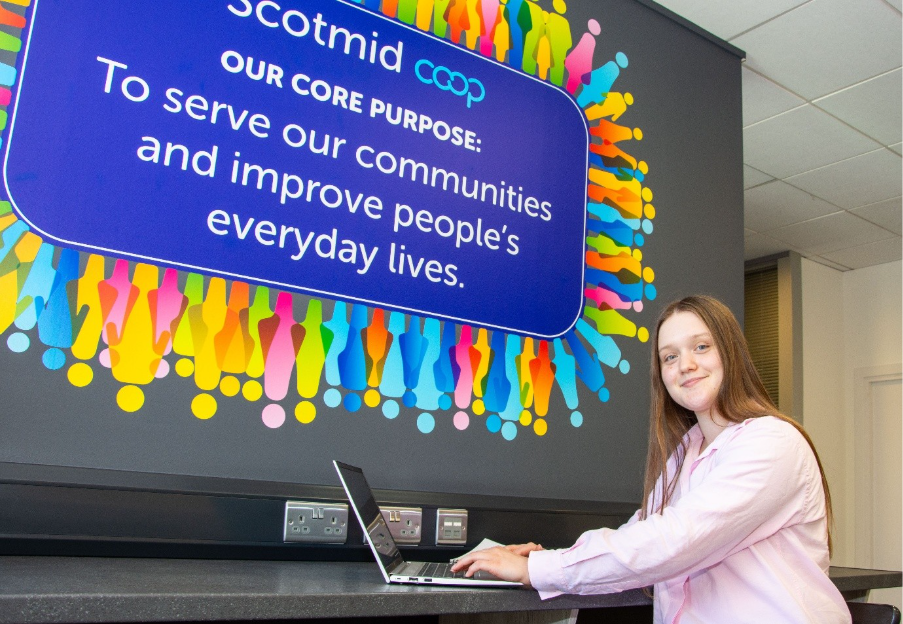
“For many young colleagues, Scotmid provides their first experience of employment, offering opportunities close to home across its network of stores in Scottish cities, towns and rural communities,” said the society. “However, our commitment to supporting young people begins before they enter the workplace.”
Through schools, including Deans Community High School, and youth employability charity WorkingRite, Scotmid offers supported placements to help young people build confidence and practical skills. Of those who have taken part in the WorkingRite programme with Scotmid, 50% have gone on to secure employment with the co-op.
The organisation also works with Salvesen Mindroom Centre to improve understanding of neurodiversity in the workplace, helping create environments where colleagues with different needs can contribute and progress.
Once in work, young colleagues can access apprenticeships, Scottish Vocational Qualifications and other training. Since 2023, 90 have completed Modern Apprenticeships, with a further 12 currently working towards their qualifications, while 25 achieved accredited qualifications through online learning over the past year.
Chief operating officer Margaret Anne Clark said: “Not every young person enters the workplace with the same experience, confidence or support.” She acknowledged that rising employment costs are putting pressure on businesses’ ability to invest in new roles, but welcomed the opportunity to work with the UK and Scottish Governments to help fund jobs for under-25s.
Scotmid also runs a graduate partnership with Scotland Food & Drink, which saw a graduate join on secondment this year, with hopes of repeating it in 2027. Lauren Rafferty, who joined through the programme as commercial development coordinator, said: “Joining Scotmid through the Scotland Food & Drink graduate programme has given me real experience and the chance to contribute from the start, rather than simply observe.
“I’ve developed my skills, learned from colleagues across the business and built confidence in what I can contribute. That support early in your career makes a real difference.”