Dorothy Francis has just retired after more than 40 years as a passionate champion of co-operatives and their power to transform lives. Until the end of February, she was a co-director of Case (Co-operative and Social Enterprise) in Leicester, providing advice, support, and training to individuals and communities committed to building the co-operative economy.
In her decades-long career, she has helped over 200 social enterprises realise their potential, working with some for over 30 years.
Speaking to Co-op News shortly before she stepped down, Dorothy described her feelings as “bitter-sweet”.
“Co-ops have been my life,” she says. “I am very sad to be leaving, and I did not need to retire. However, I think there comes a point where you start thinking about how much time you actually have left. I also want to spend more time with my family and my husband and travel more, and I think it is time to move aside and encourage the younger generation.”
Now 65, she began her co-op journey after leaving school and the immediate security of what was then ‘a job for life’.
“I was 19 and working for the GPO (General Post Office), a first-generation immigrant from a council estate in Coventry. In those days, that was a pinnacle of achievement, a gold-plated job for life. When I said I was leaving, the manager couldn’t believe it, but I knew there had to be another way to work that was more accountable and democratic.”
Related: Britain’s co-op sector is lagging – so what can it learn from abroad?
She went to Birmingham University and studied for an English language and literature degree. “I came out looking at the prospect of 40 years of work ahead of me and decided I was going to be a social worker. I applied to Warwick to do a one-year CQSW (certificate of qualification in social work) and an MA. It was 40 hours full-time a week.
“I thought I had found my niche, applied, and they offered me a place. Then the university board wrote and said the interview panel should not have given me a place, as it would be too difficult for someone with no social sciences background.
“At the time, it was devastating, but if I had gone on that course, I would never have joined the co-op movement.”
One week later, her life radically changed course, and the long co-op journey began.
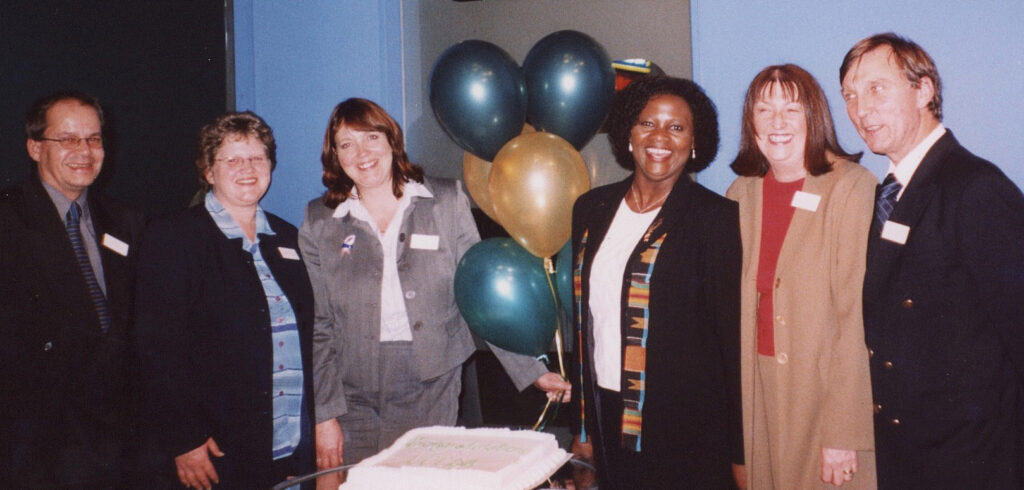
Main image: With her Co-operator of the Year award in 2021
“1985 was a blessed time, which allowed us to be socially mobile and know we could change our lives. Every major city had an independent radical bookshop, but not much attention was given to black writers. A group of friends approached me and said, ‘We are setting up a bookshop because we are tired of being ignored’.
“It was too late for me to apply for another course, so I agreed to get on board for 18 months. Then they said, ‘by the way, we are thinking of setting up as a co-operative’. It was like a light bulb going off in my head. I often say I was looking for co-ops before I knew what they were!
“We were keen and interested but wet behind the ears; they knew about the national Co-operative Development Agency (CDA), and we went there for advice, and I met John Goodman, who was a great mentor and supporter of mine. We ended up doing marketplaces and events, but then a job came up at the CDA, and it hooked me in.
“The irony is, when I left the GPO, I rolled my eyes at the idea of a job for life, but that’s exactly what happened. I never left…”
Originally known as Leicester and County Co-operative Development Agency, Case’s re-brand reflected its ambition to deliver beyond county boundaries to a more diverse range of social enterprises. Unlike most of the original regional CDAs, it has survived seismic changes in the political landscape.
“When I joined,” says Francis, “there were so many CDAs across the Midlands. In London, there was one in every borough, and so many different networks and conferences. Unfortunately, a lot of CDAs were funded by local authorities, and as the political colours changed, we watched them all picked off one by one.
“We had seen this in the wind and went to the local authority and said ‘We want you to decrease our funding over five years by 20% annually while allowing us to take on contracts to give us independence. That strategy helped to ensure that years later, we are still here.”
Across the decades, Francis has always been committed to promoting business to women, especially women of colour and newly arrived communities, with a special interest in the promotion of equality, equity and diversity. Throughout her career, she specialised in employment law, HR, co-operative working practices and management. One of her first tasks was to run a programme for women returning to education and look at strategies for helping people empower themselves through running social businesses.
Her own career development continued apace with a raft of qualifications, including a certificate of education, while coping as a single parent with a baby daughter. She is a Companion of the Chartered Management Institute and a member of the Chartered Institute of Personnel and Development. In 2016, she received the OBE-equivalent Lifetime Achievement Queen’s Award for Enterprise Promotion. One year later she was awarded an MBE in recognition of services to enterprise and the community. In 2018 the University of Leicester awarded her an honorary doctorate of laws.
Looking ahead, her hope is that the co-op movement can continue to build on its huge potential, which she says has still to be realised.
“It took me three years of university and an accident of fate to find out about co-operatives,” she says, “and children are still not taught about them in schools. It’s true there is a slightly wider understanding than there used to be, and the current government is committed to doubling the movement in size; however, there are still so few legal support structures and not enough funding.
“There are also fewer support agencies than there used to be, so if people need additional help – for example if they come from disadvantaged communities, have a disability, or are long-term unemployed they may find it harder to set up due to the barriers they face.”
For now, Francis is taking a well-earned rest and looking forward to a holiday in Jamaica, but is still involved in several community projects, including the Leicester Gazette, a successful independent co-operative newspaper.
After decades of devotion to the cause she is still optimistic about the future and has lost none of her youthful radicalism.
“I still have that same belief in the co-op movement. We face challenges in areas like health and housing but they are usually created by others. We are still pioneering social change and always will be. If we go back to 1844 and the Rochdale Pioneers that’s how co-ops started. Those Pioneers didn’t pool money because they wanted to run a shop, it was about social need.
“We need a fundamental ground change, and that will not come from capitalism. If you believe in community control, equity, and diversity, you try to bring about change.
“We need to have that underpinned by government and by institutions, so we are not always swimming upstream; the tide needs to go our way so we can change the world.”
Looking back, she says: “Case is an ever-changing, dynamic organisation which allowed me to grow socially and professionally. I would go into meetings and say ‘I am Dorothy’ and work with people who wish to change the world. It’s been such an honour. In fact, it’s been a blast.”