On 27 November 2025, I gave the opening address at the National Emergency Briefing (NEB) in London on the climate and biodiversity crises. I joined ten experts from across civic society representing the scientific, legal, military, nature and medical professions to deliver the briefing, which was attended by 1,200 of the UK’s leaders from politics, faith, culture and business … including co-ops.
Much like the televised briefings delivered during Covid, the aim was to deliver sober, science-based overviews of the various climate and nature crises that the UK faces. It was chaired by the academic and author professor Mike Berners-Lee and it sought to galvanise our country into providing concerted action on the crises before it is too late.
The climate and nature crises are the greatest threat to all life on earth, a threat far, far greater than Covid. Successive UK governments from all the parties have failed to take the action necessary to address the crises, let alone stay within the science. Tragically, they have also failed to inform the public of the very real threat to each of us, the scale of action that is needed to prevent disaster or heed the increasingly urgent scientific warnings. The resultant lack of public access to accurate, science-based information has created a dangerous vacuum, which has been filled by the dangerous climate-denying voices who have created policies and headlines guaranteed to push us towards irreversible climate breakdown.
The lack of truthful information and tsunami of misinformation is the result of powerful lobbying groups like those from the fossil-fuel industries, who continue to be major financial backers to political parties and who have nobbled some of our politicians. The result is a failure of leadership that puts countless lives at risk, both in the UK and across the world. In developing countries, which cannot afford to protect themselves from the effects of extreme weather events such as increasing sea levels, flood waters and storms, millions of people are already being impacted by food shortages, price shocks, economic instability and rising geopolitical risks.
Following the briefing, we sent a letter to prime minister Keir Starmer and all the major broadcasters asking them to properly address the issues. The letter asks the government and all public service broadcasters to “hold an urgent televised national emergency briefing for the public, and to run a comprehensive public engagement campaign so that everyone understands the profound risks this crisis poses to themselves and their families”. To date, over 40,000 people have signed it, and I would urge co-operators to add their signature to the letter too.
Related: Co-operatives make their voices heard at Cop30 in Brazil
Before giving the speech, I had reflected upon a time in our recent history when we had to make the type of changes to our society that are needed if we are to follow the science and stabilise the planet before it is too late. That’s why I said the UK must step up and lead as it did in the Second World War – by developing a global action plan for tackling the issues. During the war, the pivotal moment in the conflict came on 6 June 1944 with D-Day when we committed the largest resources this country has ever seen to tackle the threats of fascism. That’s the scale of commitment we now need to see from our government to tackle the climate and nature crises. We need measures like emergency legislation, job creation in green technologies, and heavy investment in resilience and decarbonisation if we are to have any chance of holding temperatures down to a 2°C increase above pre-industrial levels … if we want to secure our future on this planet, the only home we have.
You might be wondering what this has to do with co-operatives. As well as coinciding with COP30 held in Brazil, the NEB also marked the end of the International Year of Co-operatives. I’m a fan of co-ops, and so was my mother, who shopped at our local one in Southampton when I was growing up and could recall her divi number off by heart. Like her, I’m now a member and carry my little blue card on my phone. As a vegan and before that a vegetarian for over 30 years, I have always shopped at stores which support my values, including my local Co-op in the New Forest.
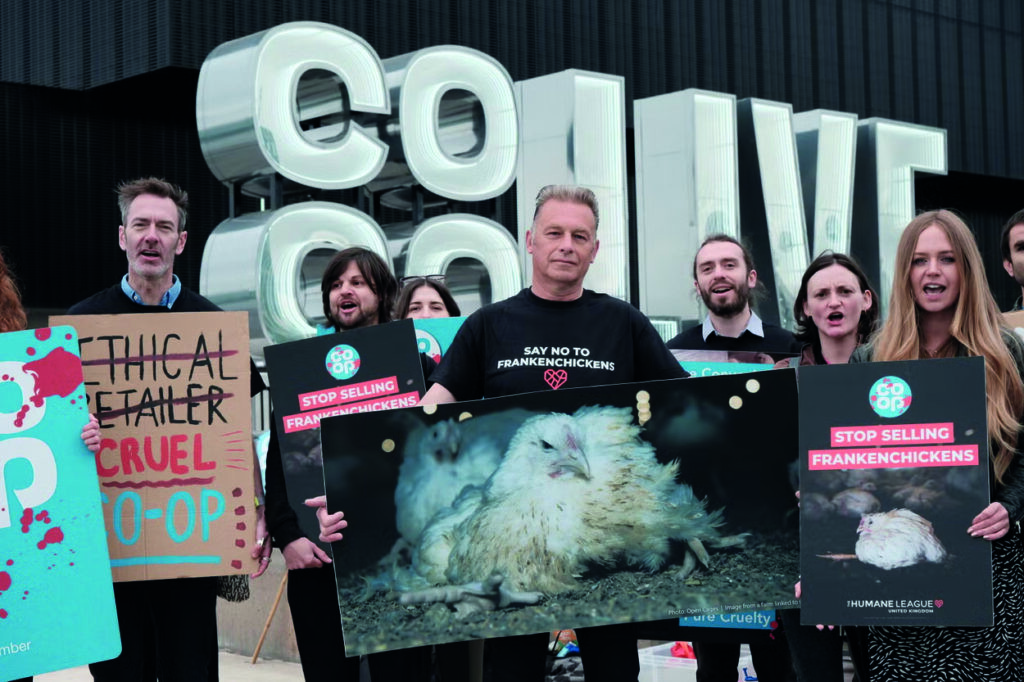
Which is why I have campaigned for the so-called ‘ethical retailer on the high street’ to stop selling Frankenchickens (genetically-selected, abnormally fast-growing poultry) – a position supported by a motion passed at the 2024 Co-op Group AGM by a big majority of its members. This year, along with the Humane World for Animals, I again lobbied members at the Group’s AGM to convince the board to use a different type of chicken with higher welfare standards.
So, I was pleased to hear the CEO of the new co-op formed by the merger of Central and Midcounties Co-operatives, Debbie Robinson, say she would like to see a ban on Frankenchickens. This new co-op will have annual sales of around £1.8bn, nearly 800 retail sites, over 13,000 employees and over a million members, and I hope its stance will lead to all co-op retailers finally adopting the same position.
The unique co-operative business model is defined by its values and principles, meaning that, both nationally and internationally, it has a vital role to play in meeting “common economic, social and cultural needs” through “jointly owned and democratically-controlled enterprises”. Its success in doing this is shown by its impressive statistics. In the UK, over 10,000 Co-op businesses contribute over £179bn to the economy and employ over 1.5 million people. Globally, there are over 3 million co-ops in over 100 countries representing over 1 billion members and employing over 280 million people. The turnover of the top 300 co-ops alone is $2.79tn.
Related: Life lessons for a living world in the Forest of Dean
Co-ops now have a real opportunity to turn economic success into meaningful influence by leading this compassionate transition on the global stage.
Internationally, I know co-ops are committed to Sustainable Development Goals (SDGs) and the most recent policy briefing from the Committee for the Advancement and Promotion of Cooperatives (Copac) demonstrated how co-ops are delivering SDG13 (combating climate change). However, co-ops need to go much further, and I’d like to see the International Cooperative Alliance (ICA) formally adopting climate and biodiversity action as a standalone, explicit principle in its constitution, adding to its existing seven core co-operative principles. I’d also like to see co-ops using their influence to convince civic society of the urgency to act on the climate and nature crises by bringing together all the key players in their host countries and holding their own National Emergency Briefings. In this way, co-operatives could bring real pressure to bear on governments across the world, as well as other key players like the global financial and insurance markets and the United Nations.
At the end of the NEB in London, the experts concluded that continuing with “business as usual will lead to catastrophe”. With its unique business model and values, there has never been a more critical time for the world’s co-ops to step up to the challenge and take a prominent leadership role in tackling the climate and biodiversity crises. Come on, let’s do it together: we don’t have a choice.