Andy Burnham, who is running to replace Keir Starmer as British prime minister and Labour Party leader, laid out his economic vision in a speech in Manchester today (29 June). If successful, Burnham would be the UK’s first prime minister under the Labour and Co-operative banner.
“If people in 1844 could form the co-operative movement in Rochdale to lower the price of food, then why can’t we now, with similar courage, make life better?” he asked.
The Co-operative Party, an independent political party in the UK, has an ongoing electoral agreement with the Labour Party, allowing the two legally separate entities to field joint candidates. Founded in 1917, the party stands for a society where wealth and power are shared, and businesses serve members rather than remote investors.
Related: Andy Burnham’s Makerfield win paves way for Labour/Co-op leadership contest
Globally, there are over 3 million co-operative enterprises – with the top 300 alone worth USD 2.8tn. Co-operative businesses have been lauded for their sustainability and long-term resilience, with co-op startups twice as likely to survive their first 5 years compared with conventional companies.
Burnham was speaking at the People’s History Museum in Manchester, a space dedicated to the history of working people, democracy, and radical politics – including the co-operative movement – and the choice of venue gave a strong signal about his long-term vision for the country.
This vision, he said, is rooted in a plan for “good growth in every postcode and hope in every heart”, and a “10-year mission to raise people’s living standards”.
Burnham believes that to fix the economy and the country, “we need to change politics, and we need to do it now”, and in his view the route to this is greater co-operation and collaboration.
“I am going to do things differently, by building a more collaborative politics in Westminster, by taking power out of the centre and putting it in the hands of the people and places who can use it best,” he said, outlining his plans for “the biggest rebalancing of power our country has seen”.
Burnham pledged to “reach out to other political parties to find as much common ground as we can and build that more collaborative approach … [We need to] pull in the same direction and move forward together.”
Whereas Westminster and Whitehall are set up for conflict, “the Greater Manchester way is based on strong partnership between all sectors: public, private, community, voluntary, academic, faith, and our trade unions,” he added.
He set out his stall for a Manchesterism as a “vision for good growth and a rejection of the old trickle-down model”, and a plan built on a foundation of sound finances and a type of devolution that gives additional powers for rural economies, areas undergoing industrial transition, coastal towns and for London too, “so London can do more for itself and remain the world’s greatest capital city”.
Related: Community power in the UK: Reviving the social club
The cornerstone of his ambition is a Number 10 North, a Prime Minister’s office in Manchester that will serve as “the nerve centre of a rewired Britain [and] create a more streamlined state with a clearer purpose to power up all parts of the country and put a laser-like focus on good growth and regeneration”.
This office, he said, will support the regions on three tasks: reform of essential utilities, reindustrialisation and regeneration of places. Under Burnham’s leadership, Manchester became the first combined authority to bring buses under local control, and he has similar national ambitions to enable all parts of the UK to take greater public control of essential services like water, housing, energy, and transport.
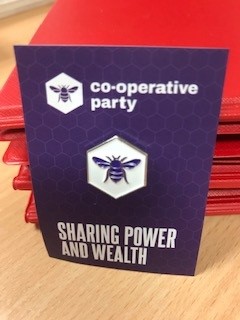
During his speech, Burnham was wearing a lapel pin of the Manchester bee; the bee icon also serves as a symbol of the Co-op Party (left) and of the co-operative movement more widely – and can be seen on items throughout the People’s History Museum.
“[This museum] holds real significance for me,” he said, “because these galleries tell the story of our country better than anywhere else. How, through time, it has not been run in the interests of the many, and how ordinary people have fought to change that status quo and make it fairer.
“Today we must take inspiration from that history and get ready to repeat it.”