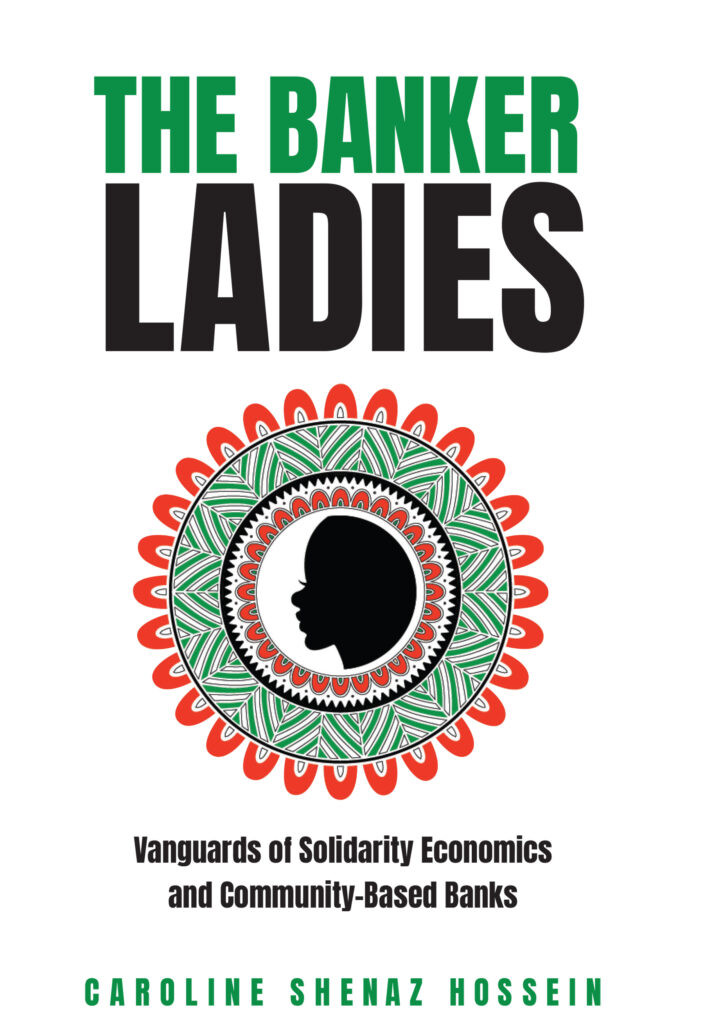
The Banker Ladies: Vanguards of Solidarity Economics and Community-Based Banks, by Caroline Shenaz Hossein
First published in 2024, The Banker Ladies is now available as an open access publication from the University of Toronto Press at bit.ly/4d7tus2
In this absorbing book, Caroline Shenaz Hossein (pictured) tells the story of the informal co-operative banks and rotating savings and credit associations (Roscas) used by the African diaspora, and of the women who run them.
Rosca is the term used by academics to collectively describe these informal banking institutions, while their members around the world use a range of names depending on their geographic and cultural context, such as the Jamaican Pardner, Peruvian Juntas or Egyptian Gameeyaa. The term Susu is used in Ghana, Trinidad and Tobago, Grenada and St. Vincent, while Hagbad, Shalongo, Ayuuto are used in Somalia.
Members of such groups regularly pay in, and take turns to receive a payout for whatever they might want or need, such as their children’s education, commemorating life events, or emergencies.
Hossein is Canada research chair and associate professor of global development and political economy at the University of Toronto Scarborough. Hossein was drawn to the work of the Banker Ladies through her own experiences and heritage. This includes both family trauma from engaging with Canada’s mainstream banking sector, and the empowerment of her great-grandmother Maude Gittens, a Chief Banker Lady in Trinidad.
“This story was handed down to me as a child of the Caribbean diaspora,” she says. “With this book, I am now telling the stories of the hundreds of women I interviewed, each of whom represents the many who came before them.”
Banker Ladies – a term coined by women in the Black diaspora – are individuals that voluntarily organise Roscas for self-sufficiency and are intentional in their politicised economic co-operation to counter business exclusion.
Related: Exploring the Caribbean roots of the British credit union sector
Drawing on decades of research and 443 interviews conducted in the Caribbean and Canada, Hossein’s book represents the experiences of an estimated 11,000 Rosca members.
She describes her research as “unapologetically biased” toward the co-operative model, especially co-ops that are informal, and specifically Black women co-operators, “who have been purposely sidelined and put down for what they do”.
Despite the clear benefits brought by Roscas, these systems are often protected or hidden from outsiders, says Hossein. “In the context of Roscas, the informal pooling and sharing of funds is far from illegal. Yet, the women who participate in Roscas still worry that their activities will be viewed as illegal or construed as a form of tax evasion.”
Canadian Banker Ladies experience this issue more acutely than those in the Caribbean. In the book, Hossein details how Black Muslim women in Toronto are labelled as terrorists and money launderers, and how laws like the Ontario Civil Remedies Act gives authorities the legal power to seize funds that are “deemed to be earned in questionable ways”.
For that reason, Hossein took time during her research to build trust with the Banker Ladies in their communities.
“I hung out in their homes, watching soaps, eating their food, going to the markets, going to the bars and churches, running random errands, and visiting their community centres … The Banker Ladies watched me carefully from the start.”
Hossein also worked with locally based research assistants who were familiar with the area and could introduce her to the Banker Ladies.
“This research is not easy to carry out; so much of it is hidden from the public eye,” she explains.
“Researching and writing about community-based Roscas takes time; the institutions are informal on purpose, while much of the academe continues to insist on formalised research.”
In the book, Hossein describes facing significant challenges in the academic world.
“Several white colleagues made it abundantly clear to me and my students that Roscas have no place in the co-operative sector,” she states, arguing that her research on the Canadian Banker Ladies particularly troubled white scholars “because it exposed discrimination against Black women in the social economy” and “blatantly revealed how the social economy turns a blind eye to informal co-operative users”.
As well as challenging bias in academia, Hossein’s work also has wider implications for the co-operative movement.
Drawing on decades of work by scholars including W. E. B. Du Bois and Jessica Gordon Nembhard, Hossein places the story of the Banker Ladies within the wider context of Black co-operation, a phenomenon which predates Canada’s Desjardins and Antigonish movements, as well as the UK’s Rochdale Pioneers.
Referencing a lecture given by Gordon Nembhard at the 2020 National Co-operative Business Association (NCBA) Co-op Impact conference which argues that Black people have been alienated by the co-operative sector, Hossein takes this assertion “one step further”.
“I would expand the definition of what we mean by being a co-operator to include co-ops that are not formally registered, but instead purposefully organized informally. Opening up what counts as a co-operator would help to decolonise the co-operative sector, moving it away from its fixation on the formal.”
In the book’s final chapter, Hossein makes a number of recommendations for making Roscas an integral part of the economic ecosystem, including crediting the African Diaspora for its contribution to the co-operative sector. Hossein claims, for example, that no one at the International Cooperative Alliance (ICA) is examining the co-ops of the African diaspora, which operate within a unique cultural context, distinct from the ICA Africa regional office established in 1968.
Hossein also advocates for an end to the confiscation of Roscas’ assets and calls for the remuneration of Black women co-operators such as the Banker Ladies. “We should be compensating the Banker Ladies for their efforts to address underdevelopment,” she says. “These women are social entrepreneurs who care about community development.”
She also calls for Roscas to be recognised as an invention of the Global South, and for the public to be educated on the model, with the women who run them acknowledged as pioneers in co-operative finance.
To that end, Hossein has produced a documentary, also called The Banker Ladies, which is available to watch online, and delivered a lecture in 2021 with Big Thinking on the Hill, to communicate these ideas to a wider audience.
In 2022, a group of women came together to form the Banker Ladies Council in Canada, to advocate for Roscas as “life-preserving systems” and to educate the Canadian public about them. In her work with the council, Hossein describes encountering “citizens who are now finding their voice”, and holding open discussions about Roscas and informal co-operatives, which have traditionally been held secret.
“We believe in recognising the value of informal banking systems, protecting the rights of those who use them, and building a strong, united membership that brings visibility, voice, and dignity to this age-old practice,” says the council.
“We are here to legitimise what our communities have always known: our collective wealth is our strength.”