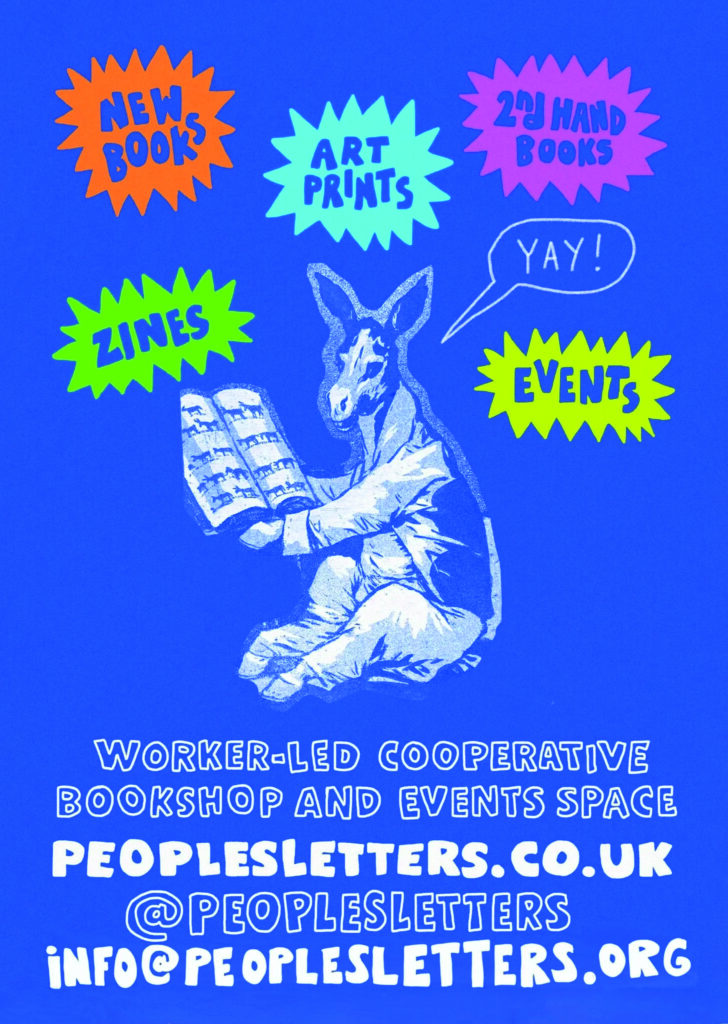
This month, the People’s Letters marks its first birthday as a worker-owned bookshop and community space.
Located on Cambridge Heath Rd in London’s Bethnal Green, the shopfront is friendly and inviting, with colourful handpainted signs in its window. Inside, you are greeted by a cosy lounge-style set up of sofas and armchairs, free tea and coffee-making facilities, artwork, zines, and of course, lots of books.
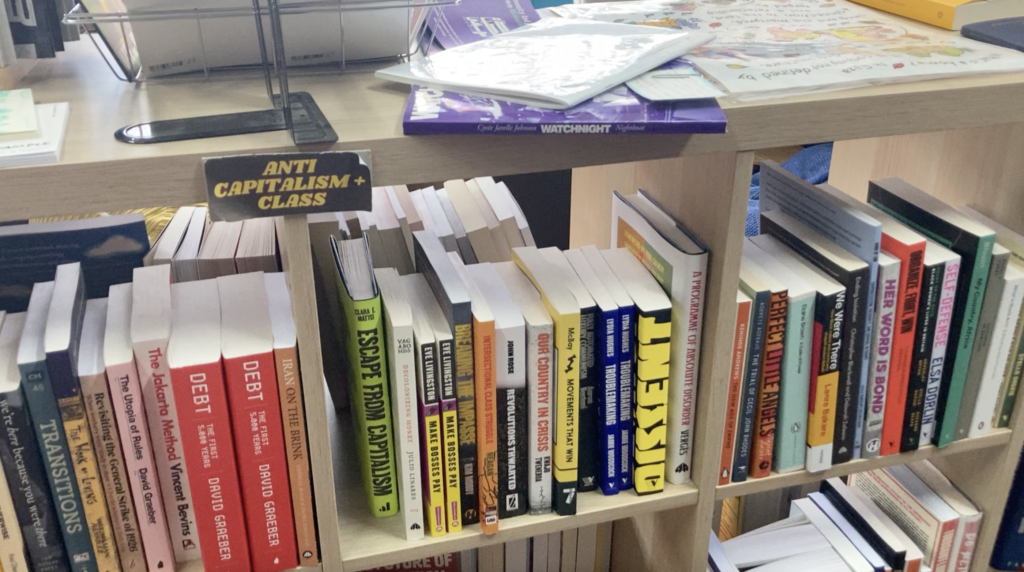
“We’ve prioritised which books we stock with marginalised authors as the priority,” explains worker owner Jack Parker as he shows me around the shop floor – including sections dedicated to translated literature, queer stories, Palestine, race and racism, anti-capitalism and class, and care and disability, alongside romance, classics, sci-fi, fantasy, and horror.
“We have a sex work section – almost all of the books we have on sex work are written by sex workers … Then we have our feminist section with a variety of feminist books. We have some self-published or indie-published authors here, just because we’re trying to prioritise people who might struggle to get their stuff in other places.”
The People’s Letters was born from the closure of Scarlett Letters, a radical bookshop which closed down last year following a dispute with its staff. Though Scarlett Letters was no more, the shop’s workers wanted to continue trying to offer a radical and inclusive space for their community.
“We didn’t want to just give up on having this kind of space,” says Parker.
“We found that, especially in this area, lots of local marginalised people, including homeless people and trans people who wanted to use a bathroom where they knew they wouldn’t be policed about it, needed the space.
“We’d kind of made friends with lots of the locals who were finding it really important to have a space to come and get warm, or cool off in the heat, and be able to have a free tea and coffee and chat to someone, alongside the actual book selling part of it.
“We didn’t want it shutting to mean that people no longer had access to all the things that we were providing.”
The opening of The People’s Letters, just down the road from the original site of Scarlett Letters, was a “massive community effort”, says Parker.
“Not just those of us who work here at the co-op, but also all of our friends and broader community came together to help make the space function.”
A key partnership that has made the opening of The People’s Letters possible is with drug charity Release, who share a premises with the bookshop and run a Harm Reduction Hub from the space.
The People’s Letters also received support from Co-operatives UK during set-up, incorporating as a limited company with worker ownership written into its governing documents.
The seven worker members come together for weekly meetings and decisions are made by consensus.
“Thus far, we have not had to break that. But I don’t think it’s impossible that at some point we reach impasses. But as is, we’ve always been negotiating stuff to make sure that we all come to an agreement that we can all at least tolerate, even if not everyone’s super happy about it.
Related: How a human chain made world news of a small co-op bookstore
“It’s probably the first time in my life I’ve had to do that in a work setting. I’ve done it with friends, or with other projects or with activist work, but it’s a very different way of working and functioning compared to if I were to get hired in a bookshop.”
Beyond being a shop, The People’s Letters is also a community space, open every day for individuals and groups to access.
Worker owner Alex Shukri speaks with pride about the space being “somewhere safe people can simply exist during the day without feeling like they have to buy something. I’ll hear people, from kids all the way up to community elders, talking about how much this space means to them in very different ways.”
“People who hang out here tend to just be people who are around the Bethnal Green, Tower Hamlets sort of area, and we see a lot of the same faces day to day of people who live locally.”
Parker explains that, while hosting an open accessible space like theirs is an ethical priority for The People’s Letters, “it makes no sense from any kind of financial or business perspective”.
Currently, worker members are not earning minimum wage as they are choosing to prioritise other costs such as rent, replenishing stock for the shop and supplies for the space.
“We pay ourselves what we can”, says Shukri. “It’s definitely a big struggle, and something that we all knew, getting into this … We definitely did not think a bookstore in a very rough economy would make any of us rich. But we did it because we wanted to, and I think that does carry us through the struggles of it, where we go, ‘we’re doing something that matters’.”
This financial reality means that worker owners are often working multiple jobs including running The People’s Letters, requiring a culture of collective support in the co-op.
“We’ll always try to help and chip in with other people’s tasks, like if somebody can’t do something or if somebody can’t come in for a shift, we try and make things work,” explains Shukri.
“We’re all understanding that this isn’t our only job, this isn’t our only responsibility, and that we all do have different things that take away our energy and time.”
A future goal for The People’s Letters is to become a licensed music venue.
“It’s been a dream since the start of having the bookstore, of having small intimate gigs,” says Shukri, who also works in the music industry.
“Artists and their teams are always looking for venues that aren’t going to charge them an arm and a leg to have a show there, and to sell their merch there.”
Shukri envisions The People’s Letters as being able to offer new musicians a place to perform for the first time, or established artists an affordable venue.
“We want to have the space be as versatile as possible because there’s so much beauty in the city, and this section of the city.”
More broadly, Shukri hopes The People’s Letters becomes “a community institution”, and somewhere people seek out when they arrive in the area.
“I want us to be able to continue to thrive, and be much more financially feasible. I think we can be a strong example of how you don’t need to sacrifice your community or your values in order to exist.
“There’s obviously plenty of examples across the UK and the world where that is also true. But I want us to be yet another beautiful reason why people believe that they can actually follow their dreams in an ethical manner, and do something that matters in their community.”