The co-operative business model is often cited as steady and resilient. In the UK, for example, twice as many co-operatives survive their first five years compared with conventional companies. But recently we have seen the end of the Co-op College; the Co-operative Heritage Trust is facing a difficult future; and several high-profile consolidations have taken place on the back of financial unviability.
In the UK, the mergers of Midcounties and Chelmsford Star into Central Co-op to form OurCoop and Irish agri co-op mergers have been well documented. In Canada, the 90-year-old grower-owned BC Tree Fruits Cooperative (pictured) dissolved and liquidated on the back of low fruit volumes, weather shocks, financial pressure and difficult market conditions.
Last year, Peru’s banking and insurance regulator (SBS) formally dissolved Credi Chancay savings and credit co-operative after determining total loss of co-operative capital and reserves. In the USA, Citybikes Workers’ Cooperative recently closed after decades in business because of long-term commercial pressures.
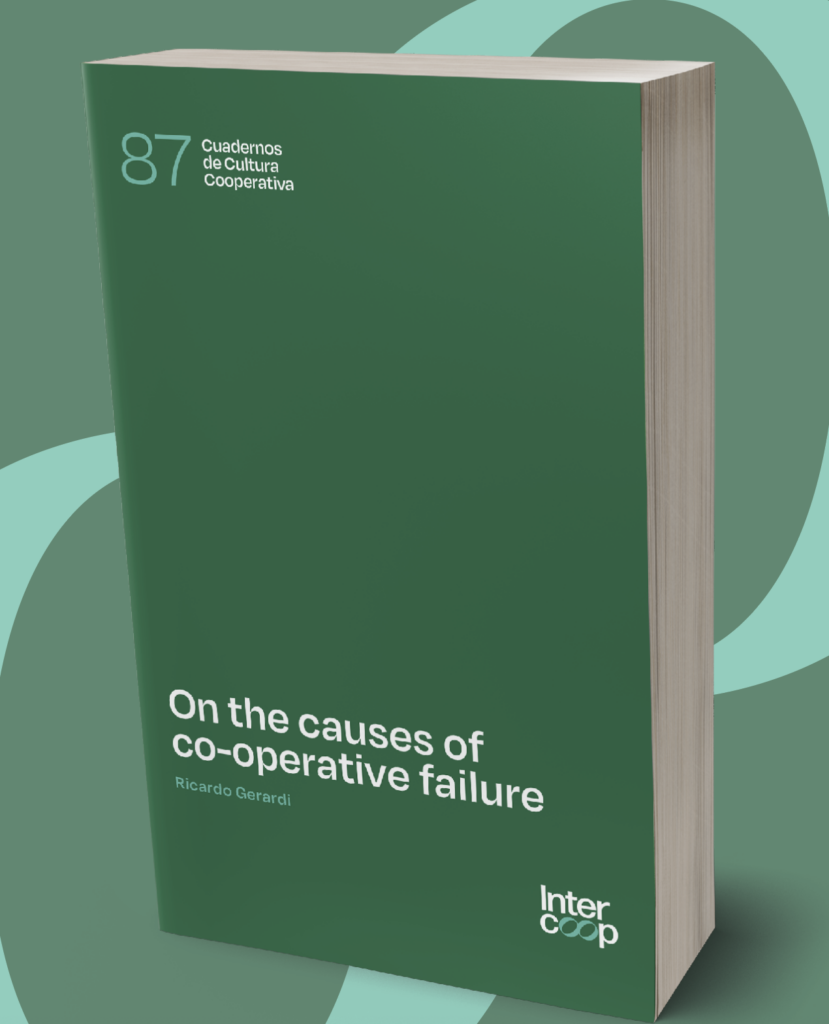
There are many interconnecting factors that can lead to co-operative failure – and a recent essay by Ricardo E. Gerardi, On the Causes of Co-operative Failure, explores this in the context of Argentina, with attention to governance, management, co-operative identity, and broader economic and institutional contexts.
His idea of failure draws on Marie-Claire Malo’s “hourglass” governance model to argue that co-operatives must balance two logics: a business logic (products, markets, competitive position) and an associative-democratic logic (member participation, elected leadership, one member one vote). General management sits at the narrowing of the hourglass, mediating between them. When they don’t align, failure follows.
“If one of these dimensions prevails over the other, or if the two cease to be effectively articulated, the co-operative experience tends to weaken and may ultimately give rise to different forms of failure or loss of co-operative character,” Gerardi writes.
But failure, he argues, can rarely be reduced to a single cause, and instead emerges from the interaction between internal and external pressures.
Internal failure factors vary from seeing the co-operative identity as a limitation rather than a strength, leadership overconfidence (including overestimating capacity to reverse decline and underestimating complexity of mergers and acquisitions used as rescue strategies) and weak board supervision. Poor recruitment, insufficient member investment and weak member ownership can also be factors. A lack of succession planning, business plans and unresolved internal conflicts can also accelerate decline.
Meanwhile, Gerardi adds, structural failures can stem from social differentiation among members, capture by private interests, adverse markets and inadequate public policy.
Related: Canadian co-operators want law change to prevent repeat of MEC demutualisation
Fundamentally, he says, “the root of failure lies in the loss of conviction and understanding regarding the nature of the co-operative”.
Gerardi shares several case studies (with different outcomes) from Argentina’s economic crises of the late 1980s–2001 period, including El Hogar Obrero (the Workers’ Home), founded in 1905 as a housing co-operative which expanded into consumer goods. At its peak, it was the sixth-largest company in Argentina in the services sector. But in the early 1990s, the Menem government’s sudden shift to neoliberalism flooded Argentina with cheap imports and restructured the economy in ways that made its vast consumer co-operative empire unviable almost overnight. This was exacerbated, said Girardi, by centralised leadership, poor information flows to the board, no contingency planning, and a decision to honour deposit commitments immediately.
In 2005, its centenary year, the co-operative was judicially “recovered” by and for its members, and it still exists today in a reduced form, primarily focused on housing.
In contrast, Cooperativa Obrera (Bahía Blanca) absorbed the financial burden itself after 2001 pesification (the conversion of dollar deposits held in Argentine banks into pesos resulting in a sharp devaluation), rather than passing losses to members, preserving institutional trust and high member acceptance of its proposed repayment alternatives.
“This illustrates how an adverse public policy could be addressed without undermining the bond of trust with members,” says Girardi. Cooperativa Obrera’s decision “was presented as a way of safeguarding the interests of members”.
He highlights how future challenges are evolving, noting that technology (particularly AI), climate change and other geopolitical disruptions (including pandemics) could shape co-operative failures – and their actions to mitigate them.
But there is hope, he says. “Various studies have shown that, despite the difficulties mentioned, co-operatives display, on average, higher survival rates than conventional firms during their first years of life. In the case of the United Kingdom, for example, approximately 80% of co-operatives continue operating after five years, compared with around 44% of conventional firms, a pattern that is reproduced – with variations – in other countries.
Gerardi draws out a number of practical lessons to understand not only how co-operative fail, but what sustains them – from early interventions and being transparent about external shocks to diversifying income.
Strategic alliances and robust crisis-response protocols and scenario planning should be “standard practice” in complex co-operatives, as should the continual strengthening of member education and participation in public policy discussion, he says.
But he also warns of the co-operative erosion that comes with success. “It is necessary to recognise the risk that economic success itself may entail when prosperity encourages forms of individualism, economism, or even mercantilism that ultimately erode, in practice, the solidarity-based values of co-operativism.”
Girardi begins and ends his essay with quotes from French economist and historian Charles Gide (uncle of author André Gide), who believed that co-operativism is defined not by the absence of failure but by the capacity to learn from it.
“Even the co-operative societies that perished did not die in vain. They served the co-operative cause effectively through the lessons they left us,” Gide declared at the 1893 Congress of Cooperative Societies.
“Do not forget to salute the co-operatives that disappeared: they are entitled to our recognition and even to our homage.”
On the Causes of Co-operative Failure is published by Intercoop, a co-operative publishing house founded in 1957 in Buenos Aires that specialises in works related to the social economy.
Ricardo E. Gerardi is an Argentine economist, researcher, writer and consultant on co-operative economics, with strong links to the University of Buenos Aires.
The full essay can be read online at intercoop.coop/wp-content/uploads/2026/04/On-the-causes-of-co-operative-failure.pdf