Founded in 1895 by Don Lorenzo Guetti, a priest from southwest Trentino, Cooperazione Trentina is one of Italy’s longest-standing co-operative federations. Formed in response to famine, poverty, and mass emigration in late 19th-century northern Italy, the co-op emerged during one of the earliest phases of Italy’s co-operative history.
In the beginning, Cooperazione Trentina brought together consumer co-ops, rural banks and agricultural collectives under a shared federated structure at a time when hunger and debt were a daily reality for the region. Now, 130 years later, it has more than 300,000 members and comprises hundreds of co-ops working across finance, agriculture, social care, retail, and energy. It’s living proof that, when rooted in place and community, co-operation can navigate complex geopolitics and far-reaching economic shocks.
Weathering a century of disruption
Initially, the federation was involved in sectors focused on the agricultural economy: mutual aid services, farming collectives, rural credit brokers, as well as consumer co-operatives (‘Famiglie Cooperative’) which aimed to sell affordable basic goods.
Like other Italian co-op structures, the federation was forced to weather the storms of the 20th century – from the First and Second World Wars to Mussolini’s Fascist regime and the Great Depression. Despite huge disruption to supply chains, the workforce, and public institutions, Cooperazione Trentina was able to survive over the years against the odds.
Related: Mussolini could not kill the co-ops
When the Second World War ended, co-operatives and their associated federated structures found a new lease of life under Italy’s new democratic government. The formation of the administrative Province of Trentino “provided essential legal and financial frameworks that revitalised co-operative activity”, explains Alessandro Girardi, the federation’s head of communications.
Provincial and regional support stimulated a massive expansion in activity; credit unions, agricultural collectives and co-operative services all became integrated, creating what he calls “a unified, resilient co-operative identity and governance framework”.
“Throughout its history, Cooperazione Trentina has consistently adapted to external shocks through collective solidarity, ethical mercantilism, federated structure, and strong ties with territorial institutions,” says Girardi. “This has enabled it to transform adversity into opportunities for renewal.”
‘A vibrant and diversified network’
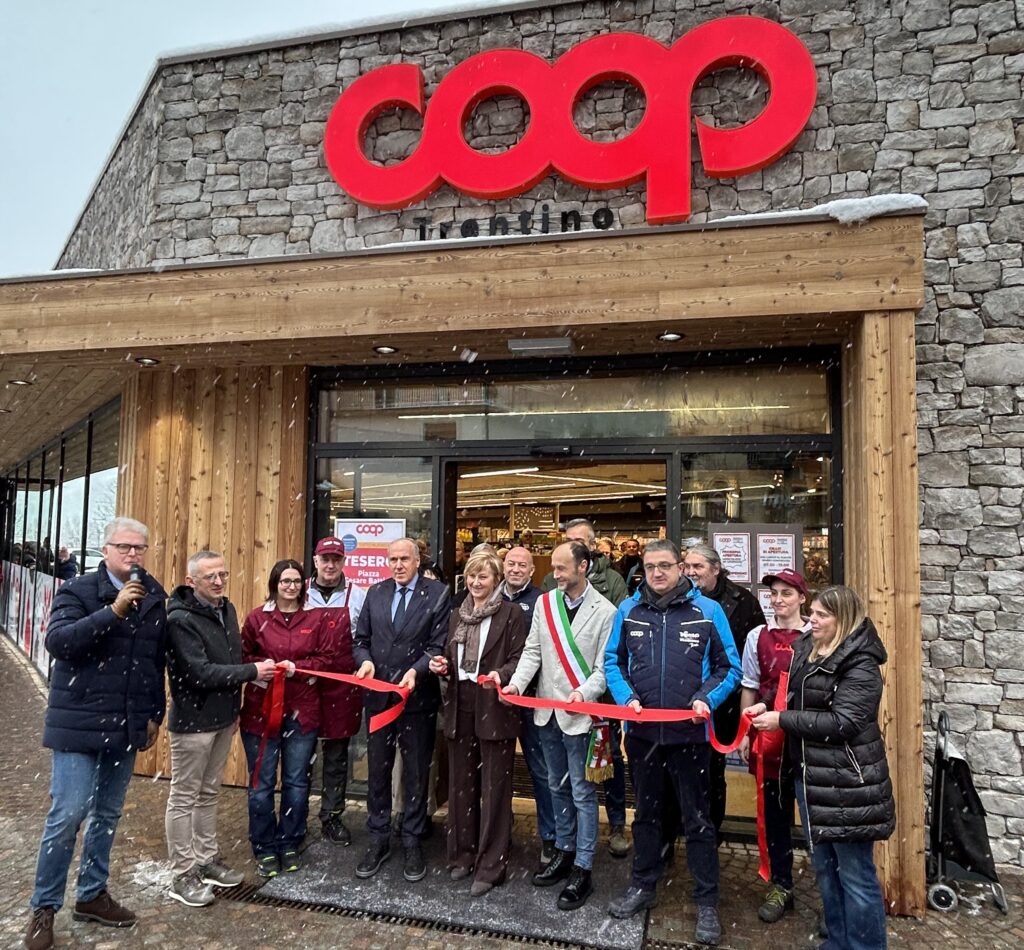
Today, Cooperazione Trentina is a vast network of co-operatives, active in a range of sectors such as finance, agriculture, retail, social care, and more. Across these sectors, the federation now includes 278 credit union branches across Trento, with over 133,000 members and a portfolio of around €24 billion. It also manages 53,000 hectares of farmland and pasture through agricultural co-operatives involved in both production and collective marketing, and has 376 retail outlets selling groceries and daily goods, offering essential products to local communities. Around 130 co-operatives here are involved in manufacturing, labour and services, with thousands of employees.
The federation also includes social co-operatives – the prominent, legally recognised form of non-profit enterprise aimed at providing social, health, and educational services in Italy, or integrating disadvantaged people into the workforce – and community energy co-operatives which focus on renewable energy projects.
Related: UK co-op councils visit Italy’s Emilia Romagna region
Additionally, Cooperazione Trentina offers a range of support services for co-operative development, ranging from consultancy, training, and supervision to public advocacy and even a job board. In total, the federation is made up of 429 affiliated co-operative enterprises.
“This wide-ranging presence allows Cooperazione Trentina not only to serve essential local needs, but also to drive sustainable development and social cohesion in the region,” says Girardi. “Through strategic support and shared services, we ensure that co-operatives remain competitive while preserving their social mission, creating a network where solidarity and economic growth go hand in hand.”
Laying the groundwork for the future
Cooperazione Trentina celebrated its anniversary at its headquarters on 20 November, where it recognised not only its history but its path forward. Historians explored the co-operative’s story over 130 years, while messages of recognition from across Italy – including president Mattarella – were shared.
The celebration came on the back of a year of commemorations, including a new anniversary brand logo and a programme of exhibitions and research exploring future co-operative strategies. It collaborated with OECD, Euricse, the University of Trento and Skopia on a study exploring demographics, digitalisation, sustainability and governance, and held local workshops and published global case studies from Spain, the UK, the Republic of Korea and elsewhere. The federation also held eight ‘labs’ across Trentino, gathering over 200 residents and co-operators to address issues such as housing access, ageing population support, digital inclusion, overtourism, and healthcare. Attendees “collectively developed co-operative-based solutions” for how these challenges affect their local area.
In September, the Federation also signed a new Protocol of Understanding with the Province to affirm collaboration areas such as local retail and small businesses, training, education, energy, and social policy development. And, at its anniversary celebrations, it outlined four strategic priorities for the coming years:
- Enhancing care services and proximity support systems for the elderly
- Addressing housing shortages with co-operative housing models and service integration
- Promoting community renewable energy projects and sustainable farming practices
- Ensuring ‘inclusive, ethical and participatory’ digital transformation across its network.
“The anniversary served as a moment of reflection on the co-operative’s longstanding social and economic role and as a springboard toward future challenges such as climate, housing, digital transformation, and ageing,” explains Girardi. “It also aligned with the United Nations’ 2025 International Year of Cooperatives, reinforcing the message: ‘Co-operatives build a better world’.”
What the future looks like still isn’t certain. What is clear, though, is that the federation has the strategy and ambition to keep moving forward in the years – and centuries – to come.