Last autumn, the UK government launched a Curriculum and Assessment Review for England, and the Co-operative College is leading the call for more about co-operatives to be taught in schools.
The campaign is in collaboration with Co-operatives UK and the Co-operative Party and is a core element of the College’s work to raise the profile of co-ops at secondary and higher education (HE) level.
“Our remit is to support the movement,” says Jacqui Thomasen, CEO at the Co-operative College. “We provide professional development to co-operators and content for young people around youth empowerment, but the need is greater than the College can provide. That was the genesis of the Co-ops on the Curriculum campaign; it was about saying this has to be more of a systemic change.”

To create a country that’s socialised with the idea of co-operation, with young people who want to make an active choice about co-operation and graduates who are enthused by it or want to become part of that movement, that has to come from inside mainstream education, she adds.
“There is a general acknowledgement within our members and the wider movement that schools need to be a big focus; the younger people start to buy into co-operation, the more effective it is, and Woodcraft Folk is a perfect example of that. But we know that schools are massively constrained, time poor, resource poor, and have so much they have to deliver; anything that’s peripheral is challenging.”
Related: How the co-op principle of education starts in the early years
In 2018, the College launched Youth Co-operative Action. Supported by the Co-op Foundation and the #iwill Fund, it aimed to inspire young people aged 12-20 to use co-operative values and principles to make a change where they live.
“But the reality was that the time and commitment made it challenging to deliver,” says Thomasen,” so it’s been scaled back. The Foundation has supported its redevelopment to make it more manageable for school delivery, and it’s now focused on co-operative values, with participants identifying their values and using the co-op model to see how their values and practice impact their community.
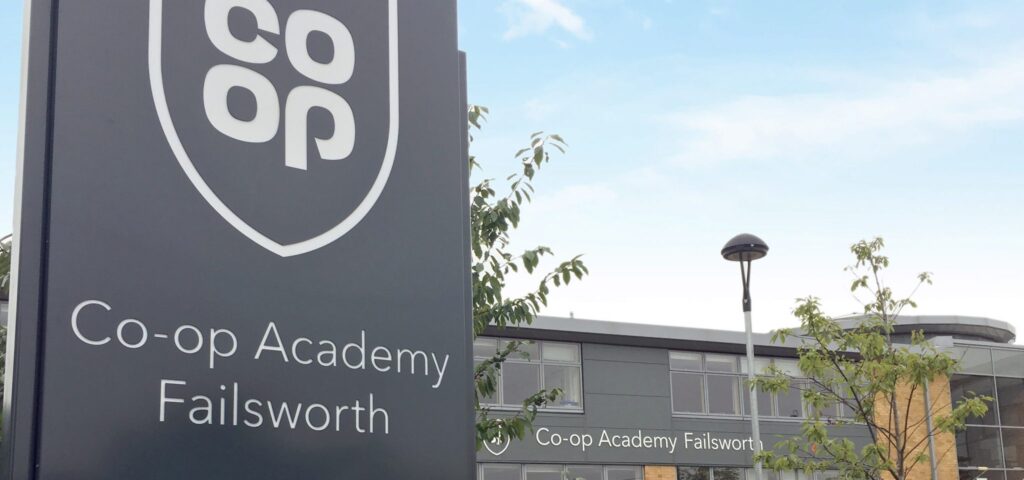
The College is hoping to work with the Co-op Academy Trust and other non-co-op schools to roll this out, training co-operative values and principles leads within those institutions to see how they can adapt it and roll it out for their context.
Parallel to this, the College is working with the Association for Citizenship Teaching to get co-operatives included in the official national curriculum programmes of study for citizenship, being looked at for the government’s current Curriculum and Assessment Review (the last review took place in 2014).
“Each curriculum area has a document setting out what pupils aged 5-16 can be taught and assessed against. If we can get the words ‘co-operation’ and ‘co-operativism’ onto this document, it’s a massive leap forward, because then there is an option.”
Related: A year in the life of the Co-op Academies Trust
For now, the College is focusing on secondary school Key Stages 3 (ages 11-14) and 4 (ages 14-16), when citizenship studies in England is a statutory subject and optional GCSE. The subject explores the rights and responsibilities of citizens in a democratic society, with a focus on how citizens can actively take part in public life and contribute to society.
Citizenship GCSEs are taught in 600 schools, with 21,000 students. At its peak, there were over 100,000 students taking this exam, before rollback under the last Conservative government.
“This is one of our biggest opportunities. We’ve got kids who are 13 years old now who are going to be voting in the next general election and have never thought about anything political. And co-operatives, as democracy in action, provide a really tangible way of getting young people to understand participation and what citizenship in action means.”
She acknowledges there is a need to target history and business curricula too. “It’s on the to-do list … but the problem here is that co-operation is incredibly complex. So when you start putting it into the business curriculum, it can be really off-putting to teachers who already have to teach a massive breadth of stuff, whereas in citizenship, co-operation is accessible because it’s demonstrating what they’re trying to teach.”
But Thomasen’s own background is higher education; she left her role as head of external engagement at the Open University Business and Law School and joined the College because of personal frustration at the lack of co-op content at the HE level.
“A group of us tried to set up a co-op after the owner of our local health food shop wanted to retire” she says. “We got some support from Co-operatives UK, but working in business schools, I went looking for content to help me, and I couldn’t find anything. The OU is often cited as the leading socially responsible business school, but there was a 15 point elective on the MBA and that was it. I couldn’t access anything meaningful, even through the library. That was one of the main drivers for joining the College, because I could see some easy ways to change this. But its been challenging because, of course, there is a cost implication to this, and there’s no central funding for all of this work.”
Less than 10% of UK business schools include co-operatives at either undergraduate or postgraduate level – “and generally, where there is something that can be taught, it’s an elective level and thrown in with social enterprises”.
To address this, the College is now working directly with a number of business schools “who have got real ambition to recognise co-operatives,” says Thomasen, adding that there are two core strands of HE work within the Co-ops on the Curriculum campaign.
“Firstly, we’re looking to develop case studies around co-ops, because that is the easiest way for business schools to pick up taught content on co-ops when they refresh their courses, which happens at least every seven years. The other big piece of work is with the accrediting bodies.”
The three largest international business school accreditation associations are the AACSB (The Association to Advance Collegiate Schools of Business), AMBA (The Association of MBAs) and EFMD (European Foundation for Management Development) with its Equis accreditation.
“Business schools are often double or triple accredited,” explains Thomasen, “which basically helps students assess their quality. All the accreditations include ethical and alternative business reporting requirements, but this is often translated into learning about social enterprises, charities and the public sector. Co-operatives don’t get a mention. So we’re working with and through these bodies, and the Chartered Association of Business Schools (Cabs, the UK membership body) to try to raise awareness within schools and also to try to force a bit of change by saying, ‘come on, if you’re standing by your credentials, co-operation has to feature.’ It’s a slog, but it’s starting to yield some results.”
For Thomasen, these results include getting a paper accepted at this autumn’s Principles for Responsible Management Education (PRME) conference, titled: Missing from the curriculum: practitioners’ perspectives on the co-operative gap in UK higher education.
“PRME is a UN Global Compact; the majority of business schools are signatories to PRME, and they have to report on their progress. I’m now working with PRME directly to progress co-operation here, too. I was invited to talk with the steering committee at another conference for PRME for the UK and Ireland chapter, and I’ve spoken at a couple of Cabs conferences, and one Equis conference.”
But while business schools are “a massive piece of the puzzle”, there’s also an enormous opportunity for graduates in other disciplines who currently don’t get to hear about co-ops as an option when they’re graduating and looking at career opportunities, adds Thomasen. “Most career services don’t have any content on co-ops, so we’re hoping to work with Co-operatives UK to create a solution for this. Social care graduates and creative individuals, for example, are being told to set up as freelancers, whereas co-ops could be a really good option for them.
“We’ve recently started a pilot with Manchester Met University’s School of Digital Arts (Soda), working out how we can support their employability ambitions for their students and graduates through different ways of working together, from bringing international guests into their environment and having them collaborate on joint projects, to showcasing creative, successful co-operatives.”
The College has been working closely with the Department for Education, the All-Party Parliamentary Group for Education, and the co-operatives and mutuals team within the government’s department for business and trade, and on the back of this, Thomasen was invited to represent the College at the King’s Garden Party for Education and Skills, and a reception for co-operatives and mutuals held in June at No.10 Downing Street
“The College has had challenges in defining a financially sustainable path without core funding,” says Thomasen, “but we have done an extensive review of our operating model, and are now looking to create a strategic partnership with Co-operatives UK, to create a one-stop-shop for education, learning, training and development for the co-operative movement in the UK.
“It feels like there are so many directions that need attention; sometimes when you start looking at everything, it can feel daunting, but in terms of what we need to do to meet the movement’s needs, I think all of this is critical.
“If we don’t do it now, it’s not going to happen.”