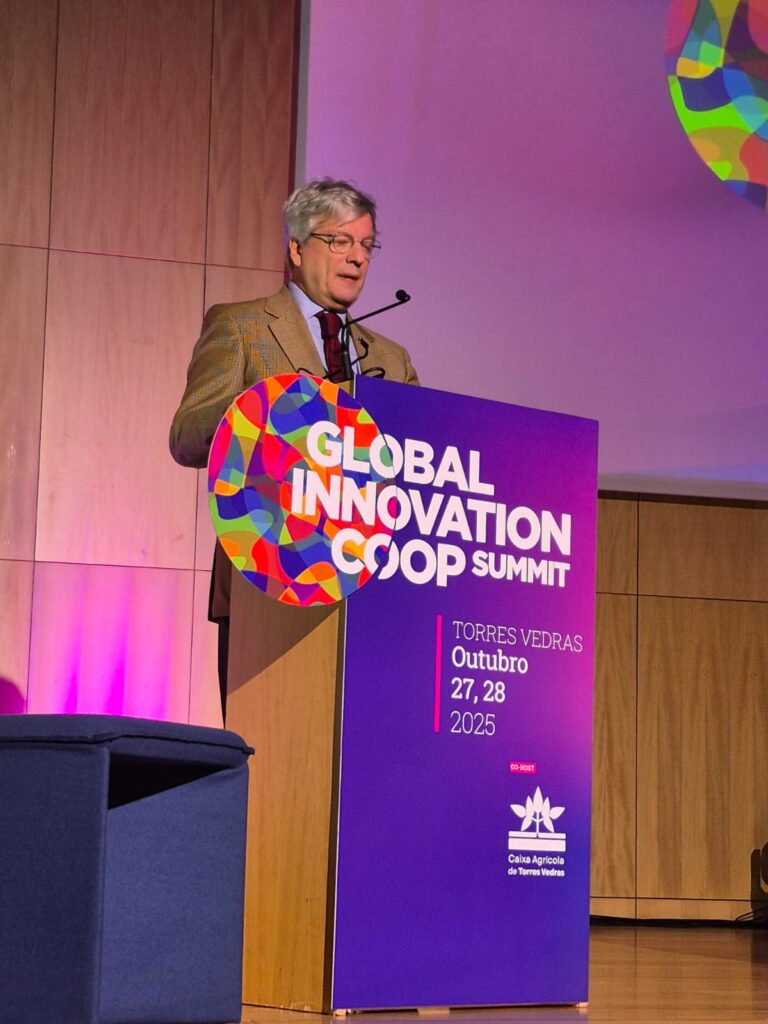
What does innovation look like in the age of AI and big data? And where do co-ops fit in? According to Cooperatives Europe’s president, Giuseppe Guerini, co-operatives innovate in a different way from other enterprises.
“The co-operative business model shows we can do business without destroying,” he told the Global Innovation Coop Summit in Torres Vedras, Portugal, which explored some of the ways co-ops around the world are innovating in sectors like renewable energy, care and technology. “Among the most pressing issues co-ops know how to create is trust, real trust among people. For us innovation means promoting human progress.”
Guerini gave examples of European co-ops innovating while meeting the EU’s regulatory requirements, from multi-stakeholder co-ops – which, he said, have enlarged mutuality – to renewable energy co-ops which have democratised energy ownership, or platform co-ops like Smart in Belgium, which enable freelancers to work and get social security.
“Although they are not something new, co-ops are the most sophisticated form of social innovation,” agreed Paulo Rangel, Portugal’s foreign minister.
Current global challenges may limit public powers’ ability to carry out their duties, he argued, while private ones will be focused on maximising profit. In this context, co-ops could emerge as engines generating shared wealth, employment and training. The minister mentioned the role of co-ops in empowering small communities, giving the example of the Innovation Summit being held in a small town like Torres Vedras.
“To choose such a city, such a town, to hold this meeting, is an important sign of social innovation, of what co-operativism can make to empower those in our society that are not empowered,” he said. “We look at co-operativism as an affirmation of civil society. Not as something dated, as a co-operation and collaboration setup which needs to be modernised but has huge potential in society.”
He was echoed by Manuel José Guerreiro, chair of Caixa Agrícola Torres Vedras, who said co-operatives’ focus on solidarity could help challenge pessimists.
International Cooperative Alliance (ICA) president Ariel Guarco made similar remarks in a video message, arguing that “co-ops are the greatest social innovation of modern day.” He explained how co-ops innovate by being a business model focused on co-operation not competition, democratic participation and solidarity. “That innovation is still very relevant today,” he said, encouraging participants to deepen inter-co-operation to jointly face the global challenges.
And while other organisations aim to adapt to survive crises, co-ops enable transformation, said summit co-founder Jean-Louis Bancel, adding: “Co-operation is not an alternative but a strategy for transformation and no doubt the way forward for humanity.”
Yuill Herbert, co-founder and principal of the Sustainability Solutions Group in Canada, offered an overview of the challenges facing humanity, referencing the Global Tipping Point Report 2025, which brings together the expertise of 160 researchers from across the globe.
The report found widespread dieback of the Amazon rainforest and warm water coral reefs due to deforestation and climate change.
Despite this, said Herbert, there have been some positive developments around the world, such as solar energy becoming the cheapest source of energy in many parts of the world and electric cars becoming more common. Crucially, the International Court of Justice has issued an advisory opinion that said climate change is an “urgent and existential threat” to humanity and states have been given binding legal obligations to act. Herbert described co-operatives as an antidote to endless growth and expansion, which, he said, are unsustainable.
Another potential lies in data and AI, said Samuel Vance-Law, principal researcher, Decentralization Research Center, Germany.
“Trust can come from member benefit, from how co-ops use the data or AI, and show them that trust is meaningful to them in the communities they talk about,” he argued, warning co-ops not be “paralysed by fear” and start thinking about how to use AI with integrity.
Meanwhile, Meredith Lobel, co-founder/chief product officer, Principle 6, USA, encouraged co-ops to use AI to share knowledge.
“Helping co-ops compete isn’t about embracing competition but helping co-ops compete,” she said. Principle 6 provides a structured platform for coordination and resource sharing, using AI.
But co-ops face several barriers when trying to innovate, warned Thomas Meyer, CEO of Socaps, a French co-op that provides technical assistance and consulting services to industrial equipment manufacturers and industrial operators.
“Innovation and tech will require money and the volume of money accessible to co-ops to finance innovation is extremely small compared with other players in the market,” he said. “This is not a good moment for social economy and co-ops; if we lose the fight for AI, for data, for capacity to innovate we might not have this chance again.”
Robby Tulus, international co-operative expert advisor at Global Affairs Canada’s Technical Assistance Partnership (TAP), Indonesia, pointed out that co-ops find it easier to innovate in market-oriented societies than in countries that have a more government-led, top-down approach.
One way to innovate is working together, something emphasised in different sessions at the summit.
“We shouldn’t invent anything any more; it’s all invented somewhere in the world. If I have a problem, another co-op has already sorted it somewhere else,” said Siward Zomer, chair of Energie Samen in Netherlands. He suggested sharing capacity and technology and launching a marketplace for co-ops to sell products.
Education was a recurring theme at the summit, with examples like the Arizmendiarrieta Social Economy Think Tank (Asett) and the International Co-operative Business Education Consortium (ICBEC).
Ilana Gotz, senior project manager at the European Research Institute on Cooperative and Social Enterprises (Euricse), emphasised the need to promote co-operative education not just within a co-op itself but also raising awareness and visibility about what a co-operative does.
German Lorenzo, deputy director, global public affairs & communications at Basque Spain’s worker co-op federation Mondragon Corporation, also highlighted the need for co-ops to inter-co-operate, explaining how his organisation pools resources, lends money to co-ops, relocates people, and sharing knowledge among co-ops. He explained how Asett was set up to further build on Mondragon’s work by generating knowledge, connecting global networks, and contributing to social transformation through business.
So what’s next for the movement and how can it continue to innovate? Joanne Lechasseur, co-founder of the Global Innovation Coop Summit and the International Cooperative Innovation Network (ICIN) thinks co-ops will adapt to new economic realities. This, she said, will have to include reinforcing responsibility culture within co-ops, exploring sustainable development solutions, adopting new technologies, including AI, forming strategic partnerships and co-operating beyond borders.
But co-ops must also be wary is trying to be too much like other businesses.
In his concluding remarks, Manuel José Guerreiro emphasised the role of co-ops in meeting people’s needs and promoting solidarity and trust.
“We’ll win more if we can rescue words like solidarity or compassion,” he said.