On 23-25 July, over 2,000 members of the Australian Labor Party (ALP) gathered in Adelaide for its 50th National Conference, coinciding with the 135th anniversary of the Australian Labor Party and the 125th anniversary of the Federal Labor Parliamentary Party.
Last year, the ALP’s Anthony Albanese was elected to a second term in government; ahead of his election, at a Business Council of Co-operatives and Mutuals event in Perth, one minister said: “Co-ops and mutuals have an important place in our national story … They play a unique role in our economy, and one that is valued and respected by the Albanese government.”
Co-ops and mutuals were firmly on the agenda at this year’s conference, culminating in a section in its National Platform (the ALP’s core policy document) explicitly supporting the growth of the co-operative and mutual sector.
“Labor will support diverse business models which bring innovation, new products, competition and quality jobs to the market,” it reads. “These will include co-operatives, mutuals, credit unions and customer-owned banks. We recognise and support the co-operative and mutual sector’s ambition to double in size and will work to address barriers it faces to ensure an equal playing field with other corporate structures.”
Related: Australian Labor Party adopts commitment to doubling co-op sector
Melina Morrison, CEO of Australia’s Business Council of Cooperatives and Mutuals (BCCM), welcomed the move. “Even modest reform from the federal government could unleash potential across industries such as agriculture, finance and care,” she said.
“There is now a significant opportunity to strengthen the role of co-operatives and mutuals in our economy. A legislative environment for co-operatives and mutuals to prosper and grow allows them to work harder in the interests of their members, markets and communities around the nation.”
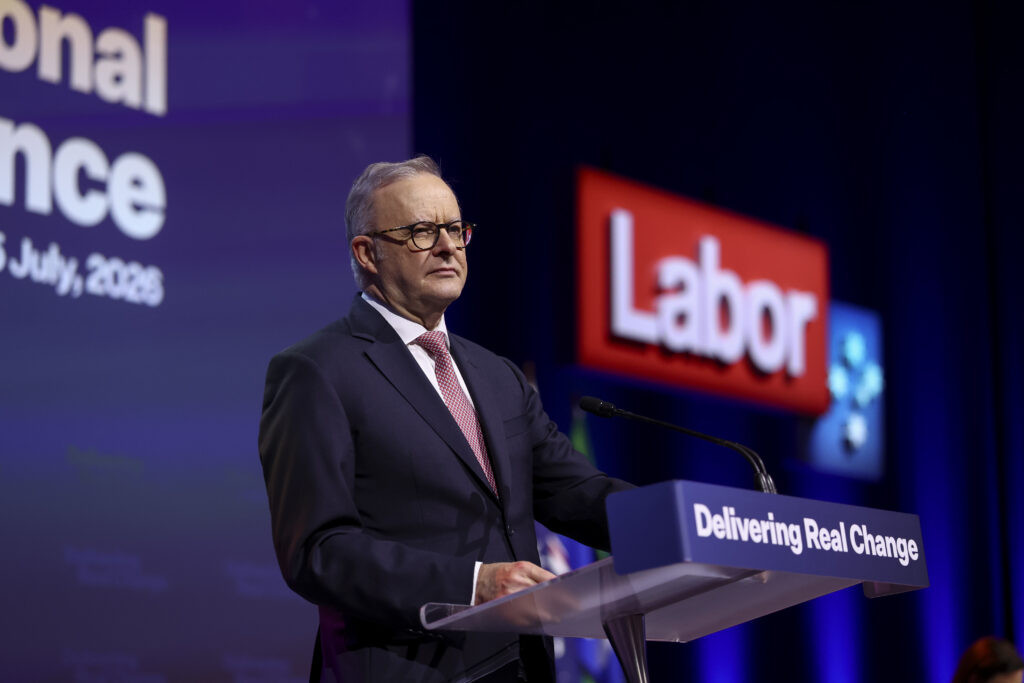
Main image: Andrew Pakes addresses the ALP conference in Australia (image: BCCM)
The announcement follows the UK Labour government’s own manifesto commitment to “double the size” of the co-op and mutual economy – a pledge many hope will be accelerated with the Co-op Party-sponsored Andy Burnham recently elected prime minister.
One speaker at the ALP conference was the UK’s Andrew Pakes, Labour/Co-op MP for Peterborough, who has also chaired the all-party parliamentary group (APPG) on mutuals.
“There is a great shared heritage between Australia and the UK that often leads to political collaboration,” he says. “It is great to see the ALP adopting a similar ambition to ours here in terms of doubling the size of the mutual sector.
“This isn’t about government imposing co-operation but about using the power of government to create a level playing field for the mutual sector. In Australia, agricultural co-operatives are more advanced than in the UK, something we can learn from.
“I am already working with Co-operatives UK, Arla and the Co-operative Group to encourage government to expand its support for mutual solutions in food and farming. There is also a lot to learn from Australia around care co-operatives and using co-operative heft to invest in new markets.
“We are stronger in the retail sector and it was great to meet local representatives from Barossa where there is a thriving mutual retail offer to see how we can collaborate between countries. And both governments are interested in how co-ops can play a role in delivering part of the solution around affordable and accessible housing.”
Related: What does ‘doubling’ the co-op economy mean – and how do we do it?
Pakes first visited the BCCM in Adelaide last year and at this year’s conference joined a panel in the LaborEngaged’26 Fringe Program, titled ‘What Australia can learn from the UK’s agenda to double the co-operative and mutual economy’, with Morrison, Michael Pilbrow (delegate for Riverina) and Linda Scott (delegate for Sydney).
The discussion highlighted the growing international momentum behind member-owned business models and the practical policy settings that can help co-operatives and mutuals grow, compete and deliver greater value for members and communities.
“I also met ministers and mutuals at federal and state level to look at how we expand capital investment in co-op models and tackle shared agendas around social care and housing,” says Pakes. “Both of these are long-term challenges where mutualism provides part of the answer. It was a great opportunity, and I will be welcoming Australian colleagues to Westminster when Parliament returns next year.”
Australia has 1,810 co-operatives and mutuals, with combined turnover of more than AU$55bn, more than 37 million active memberships and direct employment of around 95,000 people. The sector also supports nearly 367,000 small business members, showing that co-operatives and mutuals are an established part of Australia’s economic infrastructure.
“I’ve always believed in the international reach of the movement,” Pakes adds. “People’s lives have been made safer, fairer and better because of the co-operative model. And there is a lot to learn from each other. The co-operative model is one of the things I have focused on in Parliament, including my new regular pitch for the English Mustard Growers Cooperative on my patch, and I have regularly reached out and met co-operators when they visit the UK.”
Related: Farm co-ops can boost UK’s food security, says report
As the former chair of the APPG, Pakes has high hopes for the future of co-operation in the UK.
“There is no greater antidote to the politics of exclusion than co-operation, and no greater advocate in Number 10 than the prime minister. I am incredibly hopeful that we will make great strides in devolution in the next few years,” he says, adding that he believes the key to doubling is devolution: handing power back to communities through councils and mayors, and handing power back to people through the growth of the co-operative and mutual sector.
“The new PM is right in saying that the country took several wrong turns in the last 40 years,” he says, “through the privatisation of economic power, centralisation of civic power and stripping away of place as a centre of decision-making. That fuels not only inequality but also resentment that drives the
current anger in politics.
“The co-operative movement is well represented in government through the Co-operative Party and the Mutual and Co-operative Business Council.
“We now have an opportunity to do two things: expand the growth of the sector as a driver for growth in every postcode; and to support community co-operatives to support the foundations of place.”