Co-operation has long given women the tools to survive. This is particularly the case right now in the region of northeast Syria known as Rojava, where the women-led co-operative movement is seeking international solidarity.
Working with the UK-based Solidarity Economy Association, Khalat Shihkmous and Shevin Erdal travelled from Rojava to the ICA Conference in Panama last month to share their story, advocate for women’s rights, and call for recognition and support from the global co-operative community.
For decades, Kurds, Assyrians and others in Northeast Syria were marginalised under the Ba’athist regime. The 2011 Syrian uprisings and civil war opened a space for already organised communities within Rojava to take control of their own future.
In 2012, the Rojava Revolution began building a system founded on democratic confederalism, rooted in democratic local governance, religious and cultural pluralism, gender liberation, and an economy based on the needs of society, supported by the Syrian Democratic Forces (SDF, a Kurdish-led, multi-ethnic armed coalition). It also led to the formation of co-operative farms, factories and other businesses, with a strong emphasis on gender equality, youth participation, and ecology.
The al-Assad government fell on 8 December 2024, and in March 2025, a 23-member transitional government was sworn in. That month, the two sides signed an initial integration agreement that sought to merge autonomous administration- and SDF-controlled institutions into the state – but implementation stalled. In January 2026, the dispute escalated into fighting, and tensions continue.
Related: Co-ops and resistance in Rojava
“We started our trip with a broken heart,” said Erdal. “But once we met co-operative friends here, we felt less alone.”
Despite the risks around documentation and personal safety, Erdal and Shihkmous did all they could to make the trip happen. During a breakout session, they shared their experiences around youth and women’s engagement in an area rife with conflict.
“We came to talk about our co-ops, our struggle, our risk, our concerns, and to show what is happening in Rojava right now,” said Erdal. “Sharing this moment with co-ops that are maybe 100, 150 years old is also important for us. Our co-ops started around 14-15 years ago, so this was an opportunity to learn about their experiences, systems, regulations and laws.”
Co-operatives in Rojava began based on community need, she adds, but do not have legal protection in Syria.
Shihkmous’ organisation, Aboriya Giştî (General Economy, working with both men and women), supports co-operatives in the industrial sector, handicrafts and craft production, agriculture, food preservation, and bakeries. This includes digging boreholes, installing solar power systems, growing produce and making dairy products. On the industrial side, carton factories work to produce recycled containers, and there are factories for animal food.
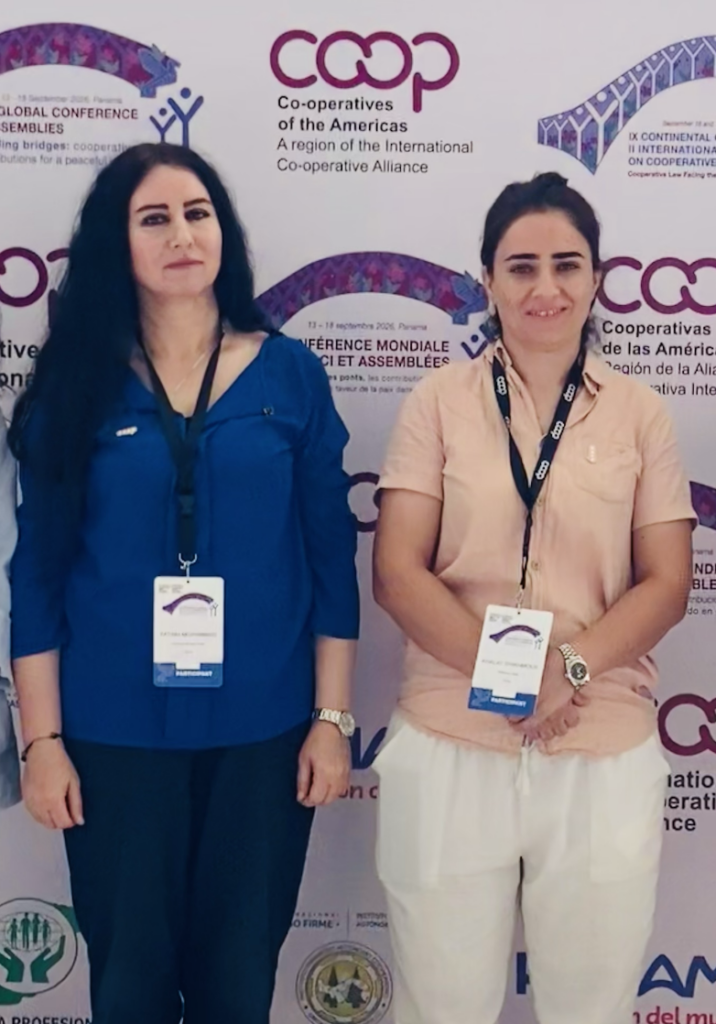
Rojava’s economy council had 12 committees. Shihkmous began in the agricultural committee as an agricultural engineer, and was later elected co-chair of the co-operatives committee (all leadership positions are shared between two people, at least one of whom must be a woman).
Since integration into the transitional government’s institutions began, she says 11 of the 12 committees have integrated. The co-operatives committee is the only one that has not.
“We wouldn’t accept integration into a system that doesn’t accept women holding positions of responsibility,” said Shihkmous. “Within the autonomous administration, we were independent. Women held responsibility and took decisions, not individually, but together.”
She can’t imagine being integrated within a government “that will give me orders and not let my voice be heard.” The current transitional president of Syria is Ahmed al-Sharaa, who led Hayat Tahrir al-Sham (formerly al-Nusra Front, al-Qaeda’s former affiliate in Syria) to overpower the former Assad regime in December 2024. Only one of the 23 ministers of the transitional government is female.
While gender is clearly a factor, there is also the issue that the integration committee itself doesn’t accept co-ops – and the integration committee would not enter negotiations.
Related: Full report from the ICA Global Cooperative Conference
Erdal is an elected member of the administration committee of Aboriya Jin (Women’s Economy) at Kongrastar, a confederation of women’s organisations in Rojava. Aboriya Jin was created “to give rights to women, because with the al-Assad regime, we noticed that women’s representation inside the government was very low,” she says.
She began as a member of her local commune, working across its economy and women’s committees, where she helped to set up women’s co-operatives. Women, she adds, can “build something from nothing”.
“Some projects started with three women and ended up with 30. In agriculture, we sometimes started with one or two sheep, and now we have more than 1,000.”
For Erdal, the integration has not worked, in part because she sees the new system as taking a radically different approach to women’s role in public life, which, she says, puts them under male responsibility and “accepts them only on whatever terms and positions are offered”.
“The state also wanted to turn the co-operatives into companies, with members as state staff on salaries and the income going to the state, which would mean they are no longer co-operatives,” she adds. “Without freedom for women, the co-operatives cannot be integrated … We can work with the new government only under one condition: if women’s rights will be respected.”
Shihkmous agrees, underlining the co-operative value of equality, and calling for global co-operative solidarity. “At the conference, we heard from many countries, but none of them are facing what we are facing. We don’t think about peace because we are in a conflict, and the difficulties that we are facing every day don’t let us think about peace.
“On the other hand, our thoughts are always about peace, and the mentality that we built within the autonomous administration was about peace. Co-operation also means civil cohesion and community cohesion. So I’m full of hope.”
She notes the internationalism of the conference logo. “I like the logo because it makes you consider that maybe we can do something together.
“We have this saying that ‘one hand cannot clap’. Maybe there are many people like us in the same situation. The same struggle, sharing the same needs, sharing the same thoughts, building the bridge. Sharing co-operative principles around the world and fighting against capitalism and for the environment. When the community is free, and there is peace, women can also be free and at peace.”
Their call to the global co-operative movement is to recognise Rojava and its co-ops, and to raise awareness of their situation while protecting co-operatives from being absorbed into the state. Sharing co-operative expertise, legal models and experience would also help.
Erdal adds, “What we need from this conference is to raise the voices of women from Rojava, advocate for women’s rights and make sure that 14-15 years of effort and sacrifices aren’t wasted. We want to show everybody the risk to women today in the new Syria and advocate for legislation protecting our women and our co-operatives.”