A white paper, commissioned by the Co-op Group, warns that a shadow economy on the high street is undermining legitimate businesses and urges the government and local authorities to crack down on illegal activities such as the trade in illicit cigarettes.
The Group says the study, backed by a YouGov survey and government data, “lays bare how Britain’s high streets are being driven by criminality not honest competition”.
It says illicit tobacco sales and “the brazen trade in stolen and counterfeit goods” are met with “no effective enforcement locally or nationally, creating a ‘shadow economy’ that is undermining legitimate businesses and, as a result, threatening the future of our high streets and leaving organised crime to define the future of communities”.
Written by criminologist Prof Emmeline Taylor, the white paper, Legitimate High Street Framework, says it is important that government and local authorities act to disrupt organised crime networks.
“Crime doesn’t just exploit declining high streets,” warned the Group, “it can kickstart and accelerate their decline, and where there are no meaningful consequences, or limited sanctions, these rogue businesses simply relocate, change their name and open up a few doors down”.
The Group is now calling on the government to increase investment, increase the number of premises raids and significantly improve the use of Tobacco Track and Trace (TT&T) system.
It says the illicit tobacco trade is one of the “clearest examples of how organised crime is undermining the legitimacy of the high street”.
“This trade growing at an alarming rate,” says the Group, “with estimates ranging from two to ten billion illicit cigarettes in the UK with £1.4bn in lost annual tax duty.
“Tobacco is a high value commodity functioning in some criminal markets almost as alternative currency with organised crime gangs exploiting price differentials between legitimate and illegitimate and consumer demand for cheaper products, by expanding the illicit tobacco market.”
A YouGov survey commissioned by the Group reveals that over one third of UK smokers (36%) have bought illicit cigarettes.
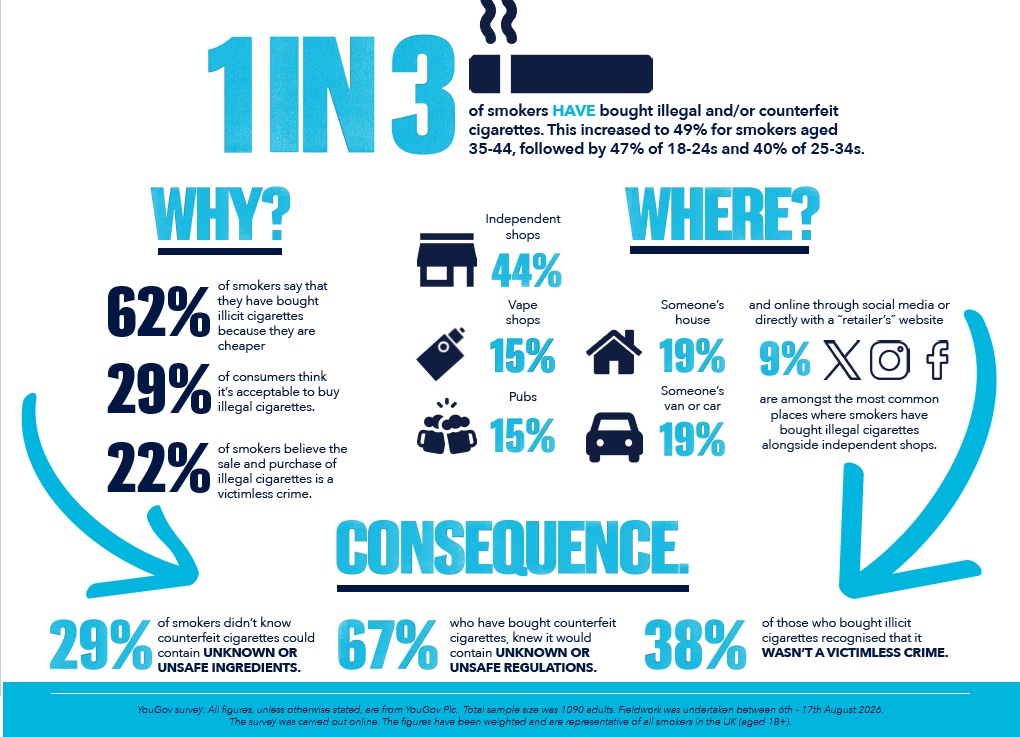
For those buying counterfeit tobacco products, the contents can often be unknown, and frequently contain material not meant for human inhalation. However, whilst 67% of smokers who buy these products are aware they may not be pure, they are willing to take the risk.
The survey found that 62% of smokers buy illegally because they are cheaper. A recent, undercover exercise by the Group, conducted in a small geographical area, targeted 24 seemingly ‘legitimate’ shops and found 18 of them – 75% – were selling illegal tobacco with an average price of just £5 a pack and the highest price only £8.
The UK is Europe’s second largest illicit cigarette market, after France, with thousands of premises across the UK selling these products.
According to the Group’s survey, illicit cigarettes are often bought from shops trading under the guise of legitimate businesses – corner shops (44%), vape shops (15%) independent supermarkets (11%) and barbers (4%).
“These businesses form part of a wider criminal ecosystem,” says the Group, “benefitting the organised crime gangs not just by providing profit but in the legitimacy, they present as a store front.”
Related: Co-op Group launches social mobility tools as poll warns of class barriers
Freedom of Information requests submitted by the Group reveal that local councils in England are woefully absent in tackling these criminals and the growth of seemingly legitimate shops which service this shadow economy. The FOIs revealed:
- On average, councils visit just four shops a month to investigate the sale of illegal cigarettes. confiscating illegal cigarettes from just one shop every two weeks and seizing the equivalent of just one illegal cigarette per resident over three years.
- Activity varies massively by location. 66% (two thirds) of seizures and over 75% of confiscated illegal cigarettes were undertaken by just 25% of local councils, which begs the question: what are the remaining 75% of councils doing?
- Regional variation is even starker, with trading standards offices in Yorkshire and the Humber seizing ten times the number of cigarettes per resident, than their counterparts in London.
There is clear evidence that when action is taken, results can be achieved, the Group argues. Its FOI shows that when local councils visit suspect shops, they find illegal cigarettes almost half (43%) of the time, confiscating an average of 8,000 illegal cigarettes per seizure.
“But with the number of raids so limited, real change isn’t happening,” it adds. “Closure notices and orders provide local councils and trading standards with certain powers, but they are not being used.”
The Group also points to the “extremely limited use” of the Tobacco Track and Trace (TT&T) system, which enables all tobacco products to be tracked through the legitimate supply chain to the retailer.
Its FOI request found that 122 councils reported less than 500 TT&T referrals from more than 8,200 seizures in total – fewer than 6%. The vast majority of these referrals (75%) were reported by just 15 councils, with more than half (57%) reporting no engagement with the T+T technology at all.
“The evidence we have collated shows how shadow and illicit economies are shaping the face of high streets up and down the UK, creating an unsafe environment, impacting legitimate businesses, preventing £1.4B reaching the public purse,” said the Group’s director of public affairs and campaigns, Paul Gerrard.
“Co-op has been the leading voice on tackling retail crime within our own shops, but we need government and local authorities to invest more time, money and effort into fighting the illicit tobacco trade, which is growing to unprecedented levels, as the £30m committed by the government to this issue, won’t even touch the sides of the problem. Increased investment now will reap long term benefits, not only to the public purse, but to drive social and commercial benefits of thriving high streets and communities.”
Prof Emmeline Taylor – who previously worked with the Group on the issue of crime against retail workers – said: “Britain’s high streets are the lifeblood of communities.
“However, we can see that crime is not simply a consequence of high street decline, it is now one of its principle drivers. Illicit tobacco, retail theft and the stolen goods market not only generate victims, but they also distort local economies, undermine legitimate commerce, erode public confidence, and weaken the opportunities for successful regeneration.
“The proposed Legitimate High Street Framework is a criminology informed approach to providing a coherent framework for protecting lawful enterprise, disrupting organised crime and restoring confidence. If Britain’s high streets are to experience the renaissance envisaged under Andy Burnham’s policy platform, tackling crime must be recognised as a prerequisite for renaissance, not simply a parallel objective.”