Bronwyn Wilde (main image)
Tell us about yourself?
I am from Aotearoa, New Zealand. Back home I was an environmental lawyer and trustee at my own local community project, Vogelmorn – a rescued bowling club building turned into a multi-use space with a cafe, toy library, live music, theatre and much more. For the last few months I have been travelling around Europe and the UK learning about, and volunteering my skills at, other community initiatives while I look for a place to settle long term.
How did you first hear about co-ops and the Youth Summit?
My previous experience with community projects has been in the charitable or non-for-profit space. In Aotearoa I had only heard of co-operatives in the context of behemoth agricultural co-ops like Fonterra who, as one of the largest emitters of greenhouse gases in the country, are often viewed by the community as part of the problem, not the solution.
Related: Report on the National Youth Summit
Not until I arrived in the UK did I realise the long history of co-operatives here for a range of purposes, including using community shares to crowdsource climate initiatives like Fordhall Farm and the community-owned wind turbine in Lawrence Weston. When I received a well-timed Instagram ad to attend the Co-operatives UK Youth Summit, I leapt at the opportunity to learn more about this structure.
How were you feeling when you arrived?
I was slightly daunted entering the conference not knowing a single person or thing about the co-operatives movement, but everyone I spoke to was very open and willing to explain how their unique co-op worked. As the youth attendees, we easily broke the ice with each other by confiding we were all slightly perplexed by the same question: “what exactly is a co-operative?”
What did you think of the sessions?
Luckily, the summit started with a co-ops 101 session explaining exactly that, before we broke off and explored a number of potential applications of the co-op model.
Unsurprisingly, AI and tech sovereignty were hot topics. I was interested to hear about plans for a community-owned data centre in Blackpool where the computational heat generated will be used to warm a local public swimming pool. I also spoke to a member of Radical Routes who explained how they support new co-ops to host their own websites and emails, to avoid relying on offshore big tech providers.
I was surprised to hear from other attendees that they struggle with very similar problems to those faced by my community group back home – maintaining community engagement beyond the AGM. There was a lot of discussion about making engagement more accessible in an increasingly time- and money-stretched society – by offering transport subsidies, food and childcare arrangements, for example.
What was your main takeaway?
While I learned so much over the weekend, I walked away feeling like my initial question, “what exactly is a co-operative?” remained ever so slightly unanswered. That was not a failing on the part of any of the incredible speakers or representatives I met. Instead, as one delegate helped me realise, it is an age-old problem facing the co-op movement. The importance of conferences like these enable people to step back and be reminded of the bigger picture.
what are the biggest challenges facing younger generations – and how can the co-op model address them?
In my experience, young people are paralysed by the crises they face – mental health, cost of living, climate – and are unsure how to effect the change needed to address these. Rather than feeling powerless between governments and corporations, a mutualisation model could offer young people an alternative, one that empowers them to seize opportunities for change.
If you had one message to the wider co-op movement, what would it be?
In a time where distrust in governments and corporations is high, I believe the co-op movement has a critical role to play in reminding us of the power of ordinary people coming together, transcending differences and political alignments, to actively shape local solutions to the world’s problems.
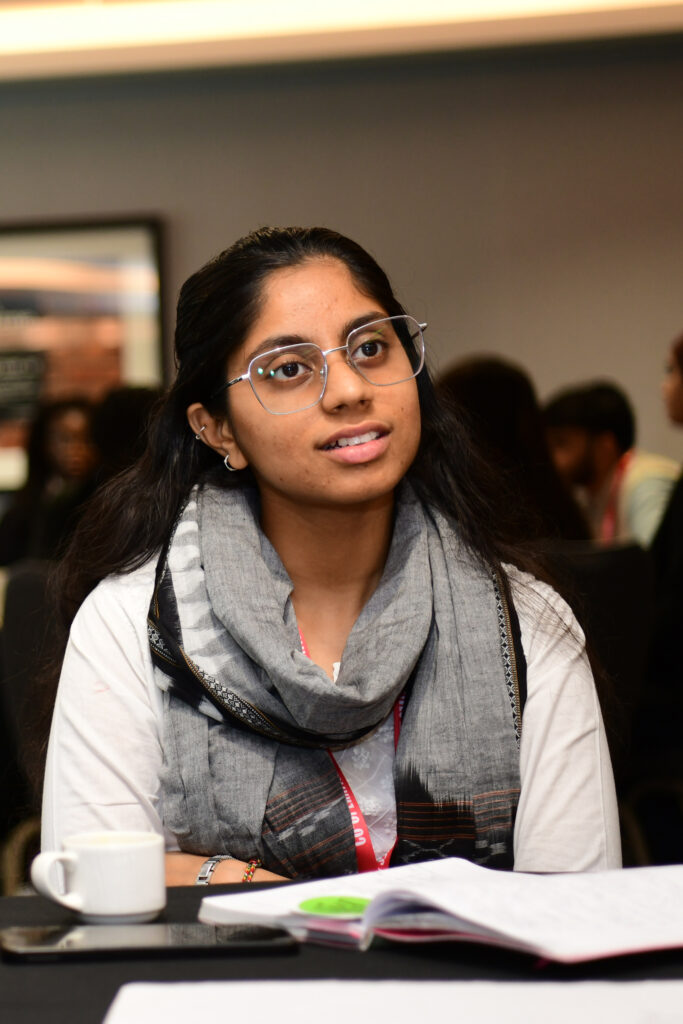
Amogha Srinivas Gorur
Tell us about yourself!
I am Amogha, a social designer from India, pursuing an MSc in social innovation and entrepreneurship at the London School of Economics (LSE). I worked on design, production, and technology projects with women’s artisan co-operatives. Seeing co-ops
in motion, I am really enamoured by their built-in approach to serving both purpose and profit. This interest deepened after I came to LSE, where I chose to do my dissertation on the role of external organisations in building self-governance of co-operatives.
How did you first hear about co-ops and the Youth Summit?
I first heard about co-operatives as a small kid, whose mother would drag her along on shopping trips to the Weaver Co-operative Shops.
I got in touch with Co-operatives UK to participate in my research, and they suggested I attend the Youth Summit, as it would be a hotspot for understanding the co-operative ecosystem in the UK. I am grateful to have had the opportunity to be there and absorb all the energy.
What made you want to attend?
The curiosity to understand how the UK co-op ecosystem looks, feels, and thinks, its stories, challenges, and origin narratives. However, once I stepped in, I was a bit overwhelmed, unsure if I could place myself in a context that was new on the surface but familiar at its core.
What did you think of the sessions?
The sessions were designed in a comprehensive, all-rounded way. Everyone had a place, whether a co-operative veteran or an amateur, a space to reflect and understand. They spoke to multiple audience groups, which shows the movement’s dedication to being inclusive.
I learned that though the UK co-operative movement looks different on the exterior from the Indian context, the challenges that plague it are the same. There is a built-in collective trust and affinity, they genuinely want to support and uplift each other, to thrive together and not individually … They rely on collective action, trust, and structure, a rigour that is often difficult to achieve when profit and purpose must be balanced, which co-operatives do well.
What was your main takeaway?
Co-ops survive on collective action but thrive on collective trust. They rely on member relations and affinity. And while a co-op serves members with similar interests or a community’s needs, it needs diversity of thought to remain agile and robust, and to avoid groupthink.
what are the biggest challenges facing younger generations – and how can the co-op model address them?
As younger generations engage with the workforce, many are not aligned with how earlier generations functioned. To escape this and achieve empowering positions, many turn to entrepreneurship, giving rise to startup culture, which makes them individualistic and alone in their ventures, yearning for social connection.
Co-operatives are a way to address this: the feeling of being empowered while still functioning as part of a collective. Younger generations, especially those interested in social impact, should start seeing this model not as a thing of the past but as something dynamic and absorptive of cultures, contexts, and aspirations.
If you had one message to the wider co-op movement, what would it be?
Let the co-operative model be the thread that makes one more empathetic, compassionate, and appreciative of others’ socio-cultural realities, achievements, and advancements.