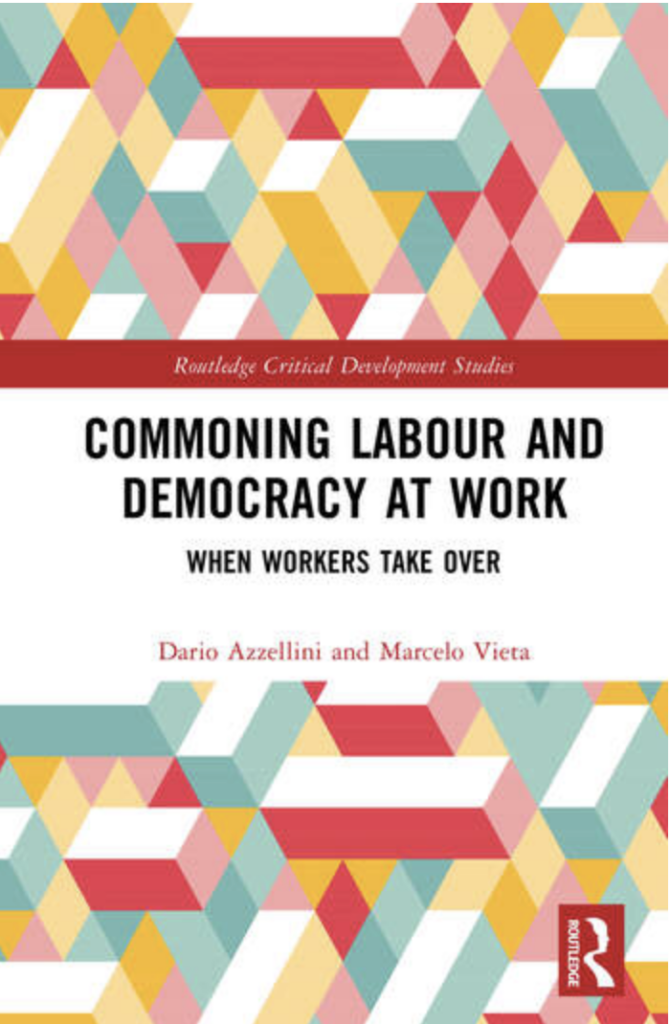
Workers’ self-management is on the rise, as a response to recurring neoliberal crises: this is the central argument in a new book co-authored by Professor Dario Azzellini, senior researcher at the Institute for Sociology, University of Duisburg-Essen with previous roles at the Autonomous University of Zacatecas (Mexico) and Cornell University (USA).
In particular, Commoning Labour and Democracy at Work homes in on worker-recuperated enterprises (WREs), a form of workers’ self-organisation whereby workers restart troubled, bankrupt, or shuttered companies as co-operatives or other forms of democratic workplace.
Worker buyouts are not new – and Co-op News’s recent interview with Bruno Roelants touched on the success of Italy’s Marcora Law, which facilitates such transfers. But Azzellini argues that WREs are transformative not just for workers and organisations, but communities and wider democracy too. He and co-author Marcelo Vieta add a class-analysis dynamic to the re-emergent labour question, drawing on a range of contemporary case studies from around the world.
“What we try to do in the book is to go back to the original idea of what co-operatives were at the beginning,” Azzellini says. “And co-operatives at the beginning were part of the workers’ movement. It was a collective response to the idea of ‘everyone according to their capacities, and everyone according to their needs’.”
He believes many contemporary challenges stem from “connecting the right to decide to the same principles as capitalism and ownership. I think it shouldn’t be ownership. It should be work that gives the right to decide”.
He adds: “In an ideal case, I would say we have three groups in society that should be part of decision making: producers, workers and consumers. These groups can have very different interests, and in a democratic society, these interests would somehow be negotiated. We’re not at the point where society is organised enough to do that. So I think that the first step should be the control over work.”
In his view, workers should be able to control the work, the labour process, the conditions, what they produce and what for. “That’s what we find interesting about different types of co-operatives and how they bring us back to this original idea … Co-operatives are not just a model with many owners instead of one, but a different way of society. It’s a different model of living together, of producing, of consuming, of decision making. The bottom line is, who has the right to decide? People have the right to decide about their own lives.”
Azzellini acknowledges that the economic structures and histories of different countries have a huge impact on the development of co-operatives. “In the US, it’s much more difficult to set up co-operatives … I think that the whole of the US has probably fewer co-operatives than my neighbourhood in Berlin,” he jokes.
Related: Worker co-ops rising in the USA
“And there are so many other contexts that affect co-operatives – in the UK for example, I would still tie a lot of what has happened in the last 50 years to the defeat of the miners. That was such a neck breaking issue that I think destroyed the British labour caste for a long, long time and in a really brutal way. Then in other places you had the promise that capitalism would solve everything, and we’d all be happier.
“But I think at the same time you have the idea of co-operatives coming back – in a lot of places they emerged as a response to the financial crisis in 2008, while in many places, you have a much stronger, politicised movement of co-operatives in Latin America.”
He gives the example of Uruguay, where since the 1960s there has been strong co-operation between co-operatives and other workplaces.
“The co-operatives are unionised,” Azzellini says. “If there’s a strike in the sector, co-operatives in the same sector go on strike as well, so that they don’t disturb the strike of the other organisation. The National Co-operation Association has a seat in the general directors board, the General Union Confederation, and the union itself is founding co-operatives.”
But you also have places where unions ignore co-operatives,” he adds, “where they don’t care because they don’t feel responsible – they have the classical idea a union is the kind of negotiation mechanism between work and capital, and because this negotiation does not exist in co-operatives, the union has no place.”
This is changing in some Latin American countries, he says, as well as in Europe.
“In France, the General Confederation of Labour (CGT) does not mobilise for co-operatives, but if the members want to take over a factory, or are occupying it and want to turn it into a co-operative, then they support it.
“I think it makes sense to push into this direction [of WREs], because we will see so many closures of production sites over the coming five to ten years, with concentrations of production clusters and the economic and social desertification of other places and regions. It will be absolutely necessary for workers to step in and take over and say, ‘Okay, we’re doing it’.”
Azzellini grew up in Germany, but spent time in Italy – “which orientated my thinking towards collective and co-operation” – and he and Vieta have been working on the book for five years.
“We wanted to give an overview of what kind of like takeovers exist and what are the social value of these endeavors,” he says. “What are they doing? What are they achieving? What’s happening? What companies are being taken over?”
The case studies they look at range from an Argentinian laboratory doing Covid tests during the pandemic, to a working shipyard.
“I think what it shows is that workers can take over and can manage the production of anything, everywhere, anywhere, always,” he adds.
The case studies show that where there are failures, it is not because of economic reasons, he adds, but instead from pressure and repression from the outside.
“Anything you can imagine can be done and produced by workers, can be, and the UK is particularly fascinating in that sense, because it has one of the most historically interesting experiments of trying to transition production.”
That experiment was the Lucas Plan, a 1976 document produced by the workers of Lucas Aerospace Corporation outlining an alternative plan for the future of their company after it was announced thousands of jobs were to be cut to enable industrial restructuring. Instead of being made redundant the workforce argued for their right to develop socially useful products.
The plan was met with hostility from the Lucas Aerospace management and ultimately wasn’t taken forward but “it’s still a compelling story of an attempt at a kind of democratic and participatory transition – that in that case is relevant for today,” says Azzellini.
Another issue that emerges with worker transition, he adds, is the parallel sociological transition.
“Once workers are in control of the workplace, questions around ecology and sustainability become much more important,” he adds. “Why? Because the moment that these workers know the decisions they take have an influence, they think about them more, because it affects them […] it ties back people and economy, so building an economy that serves the people and not modeling people to serve the economy.”
He also believes that workers can achieve takeovers and win struggles if they manage to turn them into political struggles. “So as long as you trust only the law, the chances to win are minimal, because the law has not been made for workers, it’s been made to save private property. But political struggles are something we can win.”
This is more successful in Latin America than Europe, he adds, “because what they do is respond to immediate needs.
“And I think that’s something the Left in Europe has to learn again: to respond to the needs of people and to solve issues. Just like co-operatives do.”