Main image: Shaun Tarbuck, Monica Mutsvangwa, Matheus Marino, David Obonya, Kostas Papadakis, Marie-Jose Tayah (all images: ICA)
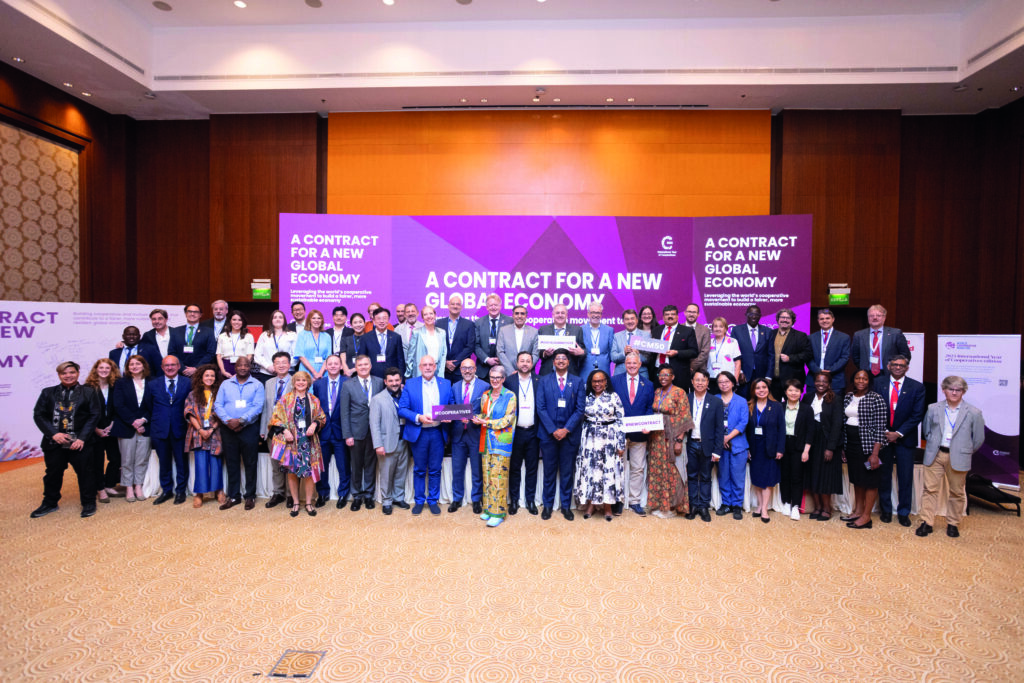
In the first week of November, ahead of the second World Summit on Social Development in Qatar, co-operators met in Doha to launch three tools designed to help co-operators continue to ‘Build a Better World’.
Hosted by the International Cooperative Alliance, over 100 co-operative leaders, UN representatives and government leaders witnessed the launch of the CM50 Manifesto and the ICA’s 2026-2030 strategy. The event also saw the launch of a special edition of the World Cooperative Monitor, a data-driven report that demonstrated the top 300 co-ops and mutuals have combined turnover of US$2.79tn.
CM50 and a Contract for a New Global Economy
The Cooperatives and Mutuals Leadership Circle (CM50) is an initiative of the ICA established earlier this year, which brings together leaders of some of the world’s largest co-operative and mutual enterprises, who together have a shared turnover of over $300bn. At its official launch in Doha, its first action was to publish its manifesto: a Contract for a New Global Economy.
The document outlines a commitment by CM50 members to accelerate progress on social development, climate action, and shared prosperity – while urging policymakers to embed co-operative solutions into national and global economic strategies.
Related: CM50 leaders pledge to ‘drive impactful change globally’
“Our businesses work for people and the planet, not speculation,” said Shaun Tarbuck, who co-chairs the CM50 with ICA director general, Jeroen Douglas. “We are ready to partner with governments to scale solutions rooted in fairness, democracy and sustainability.”
An active call to governments and multilateral institutions, the manifesto invites policymakers to officially recognise the co-operative model, provide access to sustainable finance for co-ops, establish regulatory frameworks enabling innovation and digital growth, protect the co-operative identity and democratic governance and integrate co-ops into national SDG strategies.
During the launch in Doha, delegates heard how in turn, the CM50 would address its own four commitments:
- Creating resilient economies through co-operation
- Equitable growth (access to capital)
- Building co-operative digital ecosystems
- Purposeful leadership and next-generation co-operative education
“As a global body of co-operators, the CM50 also knows our way of working is very powerful and unique,” said Shirine Khoury-Haq, CEO of the UK’s Co-op Group, speaking to commitment 1. “From Rwanda to Bosnia to Guatemala, co-operation and mutuality has been a cornerstone of rebuilding communities ripped apart. Hate divides communities, co-operation builds them.” Co-operation is a tool for peacebuilding, resilience, and post-conflict reconstruction, she added. “In the toughest of places, the most intractable of conflicts, co-operation shows that peace is possible.
“Our movement has the global network, the assets and, most importantly, the values and principles to help rebuild communities. I know that we will meet the challenge ahead of us.”
Speaking to the second commitment (access to capital), Coop Exchange’s Stephen Gill described how the current financial system “was built to serve investor-owned firms, not member-owned ones”.
“When we look at the challenges facing co-ops, the conversation often turns to access to capital,” he said. “But in truth, capital exists in abundance; the real constraint isn’t the amount of capital, it’s the architecture that moves it.”
The task, he added, is to redesign systems and “build capital pathways that protect democratic control while unlocking scale”.
“This turns our collective balance sheet into a flywheel – internal co-operative capital investing in co-operative growth … When we redesign finance around co-operation, we don’t just raise funds. We build the plumbing for a fair global economy.”
Related: International Year of Cooperatives closes at Doha
Debbie Robinson, CEO of the UK’s Central Co-op, spoke about the importance of the third commitment and the need for a digital ecosystem for co-ops that’s “Co-op to co op, trade business to business, business to consumer”.
“My challenge to each and every one of us in this room is, how much do you want to grow your trade? How much do you want to improve economic participation in co-operatives? Imagine if we were to bring together the fantastic idea of co-operatives and apply digital expertise [to] create an ethical Amazon, a truly co-operative alternative.
“When we have that, when we are more prosperous, the communities with which we trade will rise out of poverty … we won’t need to be explaining co-operation. We will be living the power of co-operation.”
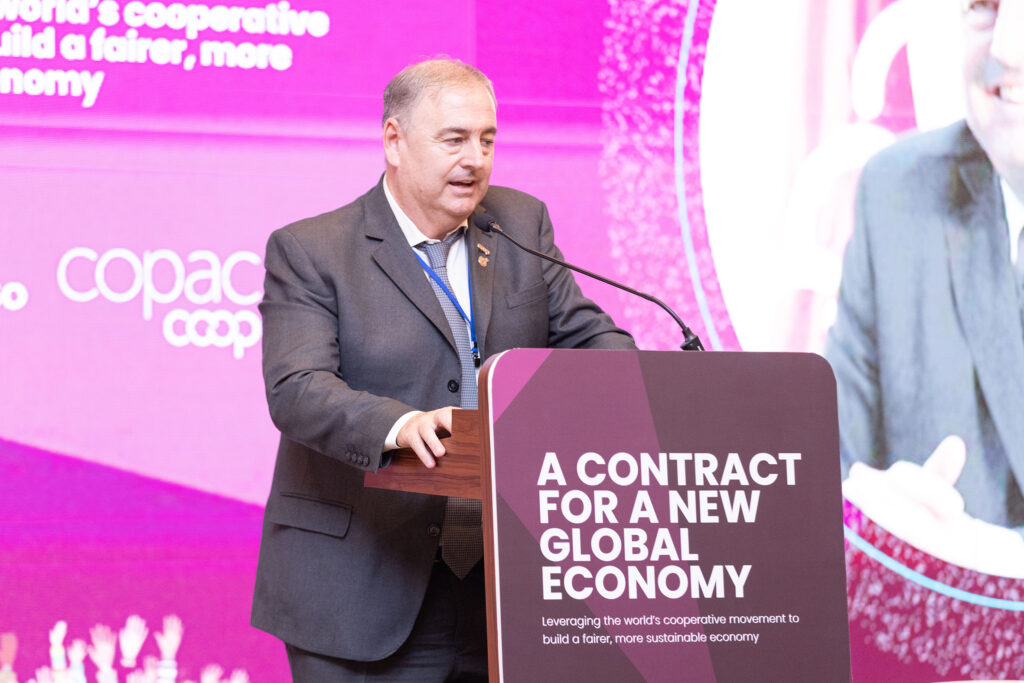
Fabíola da Silva Nader Motta, general manager of the Organization of Brazilian Cooperatives (OCB) addressed the fourth commitment, and the need for co-op leadership and education to sustain and grow the movement.
“It is essential to develop new leaders who deeply understand co-operative values and that can navigate complex global contexts,” she said. “The challenges that the world faces today require a leadership that is not only technically prepared, but also is rooted in purpose, solidarity and a deep understanding of the co-operative identity.”
She presented the CM50’s proposal of an international programme that connects young leaders to the co-operative legacy through immersive experiences grounded in our values and co-operative identity.
“This programme should go beyond traditional training, offering mentoring and real-life encounters with the history, people, and places that have shaped the co-operative movement,” she said, adding that young people are a cornerstone of this.
“By showcasing real stories and historical sites, today’s leaders can inspire and educate future generations, helping them recognise co-operatives as dynamic forces of economic and social transformation.
“We believe that this is how we ensure that the co-operative movement continues to thrive – by today’s leaders passing on its essence and its mission to those who will lead it in the future.”
ICA 2026-2030 strategy: ‘Practice, Promote and Protect’
Also in Doha, the ICA officially published its 2026-2030 strategic plan to empower the future of co-operatives. The Practice, Promote and Protect strategy is a global roadmap designed to strengthen co-operative enterprises, accelerate sustainable development, and expand economic democracy worldwide.
The strategy’s direction is anchored in the Co-operative Identity and supported by five strategic pillars: building awareness and membership growth; promoting inclusive opportunities, especially for women and youth; enabling strong policy and regulatory environments; strengthening co-operative networks and co-operation; and advancing co-operative competitiveness and innovation.
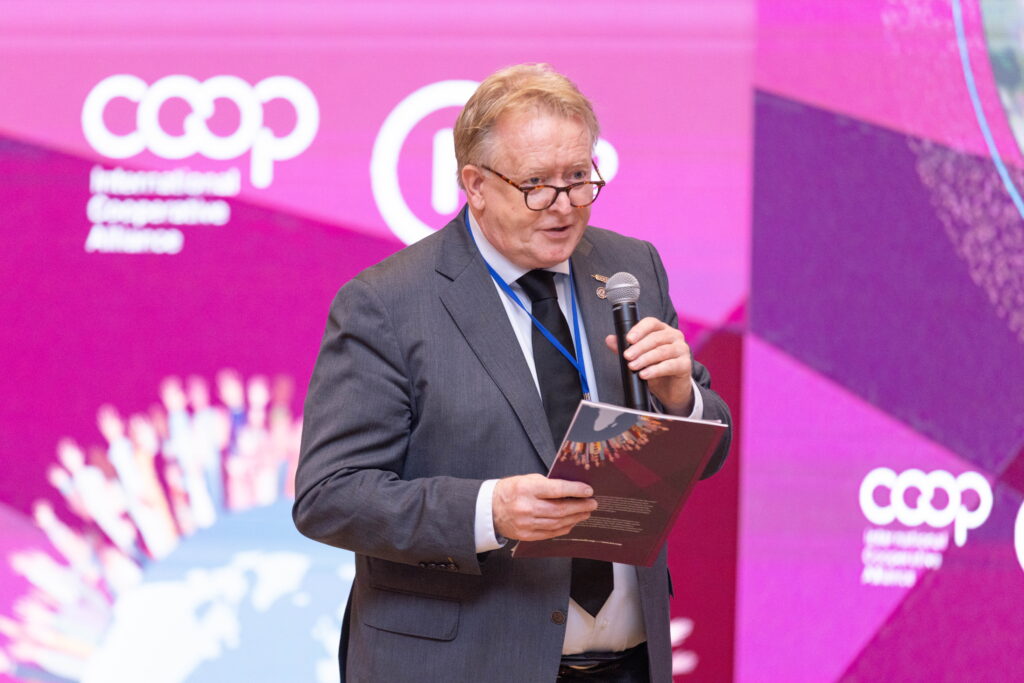
“We stand at a moment of great risk, but also extraordinary opportunity,” said Jeroen Douglas, ICA director-general. “This strategy is built by the movement, for the movement. It gives co-operatives the tools to lead in a rapidly changing global economy.”
The plan introduces major initiatives across five themes: people; data; advocacy; finance; and the future. This will include:
- Global leadership training and youth and women empowerment programmes
- Co-operative data platforms and digital knowledge tools
- Strengthened policy advocacy and legislative alignment
- Co-operative-friendly financing and investment partnerships
- Innovation and climate-action programmes to reach net-zero pathways
“The strategy sees co-operatives as essential partners in delivering decent work and shared prosperity, as well as democratic participation and community resilience,” added Douglas. “It also highlights co-operatives as accelerators of climate and sustainability solutions, and inclusive access to housing, healthcare, finance, and education.”
Global co-operative voices
The event included a round table exploring the role of governments and the UN within the co-operative movement, where Monica Mutsvangwa, minister of women affairs, Zimbabwe, highlighted the critical role of co-ops in Zimbabwe’s economic growth, emphasising the importance of empowering women and youth. Co-operatives are also “one of the key vehicles for inclusive development” in Kenya, said David Obonya, the country’s Commissioner for Co-operatives, and are central to the economic transformation there, too.
Also on the panel, Kostas Papadakis, principal social affairs officer at Undesa, highlighted the UN’s global efforts to strengthen co-operatives, noting that “2025 has been a landmark year for co-operatives.” He spoke of the importance of linking co-operatives to the SDGs, but also the importance of data. “We need better, more consistent statistics on co-operatives to inform policy development,” he said. What you cannot measure, you cannot improve.”
Marie-Jose Tayah (ILO-Qatar) discussed the longstanding partnership between the ILO and the co-operative movement, adding that “in one year, the ILO supported co-op-based initiatives in 24 countries… indicative of strengthening collaboration and national legislative frameworks,” while Matheus Marino (CEO Coopercitrus, Brazil) spoke about the importance of having “strong alignment with the government” and the need for big co-operatives to protect small members.
The event closed with Jayen Mehta, managing director of Amul presenting the scale and impact of the organisation. But he also stressed the vital need for global collaboration. “Co-operation among co-operatives turns out to be one of our best-selling products,” he said.