In November 2024, co-operatives gathered in New Delhi, India, for the official opening of the 2025 International year of Cooperatives (IYC2025).
Twelve months later, the IYC closing ceremony took place during the programme of the UN World Summit for Social Development in Doha, Qatar. Two major milestones for co-ops emerged from the summit: they were recognised as leaders of the social and solidarity economy in a political declaration adopted by member states; and the UN is considering a proposal to establish an recurring IYC every 10 years.
Co-hosted by the International Cooperative Alliance (ICA) and the UN Committee for the Promotion and Advancement of Cooperatives (Copac), the closing event of the IYC celebrated a year of co-operative action and activity, and looked at how co-ops can continue to ‘build a better world’ beyond the end of 2025.
Delegates heard from Bjørg Sandkjaer, assistant secretary-general at the UN, who highlighted the scale of the economic and social impact of co-operatives. “This model has helped us build resilient, inclusive societies,” she said, adding that co-ops are effective because “when people own solutions together, they trust them.”
Continued commitments to the co-operative sector were made by a number of government officials who attended the event, including Monica Mutsvangwa (minister of women affairs, community, small and medium enterprises development, Zimbabwe), Javiera Toro (minister of social development and family, Chile) and David Obonyo, commissioner of co-operative development, Kenya).
Mutsvangwa highlighted the contribution of women’s co-operatives in Zimbabwe, noting that “when women form co-operatives, they lift entire communities,” which in turn impacts employment creation and social stability. Toro also spoke about the transformative nature of co-ops, which “teach democracy by doing”. She explained that co-ops build stronger societies because “they allow people to practice participation, negotiation, and shared responsibility in their everyday lives”.
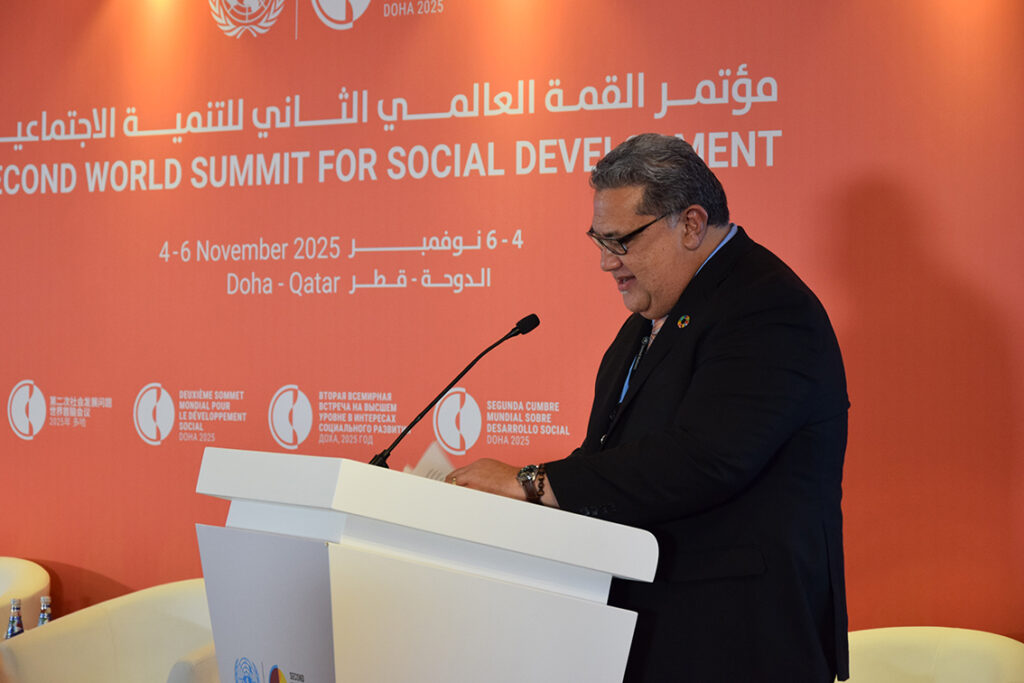
Main photo: ICA president, Ariel Guarco, presents the UN’s Bjørg Sandkjaer with a framed poster commemorating the 2025 International Year of Cooperatives
But co-operation is not a new idea, added Obonyo; it is a longstanding cultural practice. “In many African communities, co-operation … is part of who we are,” he said, adding that contemporary co-operatives “take that heritage and make it work for today’s challenges”.
The event also included a conversation with co-op sectors, moderated by Shaun Tarbuck, co-chair of the ICA’s CM50 initiative. Delegates heard concrete examples of co-operative impact across the globe, and how they contribute to poverty reduction, decent employment, and social inclusion – core themes of the summit.
Diego Guaita, CEO, Grupo San Cristóbal, detailed the scale and impact of co-operative finance, while Ayanda Seboni, group executive for Mutuality, PPS spoke about the co-op insurance sector’s role in building social resilience, and the importance of member-owned institutions in providing reliable, community-focused insurance solutions.
Related: Co-ops talk culture at Unesco’s Mondiacult conference
Debbie Robinson, CEO of the UK’s Central Co-op, described how CM50 is “a great act of solidarity [that will] create more harmony. Instead of us working individually, we work a lot closer together for the betterment of society as a whole”.
And from a healthcare perspective, Dr Carlos Zarco (Fundació Espriu and IHCO) highlighted the affordable, accessible, sustainable, and resilient nature of co-operative healthcare. “We are not just for profit,” he said. “You have to shift and change your shareholders’ profit for your stakeholders’ well-being. That is very, very important.”
There were also representatives from the agricultural sector. KJ Patel, managing director, IFFCO, stressed the need for intelligent infrastructure and support for farmers, highlighting co-operatives’ role in improving productivity and sustainability, and Jongwook Lee, executive vice president, National Agricultural Cooperative Federation (NACF), emphasised the global importance of agricultural co-operatives. “Agriculture is the backbone that supports our life,” he said. “Stable supply of food stabilises society, and based on that foundation, our economy and culture have developed.”
The event was closed by Undesa director, Charles Katoanga. “The United Nations remains committed to supporting your efforts in fostering an enabling environment for co-operatives to thrive,” he said. “We will continue to provide support through capacity development, technical assistance, and through our convening power, the exchange of experiences and best practices.”
He added that Desa will collaborate with partners to compile, analyse and share the best practices that have emerged, and will publish “success stories [that] will serve as valuable lessons, helping to further strengthen the co-operative movement.”
Katoanga also confirmed that the IYC could become a recurring event. “Member states are currently considering a proposal to declare an International Year of Cooperatives every 10 years,” he said. “And if adopted, this could be yet another major milestone of our 2025 commemoration that reaffirms that co-operatives build a better world for this and future generations.”
As an Ecosoc-accredited organisation, the ICA also took part in the summit’s formal proceedings, and on 4 November, concluded the high-level round table on “Strengthening the Three Pillars of Social Development: poverty eradication, full and productive employment and decent work for all, and social inclusion,” a session chaired by the presidents of Montenegro and Kyrgyzstan.
ICA president Ariel Guarco delivered the concluding statement at the round table on behalf of the co-operative movement. In his address, he brought “greetings from more than one billion co-operators around the world,” and emphasised that the International Year of Co-operatives “allows us to share our perspective on social development and to think together about a sustainable future.”
Speaking on the scale of global poverty, he noted that “more than one billion brothers and sisters live in this condition,” adding that poverty “not only means having fewer resources… but also surviving in an extremely precarious environment that directly impacts their health and life expectancy … It is painful to say it, but poverty also leads to death.”
Guarco argued that lasting solutions require questioning the causes of exclusion. “It will be of no use to continue discussing the role of co-operatives in promoting inclusion if the dominant paradigm in the global economy continues to generate ever more
excluded people.”
Highlighting the characteristics of the co-operative model, he emphasised that co-operatives are “not ambulances that pick up the wounded from other systems,” and that their value lies in their ability “to stop marginalisation in the first place.”